
Stop editing templates
Start building a plan that gets approved
Turn this template into a complete business plan with:
- Financial projections
- Loan-ready structure
- Clear repayment logic
Based on 40+ bank requirements

The independent bookstore industry has experienced a remarkable renaissance in recent years, defying predictions of its demise in the digital age. While e-commerce giants continue to dominate overall retail sales, local bookstores are carving out a profitable niche by offering what online retailers cannot. Inkwell, a regional bookstore chain based in Seattle, Washington, exemplifies this trend with its strategic expansion into Portland, Oregon. This article explores the strategic thinking behind Inkwell’s next chapter, offering a lens into the company’s business plan—from market research and operations to financial forecasting and competitive positioning.
Turn this template into a complete business plan with:
Based on 40+ bank requirements


Most business plans fail not because of the idea — but because the numbers don’t prove repayment.
Build a bank-ready business plan in minutes
(with projections, structure, and validation)
Inkwell is a privately held independent bookstore chain founded in December 2020 and headquartered in Seattle, Washington. The company operates under a Limited Liability Company (LLC) structure and currently maintains a regional presence across the Pacific Northwest. Since its inception, Inkwell has positioned itself as a mid-sized bookstore model focused on curated literary offerings, community-centric programming, and local author engagement.
The brand distinguishes itself from traditional booksellers by combining physical retail with cultural experiences. Each Inkwell location is designed not only as a sales outlet but also as a venue for literary events, readings, and educational workshops. This hybrid model has allowed the company to build strong customer loyalty, generate non-retail revenue, and serve as a cultural anchor within each community it operates.
As of 2025, Inkwell employs approximately 20 staff members and operates through brick-and-mortar stores, an e-commerce platform, and hybrid channels including social media engagement, partnerships with local businesses, and targeted email marketing. The company’s online infrastructure allows for local-first ordering and personalized recommendations, while its offline presence supports foot traffic through experiential retail.
The decision to expand into Portland marks the company’s first out-of-state growth initiative, strategically chosen for its cultural alignment, market demand, and scalable potential.
The Portland bookstore market presents compelling opportunities for expansion, with annual consumption estimated at $50 million and a compound annual growth rate of approximately 3.5%. This growth trajectory contradicts the broader retail narrative of declining brick-and-mortar sales, driven primarily by consumer preferences for supporting local businesses and seeking unique literary experiences.

Portland's literary culture provides an ideal foundation for Inkwell's expansion strategy. The city boasts a highly educated population, with 47% of residents expressing preference for shopping locally—a demographic alignment that strongly favors independent bookstores over mass-market retailers. This consumer behavior reflects broader cultural shifts toward community-centric retail, where purchasing decisions are influenced by values beyond price and convenience.
The market dynamics reveal interesting consumer patterns that benefit independent bookstores. Research indicates that 72% of Portland bookstore patrons express satisfaction with existing independent retailers' product selection and community engagement. However, market gaps exist, with 48% of customers noting dissatisfaction with the availability of niche genres, creating opportunities for retailers who can offer more specialized inventory.
Inkwell's financial projections demonstrate the viability of its expansion strategy, with conservative estimates projecting total revenue growth from $108,900 in the first year to $189,900 by the fifth year. This growth trajectory reflects both organic market expansion and Inkwell's ability to capture market share through superior customer experience and community engagement.

The revenue model relies on two primary streams: book retail sales and event ticket sales. Book retail represents the dominant revenue source, projected to grow from $96,300 in year one to $171,300 by year five. This growth assumption is based on expanding inventory tailored to local preferences and implementing dynamic pricing strategies that respond to customer demand patterns.
Event ticket sales, while representing a smaller revenue stream, serve a crucial role in community engagement and customer acquisition. Projected to grow from $12,600 to $18,500 over five years, these events generate direct revenue while creating opportunities for additional book sales and customer relationship building
The financial model demonstrates strong profitability potential, with gross margins projected to improve from 68.9% in year one to 73.5% by year five. This improvement reflects operational efficiencies, better supplier relationships, and pricing optimization based on market feedback. Net profit margins are expected to increase from 36.9% to 48.5%, indicating robust financial performance that supports continued expansion.
Inkwell's Portland expansion requires total investment of $200,000, with $140,000 needed from external sources and $60,000 provided through internal funding. The investment allocation reflects strategic priorities: 30% for construction and buildout, 22.5% for working capital, 17.5% each for equipment and marketing, 7.5% for other expenses, and 5% for research and development.

The funding strategy targets investors who understand the independent bookstore market's growth potential and value proposition. Inkwell offers a 20% equity stake reflecting a post-money valuation of $700,000, with 5% annual dividends payable after the first profitable year. This structure provides investors with both growth potential and income generation while maintaining management control for the founding team.

The 43-month payback period and 15% internal rate of return demonstrate attractive investment characteristics, particularly given the stability and growth potential of Portland's literary market. The investment structure supports Inkwell's long-term expansion strategy while providing investors with reasonable exit opportunities within 5-7 years.
No connection between:
Growexa builds a complete, lender-ready business plan — with financial logic and a professionally formatted PDF
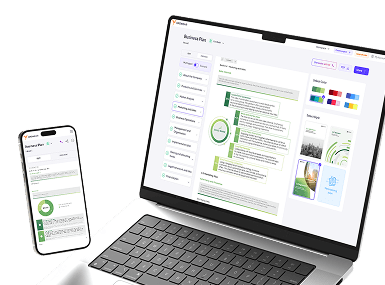
As traditional retail continues to evolve, businesses like Inkwell demonstrate that success lies not in competing with e-commerce giants, but in offering what they cannot: authenticity, connection, and purpose. Investors, consumers, and communities alike stand to benefit from a model that proves bookstores are not relics of the past, but critical spaces for the future.
Download the full Inkwell business plan to explore every section in detail — from product strategy to financial projections. Or, start by downloading the bookstore business plan template and adapt it to your own concept.
Ready to build your own business plan?
Visit Growexa to access customizable templates, guided tools, and expert-backed frameworks that help you structure your idea with clarity and confidence. Make your business not just viable — make it launch-ready.

