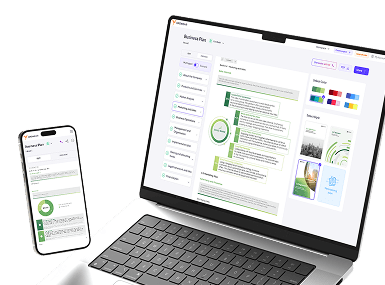
Start with a structured business plan
Download the template and replace the examples with actual costs, capacity, pricing, and revenue assumptions.

The global toy market is undergoing a quiet but significant transformation. While traditional toy retail has long been driven by seasonal demand and impulse purchases, modern parents increasingly question ownership, sustainability, and developmental value. In response, subscription-based models are emerging as a compelling alternative—offering access, curation, and educational relevance instead of accumulation.
This business plan example explores Ludis, a circular toy subscription service launched in Copenhagen, Denmark. The project illustrates how a children’s product business can combine physical goods, logistics, and digital infrastructure into a recurring-revenue platform designed for scalability and long-term customer retention.
Rather than presenting a generic concept, this example reflects a fully developed operating model with defined customer segments, unit economics, and expansion logic, making it a practical reference for entrepreneurs building subscription or circular economy businesses.
Download the template and replace the examples with actual costs, capacity, pricing, and revenue assumptions.


Start building a plan that gets approved
Ludis was created around a simple insight: children outgrow toys quickly, but parents continue to buy, store, and discard them at an unsustainable pace. Traditional toy ownership creates friction—clutter, waste, and repeated spending on short-lived products.
The Ludis model reframes toys as a service rather than a product. Families subscribe to age-appropriate “play nodes”—curated sets of high-quality, screen-free toys that rotate as a child develops. Each kit is designed to support specific developmental milestones, ensuring that play remains both engaging and educational.
By combining physical toy rotation with a digital platform that tracks usage and development, Ludis positions itself not as a toy brand, but as a long-term partner in early childhood growth.
The core offering consists of modular toy kits delivered on a recurring basis. Subscribers receive a set of toys tailored to their child’s age and developmental stage, which can be exchanged as needs evolve. This approach maximizes the lifecycle of each product while continuously delivering fresh value to families.
Revenue is generated through monthly subscription fees that include toy access, logistics, cleaning, and replacement. Optional add-ons—such as extended rotation periods or premium kits—provide incremental revenue without complicating the core offering.
This structure creates predictable cash flow while aligning revenue with ongoing service delivery rather than one-time sales.
Ludis targets urban parents between the ages of 24 and 45, particularly first-time families with young children. These customers tend to be environmentally conscious, digitally native, and willing to pay for convenience and quality. They value minimalism, sustainability, and products that support cognitive and motor development.
Demand is reinforced by broader trends toward subscription consumption, circular economy models, and conscious parenting. In dense urban environments where storage space is limited, access-based ownership offers a practical and emotional advantage over traditional toy buying.
Copenhagen provides a strong launch market due to its high concentration of sustainability-minded households and early adoption of circular consumption models.
The competitive environment includes traditional toy retailers, second-hand marketplaces, and a small number of toy rental services. Most competitors focus either on low-cost resale or generic toy rotation, often without a clear developmental framework.
Ludis differentiates itself through structured curation, design quality, and a fully integrated logistics and sanitation process. By emphasizing developmental relevance and product integrity, the company avoids competing on price and instead builds trust with parents.
The subscription relationship also creates switching costs that traditional retailers cannot easily replicate.
Customer acquisition is driven primarily through digital channels, including targeted social media campaigns and partnerships with parenting communities. Word-of-mouth and referrals play an important role, supported by the visibility of the product within social networks of young families.
Onboarding focuses on education rather than promotion. Parents are guided through the developmental philosophy behind each kit, reinforcing the value proposition and increasing long-term retention. This consultative approach reduces churn and strengthens emotional connection to the brand.
Operations are central to the Ludis model. Each toy undergoes a standardized inspection, cleaning, and sanitation process before being reintroduced into circulation. Inventory is tracked at the individual item level, ensuring quality control and efficient rotation.
A centralized logistics hub supports storage, refurbishment, and fulfillment. This infrastructure allows the business to scale regionally while maintaining consistent service quality.
Technology plays a supporting role by coordinating subscriptions, inventory cycles, and customer communication, enabling operational efficiency as volume increases.
The founding team combines experience in product design, supply chain management, and early childhood education. This multidisciplinary background is critical in a business where success depends on both operational rigor and parental trust.
Staffing is structured to support logistics, customer experience, and product curation, with centralized functions enabling expansion into new markets without proportional increases in overhead.
The Ludis business model is capital-efficient compared to traditional retail, as inventory is reused across multiple subscription cycles. Initial investment is allocated toward toy production, logistics infrastructure, software development, and customer acquisition.
Financial projections show improving margins as inventory utilization increases and customer acquisition costs decline over time. Recurring subscription revenue provides stability, while scale improves unit economics across logistics and refurbishment operations.
This business plan example demonstrates how a children’s product company can evolve into a circular, subscription-based platform with predictable revenue and strong retention. It highlights how sustainability, thoughtful design, and disciplined operations can be combined into a commercially viable business model.
For entrepreneurs, the key insight is that modern family-focused businesses succeed by reducing friction, not by increasing consumption.
To explore the full operational, financial, and investment details behind this concept, review the complete Ludis Toy Subscription Business Plan or use a toy store business plan template to adapt the framework to your own market.
If you’re ready to turn a subscription concept into a structured business, Growexa provides templates, financial models, and guided tools to help build clear, investor-ready plans.