
Stop editing templates
Start building a plan that gets approved
Turn this template into a complete business plan with:
- Financial projections
- Loan-ready structure
- Clear repayment logic
Based on 40+ bank requirements

A business plan prepared for SBA-backed financing has a different job from a general planning document. It still needs to explain the company, market, products, operations, and management, but it also has to make the financing case easy to follow. A lender should be able to see how much capital the business needs, where that money will go, what assumptions support the forecast, and whether projected cash flow is consistent with the resulting debt obligations.
Turn this template into a complete business plan with:
Based on 40+ bank requirements




Most business plans fail not because of the idea — but because the numbers don’t prove repayment.
Build a bank-ready business plan in minutes
(with projections, structure, and validation)
That does not mean there is one official SBA business plan template that every applicant must follow. The U.S. Small Business Administration explicitly notes that “there’s no right or wrong way to write a Business Plan for a Bank Loan ” and recommends using the sections that make sense for the business and its needs. SBA also notes that traditional, detailed business plans are commonly requested by lenders and investors.
The practical objective, then, is not to reproduce a generic template word for word. It is to build a lender-ready business plan in which the narrative, funding request, and SBA financial projections describe the same business under the same assumptions.
This SBA business plan template provides a structured framework that can be adapted for an SBA-backed financing application. It is intended for startup founders and owners of existing businesses who need to present their company, financing requirement, operating plan, and financial outlook in a SBA business plan format a lender can review efficiently.
The framework covers the major sections of a traditional financing plan: Executive Summary, Company Description, Products or Services, Market Analysis, Marketing and Sales, Operations, Management, Funding Request and Use of Funds business plan, and Financial Projections. Supporting documents can be added separately where required.
The template should be treated as an adaptable framework rather than a universal SBA submission form. SBA business plan requirements may differ depending on the SBA-backed loan program, the lender, the purpose and size of the financing, and the financial history of the applicant. SBA itself advises businesses to use the sections that fit their needs rather than follow one mandatory outline.
SBA loan financial projections are critical because they test whether the written strategy works numerically. Revenue should follow from customer, pricing, and sales assumptions. Payroll should reflect the staffing plan. Planned equipment or inventory purchases should match the use of funds. Debt payments should appear in projected cash flow.
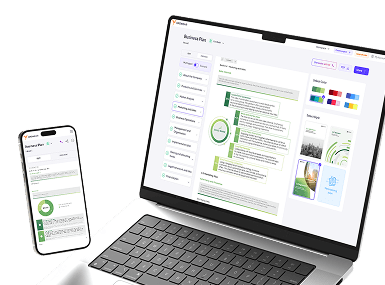
Growexa brings these elements into one workflow. Users can develop the written sections of the plan, organize financial assumptions, build projected P&L, Cash Flow, and Balance Sheet statements, and format and export the completed plan as a PDF or online document.
In many SBA-backed financing situations, particularly startup financing, lenders expect a business plan. But the exact requirement is not identical for every borrower.
SBA’s Lender Match guidance states that most lenders expect a business plan when an applicant is seeking startup funding. The same guidance separately highlights the amount and use of funds, financial projections, credit history, collateral, and industry experience as information borrowers should be prepared to discuss with lenders.
How much detail is required may depend on several factors. A startup without historical operations must rely more heavily on market evidence, startup-cost assumptions, management experience, and forward-looking projections. An established company may be able to support the financing case with several years of actual revenue, margins, cash flow, and financial statements.
Loan purpose matters as well. A company financing a major equipment purchase may need to explain capacity, installation costs, productivity, and the effect on revenue or margins. A working-capital request may require greater emphasis on receivables, inventory, payroll, seasonality, and short-term liquidity.
The applicable SBA-backed program also affects the financing context. For example, the 7(a) program can be used for purposes including working capital, equipment, real estate, certain refinancing, and ownership changes. SBA 504 financing, by contrast, is primarily designed for eligible fixed assets and cannot be used for working capital or inventory.
The business plan should therefore be tailored to the actual transaction rather than written as a generic explanation of the company.
A strong business plan for an SBA loan should give the lender enough information to understand both the business and the financing logic behind the request.
The central question is not simply whether the company has growth potential. The plan should show that the business model is understandable, the market opportunity is supported by evidence, management has the capability to execute the plan, the requested capital has a specific purpose, and the financial assumptions produce a plausible operating outcome.
| Area | What the Business Plan Should Show |
|---|---|
| Business model | How the company makes money |
| Market | Evidence of customer demand |
| Management | Relevant experience and responsibilities |
| Funding | Amount requested and use of funds |
| Financials | Revenue, costs, cash flow and repayment capacity |
| Risks | Main risks and mitigation measures |
The relationship between these areas matters as much as the individual sections.
If a company projects a major increase in revenue, the market and sales sections should explain where the additional customers will come from. If growth requires more employees or equipment, those requirements should appear in the operating plan and financial forecast. If the financing request includes working capital, the cash flow projections for SBA loan should show why that liquidity is needed and how it is expected to support operations.
That consistency is what turns a business plan from a descriptive document into a financing case.
SBA’s traditional business-plan guidance identifies common sections including an executive summary, company description, market analysis, organization and management, products or services, marketing and sales, funding request, financial projections, and appendix. Businesses do not have to follow that outline mechanically, but it provides a useful foundation for a business plan for SBA loan.
For lender-focused planning, each section should answer a specific underwriting question rather than simply fill space.
The Executive Summary should give the lender a concise view of the company and the financing request.
It should explain what the company does, how the business makes money, how much financing is being requested, how the funds will be used, what market opportunity supports the plan, and what the key financial projections indicate about the business.
The repayment logic should also be visible at a high level. That does not require reproducing the entire financial model, but the reader should understand the basic relationship between projected operating performance and the proposed financing.
Write this section after the rest of the plan is complete. Doing so makes it easier to summarize the actual conclusions of the analysis rather than introduce assumptions that later change.
The Company Description establishes what the business is today.
Include the legal and business structure, ownership, location, company history or startup status, mission, objectives, and current stage of development. If the business is already operating, distinguish clearly between existing operations and the expansion or project being financed.
For a startup, explain what has already been completed and what remains before launch. For an established company, emphasize operational facts rather than retelling the entire history of the business.
This section should explain what customers actually pay for.
Describe the products or services, pricing model, customer value, and the factors that differentiate the company from competitors. Where relevant, explain recurring contracts, subscriptions, repeat purchases, service agreements, or other sources of recurring revenue.
The purpose is not to produce a product catalog. The lender needs to understand the economic offer: what is sold, to whom, at what price, and why customers are expected to buy.
Those points should later connect directly to the revenue assumptions.
A credible Market Analysis establishes that the revenue opportunity is grounded in real demand.
Define the target customer, relevant market size, local or industry demand, competitive environment, and company positioning. Use current, attributable sources for important market statistics rather than unsupported claims such as “the market is rapidly growing.”
SBA guidance recommends examining industry outlook, the target market, competitors, trends, and competitive positioning when conducting market analysis.
The analysis should be specific to the economics of the business. A $20 billion national industry statistic has limited value for a local service company if the plan does not explain its actual service area, reachable customers, average spend, and realistic share of demand.
The strongest market section therefore connects external evidence to the assumptions used in the sales forecast.
The Marketing and Sales Strategy should explain how demand becomes revenue.
Identify the customer-acquisition channels the company plans to use, how pricing is set, how the sales process works, and what methods will be used to retain customers where repeat business matters.
Marketing spending should also be measurable. Instead of saying that the company will “use digital marketing,” specify the channels, expected lead volume, conversion assumptions, sales capacity, or other metrics that support the forecast.
A lender should be able to move from this section into the revenue model and understand where projected customers are expected to come from.
The Operations Plan explains what the company needs to deliver the sales described earlier.
Cover the location and facilities, suppliers, equipment, staffing, production or service-delivery process, capacity, and material licenses or operational dependencies where relevant.
Capacity is especially important. If a business forecasts 30% revenue growth but its existing facility, equipment, or workforce cannot support that volume, the plan should identify what needs to change.
This is also where the funding request and operations begin to intersect. Equipment purchases, renovations, inventory investment, or new hires should not appear suddenly in the financial section without an operational reason.
The Management section should reduce execution risk.
Explain who owns and manages the business, what responsibilities each person holds, and what experience is relevant to the specific operating model.
Generic biographies add little value. A lender is more interested in whether the management team has experience running similar operations, managing employees, controlling costs, selling into the target market, maintaining required licenses, or handling the technical aspects of the business.
The key question is whether the people responsible for executing the plan have evidence that they can do so.
The SBA funding request should be one of the most precise sections in the business plan.
State the amount of financing requested, the purpose of the financing, the exact allocation of the proceeds, any owner contribution relevant to the transaction, and the expected timeline for deploying the capital.
SBA’s traditional-plan guidance specifically recommends explaining how much funding is needed and how it will be used, including purposes such as equipment, materials, salaries, or expenses incurred before revenue increases.
A use-of-funds table makes the request easier to understand.
| Use of Funds | Amount | Purpose |
|---|---|---|
| Equipment | $85,000 | Purchase or installation of operating assets |
| Renovation | $60,000 | Build-out or facility improvements |
| Inventory | $35,000 | Initial or expanded inventory |
| Working capital | $70,000 | Payroll, rent and operating liquidity |
| Hiring | $20,000 | Recruitment, onboarding and initial payroll |
| Marketing | $15,000 | Launch or expansion of customer acquisition |
| Eligible refinancing | $15,000 | Existing debt, where permitted |
| Total | $300,000 | Total funding request |
The allocation should reflect the actual financing purpose and program. For example, eligible uses differ between SBA programs; a 504 loan cannot be used for working capital or inventory.
No allocation by itself guarantees approval. The purpose of the table is to make the request transparent and internally consistent.
The Financial Projections section translates the business plan into measurable outcomes.
At minimum, the model should address revenue, cost of goods sold where applicable, payroll, operating expenses, profit and loss, cash flow, projected balance sheet, debt payments, and break-even analysis where it provides useful context.
The projections should be built from the operating assumptions described earlier in the plan. If the company expects to open a second location in month seven, the model should show the related build-out costs, staffing, incremental sales, and timing. If a new machine increases production capacity, both the capital expenditure and the resulting operating impact should be visible.
SBA’s traditional business-plan guidance recommends forecast income statements, balance sheets, cash flow statements, and capital expenditure budgets. It also recommends three to five years of historical financial statements for established businesses when available and a five-year prospective outlook, with more detailed monthly or quarterly projections for the first year.
For financing purposes, the most important feature is not complexity. It is traceability. A lender should be able to understand what assumptions produced the numbers and whether those assumptions agree with the rest of the plan.
No connection between:
Growexa builds a complete, lender-ready business plan — with financial logic and a professionally formatted PDF
Financial projections should explain the economics behind the financing request, not simply present a set of optimistic future numbers. A credible SBA business plan connects every major forecast to an identifiable operating assumption: customers, pricing, sales volume, staffing, inventory, capacity, fixed costs, capital expenditures, and debt payments.
This is where weak business plans often become visible. A forecast that assumes revenue will increase by 20% or 30% each year without explaining what produces that growth gives a lender little basis for evaluating the projection. A stronger model builds revenue and expenses from the operational drivers of the business and makes those assumptions easy to trace.
The same principle applies to the relationship between the financial statements. Projected profit, cash flow, assets, liabilities, and financing cannot be developed independently. A new loan changes cash and debt. An equipment purchase affects cash and the balance sheet. Hiring increases payroll before the additional employees necessarily generate their full expected revenue.
Revenue should be built from the variables that actually generate sales.
For a retail business, a basic model might begin with:
If a store expects 1,200 customer transactions per month at an average transaction value of $42, the initial monthly revenue assumption is $50,400. Growth should then be explained through measurable changes such as higher transaction volume, a second location, additional sales capacity, price changes, or increased repeat business—not an arbitrary percentage applied to the prior year.
The appropriate revenue drivers vary by business model. A professional-services firm might use billable staff × billable hours × average hourly rate. A subscription company might model active customers × average monthly revenue per customer, adjusted for acquisition and churn. A contractor could build the forecast from jobs completed × average contract value.
The exact formula matters less than the underlying principle: the lender should be able to see what has to happen operationally for the revenue forecast to be achieved.
Operating expenses should reflect what it actually costs to produce the projected revenue.
Start by separating costs that remain relatively stable from those that change with sales or production. Rent, insurance, software subscriptions, and certain administrative salaries may behave primarily as fixed costs. Materials, shipping, merchant fees, sales commissions, and some direct labor may rise with revenue.
Payroll deserves particular attention because staffing plans often create inconsistencies between the narrative and the financial model. If the Operations section calls for hiring a manager and four employees during the first year, the forecast should reflect when each person is hired, compensation, and the resulting effect on cash flow.
Working-capital requirements should also be modeled rather than assumed away. A profitable company can still face a cash shortage if it must buy inventory before selling it, pay employees before collecting receivables, or absorb seasonal fluctuations in demand.
A projected profit does not mean the business will necessarily have enough cash to meet its obligations.
The income statement records revenue and expenses under accounting rules, while the cash flow forecast tracks when money actually enters and leaves the business. The distinction becomes particularly important when a company carries inventory, extends credit to customers, purchases equipment, makes loan payments, or experiences significant seasonality.
Consider a business that records a profitable month but has a large amount of revenue tied up in accounts receivable. Payroll, rent, suppliers, and debt payments may become due before customers pay their invoices. The company can therefore report an accounting profit while experiencing a liquidity shortfall.
For an SBA loan business plan, the cash flow forecast should make those timing differences visible. It should show opening cash, operating inflows and outflows, capital spending, financing activity, and the resulting cash position over time.
The projected Balance Sheet provides another consistency check on the financial model.
Assets acquired with financing should appear as assets. New borrowing should be reflected in liabilities. Inventory and receivables should correspond reasonably with the assumptions used in the revenue and cash flow forecasts. Retained earnings should remain consistent with projected financial performance.
These relationships matter because the three primary financial statements describe different aspects of the same business. If a financing transaction appears in cash flow but has no corresponding effect on the projected Balance Sheet, the model is incomplete.
A connected financial model reduces these inconsistencies by allowing changes in operating and financing assumptions to flow through the P&L, Cash Flow, and Balance Sheet rather than requiring each statement to be adjusted separately.
For a lender, projected growth is less important than whether the business is expected to generate enough cash to meet its obligations.
The financial model should therefore incorporate the expected debt payments associated with the proposed financing and show how those payments interact with operating cash flow. This analysis should also account for other existing debt obligations rather than evaluating the new financing in isolation.
There is no useful universal approval threshold that can be applied to every business plan for SBA financing. Lender analysis can vary with the transaction, SBA-backed program, business characteristics, collateral, historical performance, and other underwriting considerations. The AI Business Plan Generator should concentrate on presenting transparent assumptions and a financial model that allows repayment capacity to be evaluated rather than engineering the forecast around a presumed approval ratio.
The underlying business-plan structure can be similar for startups and established companies, but the evidence supporting the financing case is different.
A startup has no operating history to demonstrate what customers actually buy, what margins the company achieves, or how much cash the business produces. Its SBA startup business plan therefore depends more heavily on external market evidence, detailed startup costs, management experience, and conservative assumptions about the pace at which the business will reach normal operating levels.
An existing company can compare its projections with actual performance. Historical revenue, margins, operating expenses, cash flow, debt, and financial statements provide a baseline against which future assumptions can be evaluated.
| Area | Startup Business | Existing Business |
|---|---|---|
| Operating history | No historical operating results | Historical performance available |
| Revenue support | Market evidence and operating assumptions | Historical sales plus assumptions about future changes |
| Costs | Detailed startup and operating-cost estimates | Historical cost structure adjusted for planned changes |
| Financial documentation | Primarily forward-looking projections | Historical P&L, tax returns or financial statements plus projections |
| Cash flow | Conservative ramp-up and working-capital assumptions | Existing cash generation and projected changes |
| Debt | Proposed financing and any founder obligations relevant to the business | Existing debt plus proposed financing |
| Owner contribution | Sources and amount should be clearly documented where relevant | Existing equity and additional contribution where relevant |
| Forecast emphasis | Path from launch to sustainable operations | Relationship between historical performance and future growth |
The distinction is important because a startup should not try to compensate for the absence of history by making the forecast more aggressive. It needs stronger assumptions and clearer evidence. An established company, meanwhile, should explain material departures from its historical results. If revenue has grown 5% annually but the forecast assumes 25% growth after financing, the plan should identify what specifically changes to make that increase plausible.
Many weaknesses in a business plan for an SBA loan are not caused by a missing section. They result from contradictions between sections or assumptions that cannot be traced to evidence.
A useful final review is to read the plan horizontally rather than section by section. Take one assumption—such as hiring five employees, purchasing a new machine, or opening another location—and follow it through the Operations section, funding request, revenue forecast, expenses, cash flow, and Balance Sheet. If the assumption disappears somewhere along that path, the plan is not yet internally consistent.
Building the narrative and the financial projections separately creates an avoidable problem: every time an operating assumption changes, the writer has to determine where else that change should appear.
Growexa is designed to bring business-plan development and financial modeling into the same workflow. Users can structure the plan, generate and edit written sections, organize operating and financial assumptions, and develop the projections that support the financing case.
The financial model includes projected Profit and Loss, Cash Flow, and Balance Sheet statements. That makes it possible to examine how assumptions about revenue, staffing, expenses, investment, and financing affect more than one financial statement rather than treating each output as an independent spreadsheet.
This is particularly useful when preparing a lender-focused plan because the narrative and numbers need to describe the same operating scenario. If the funding request changes, the use of funds and financing assumptions can be reviewed accordingly. If hiring is delayed, payroll and cash requirements should change. If the sales forecast is revised, the effect should carry through the financial model.
Once the plan is complete, Growexa can format and export the finished document, including PDF output, so the written analysis and financial projections can be presented as one coherent business plan.
Growexa is a business-planning platform, not an SBA lender, and using software does not determine whether a financing application will be approved. The value of the platform is in helping the business owner build, test, organize, and present the underlying plan more systematically.
Before submitting a plan to a lender, use this SBA business plan checklist to confirm that the document covers the complete financing case rather than simply the company story.
The checklist is intentionally broader than a simple table of contents. Having a Market Analysis heading, for example, is not enough if the section contains no evidence that supports the sales forecast. Likewise, including financial statements does not make the plan lender-ready if the numbers contradict the operating assumptions.
A strong SBA business plan template provides structure, but structure alone is not what makes a plan credible. The real work is connecting market evidence to sales assumptions, sales assumptions to operating requirements, operating requirements to the funding request, and the funding request to a financial model that shows what happens to profit, cash, assets, liabilities, and debt obligations.
That is also the standard to use when reviewing an SBA business plan example or downloading an SBA business plan PDF. Do not judge the document by how polished it looks. Ask whether every important number can be traced back to a defensible business assumption and whether the narrative and financial statements tell the same story.
Growexa is built to help business owners do that work in one place—from structuring and drafting the plan to developing connected financial projections and preparing the finished document for review.
Build your SBA business plan in Growexa, test the assumptions behind the numbers, and prepare a complete lender-ready plan before approaching a financing partner.
A lender-focused SBA business plan should explain the company, products or services, market, sales strategy, operations, management, funding request, use of funds, and financial projections. Supporting documents can be included in an appendix. The exact content should be adapted to the business, financing program, and lender requirements.
SBA's current traditional business-plan guidance recommends a prospective financial outlook covering five years, with quarterly or monthly detail for the first year. It also recommends three to five years of historical financial statements for established businesses when available. Individual lenders may request different periods or additional schedules, so confirm the requirements for the specific application.
No. A business plan is one component of a financing application. Lenders consider additional factors and documentation, and requirements differ by transaction and program. SBA's Lender Match guidance, for example, separately highlights the business plan, amount and use of funds, and credit history when preparing to approach lenders.
The underlying business logic is largely the same. The difference is emphasis. A plan prepared for SBA-backed financing needs to make the financing request especially clear: how much capital is required, where it will go, how the investment affects operations, and whether projected cash flow supports the resulting obligations.

