Ukraine
 USA
USA
 Austria

Stop editing templates
Start building a plan that gets approved
Turn this template into a complete business plan with:
- Financial projections
- Loan-ready structure
- Clear repayment logic
Based on 40+ bank requirements

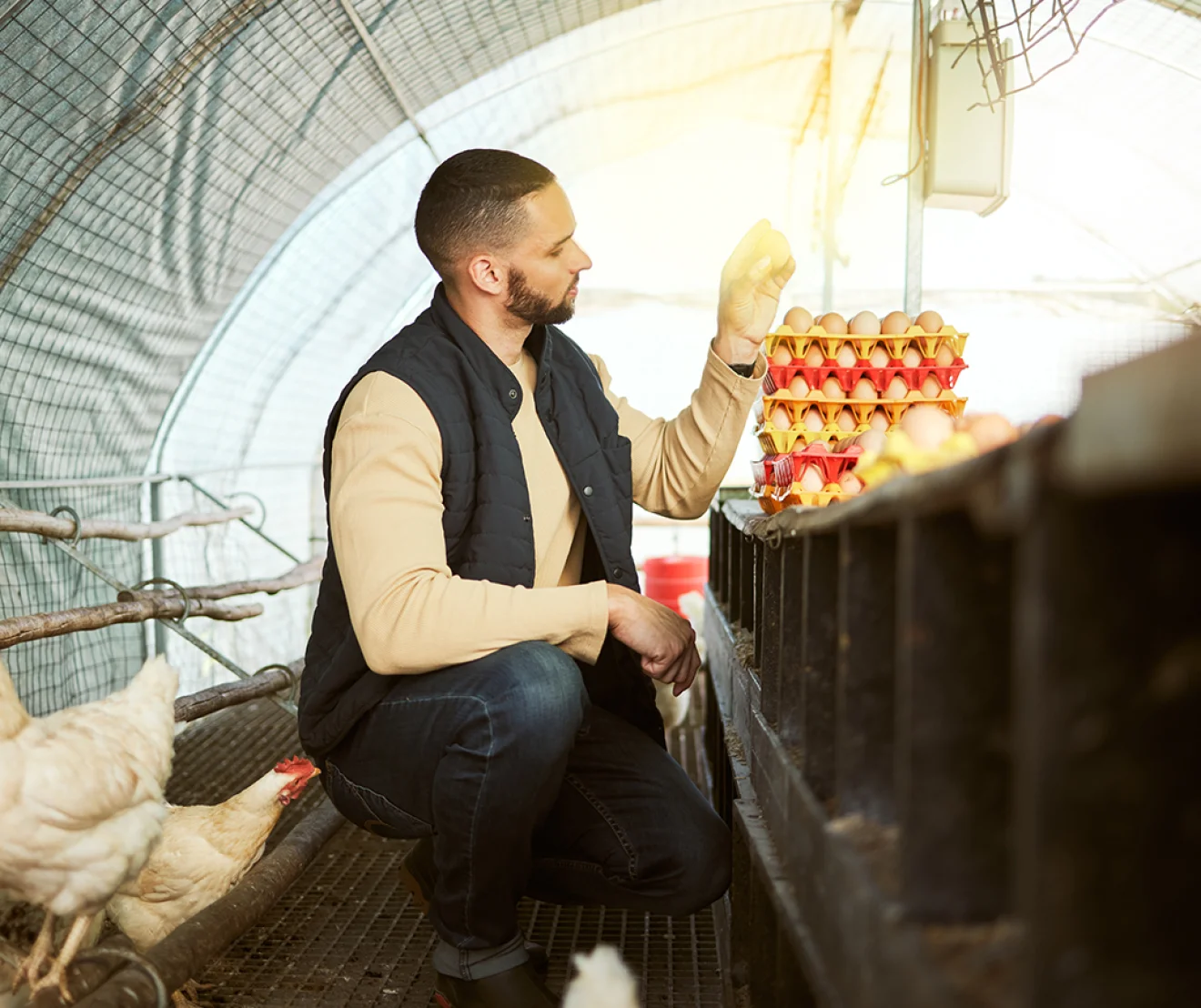
A poultry farm does not earn money simply because birds are growing. Cash goes out first—for chicks or pullets, feed, labor, utilities, litter, veterinary inputs and housing—and revenue arrives according to the biological cycle of the flock. A small change in mortality, feed conversion or market weight can therefore alter the economics of an entire poultry production cycle.
.
Turn this template into a complete business plan with:
Based on 40+ bank requirements



Most business plans fail not because of the idea — but because the numbers don’t prove repayment.
Build a bank-ready business plan in minutes
(with projections, structure, and validation)
That is what separates a useful poultry farm business plan from a generic agricultural forecast. The financial model has to begin with birds: how many enter the house, how many reach sale or productive age, how much feed they consume, how quickly they reach the target output, and what price the farm actually receives.
The U.S. market is large enough that national demand is rarely the central planning question. USDA Economic Research Service (ERS) valued U.S. poultry-sector sales at $70.2 billion in 2024, including $45.4 billion from broilers and $21.0 billion from eggs. For an individual farm, however, production efficiency and the buyer arrangement matter more than national market size.
A poultry farm business plan template should establish a direct line from flock assumptions to cash flow.
The document needs an executive summary describing the farm, production model, scale and funding requirement; a market section identifying buyers and pricing arrangements; a production plan covering flock size, housing, cycles, mortality, feed and biosecurity; an operating plan for labor, utilities, equipment and manure management; and a financial plan showing startup investment, production costs, revenue, working capital and debt service.
For a broiler operation, the central forecast can be expressed as:
Birds Placed × Survival Rate × Average Sale Weight × Price per Pound = Revenue per Flock
For layers, the logic changes:
Average Laying Hens × Eggs per Hen × Realized Price per Egg = Egg Revenue
Those formulas force the business plan to explain where revenue comes from. A forecast stating that sales will increase 15% next year is much less useful if it does not show whether that growth requires another poultry house, more production cycles, higher stocking levels, improved flock performance or better pricing.
The same discipline applies to costs. Feed should move with bird numbers and production performance. Utilities should reflect housing and climate-control requirements. Labor should match the operating model. Capital expenditure should correspond to the production capacity assumed in the forecast.
Broilers and layers may share buildings, feed systems and biosecurity concerns, but economically they are different businesses.
Broiler production converts chicks and feed into saleable live weight over relatively short cycles. USDA notes that broilers can reach production readiness in roughly seven to eight weeks, considerably faster than cattle or hogs.
The short cycle makes flock-level economics particularly important. A farm may run several cycles each year, but every cycle has placement, feed, mortality and downtime assumptions.
For an independent operation, the model also needs to distinguish between producing birds for a processor under contract and raising birds for independent sale. In an integrated contract arrangement, the grower's economics may center on housing, equipment, utilities, labor and contract payments rather than ownership of feed and birds. An independently marketed farm carries a different set of commodity and sales risks.
A broiler farm business plan should therefore state who owns the birds, who supplies feed, who carries price risk and how the farm is paid before presenting a poultry farm profitability estimate.
A layer farm business plan has a different cash-flow profile.
Layers require an establishment period before egg production reaches commercial levels. Revenue then depends on the number of productive hens, laying performance, egg grades, sale prices and flock age.
Housing systems matter commercially as well as operationally. Conventional, cage-free, free-range and other production systems can involve different capital requirements, stocking densities, management practices and buyer specifications. The plan should use the system required by its intended customer rather than assume that one model automatically earns a premium.
Layer economics also require a replacement strategy. A financial forecast that projects stable egg output indefinitely from the same flock ignores biological changes in production.
A mixed farm can combine eggs, meat birds, pullets or other poultry-related income, but diversification does not remove production constraints.
Separate revenue and cost assumptions should be maintained for each activity. Feed consumption, production timing and buyer requirements differ. Combining all birds into a single "poultry revenue" line makes it difficult to determine which part of the farm actually generates margin.
Mixed production may be appropriate where direct-market customers buy several products or where farm infrastructure can support multiple activities. It should not be assumed to improve profitability simply because it creates more revenue lines.
For poultry, the buyer is often more important than the theoretical size of the market.
A farm selling broilers under a production contract has a fundamentally different commercial position from an independent producer selling processed birds to restaurants, retailers or consumers. Likewise, a layer farm supplying a regional distributor operates differently from a small farm selling eggs through farmers' markets or local stores.
The market section should therefore work backward from the buyer.
What quantity will the buyer accept? At what specification? How is price determined? Who pays for transportation? Does the buyer require particular processing, certification, bird weight, egg grade, packaging or production practices? How often does payment occur?
USDA reports that poultry meat represented 51% of U.S. red-meat-and-poultry disappearance in 2024, while 13.6% of U.S. poultry meat production was exported. Those figures establish the importance of the sector, but they do not establish a sales channel for a new farm.
For independent farms, processing access can be as important as customer demand. A plan to sell 5,000 processed broilers locally is incomplete if the farm has no viable processing arrangement capable of handling the planned production schedule.
Layer operations should similarly connect flock size with realistic egg outlets. Increasing the flock from 2,000 to 5,000 hens is not merely a production decision; it requires a market capable of absorbing the additional daily output.
Poultry production concentrates biological value inside a controlled environment. The operating plan has to protect that environment.
Housing design, ventilation, heating, cooling, water availability, lighting, litter management, stocking practices and backup power all affect flock performance. A ventilation failure is not simply a maintenance problem if it changes mortality or weight gain.
Biosecurity deserves similar financial treatment. USDA APHIS recommends practices including limiting unnecessary access to birds, cleaning and disinfecting equipment and vehicles, maintaining dedicated footwear and clothing where appropriate, and monitoring flocks for signs of disease. USDA APHIS Defend the Flock program
The financial model should not attempt to predict a disease event as if it were a normal operating expense. It should show the farm's exposure and contingency capacity: mortality assumptions, downtime between flocks, emergency liquidity, insurance where available, and the effect of lost production on debt service.
Highly pathogenic avian influenza illustrates why the distinction matters. USDA notes that the impact has differed significantly across poultry segments; broiler losses represented only a fraction of annual slaughter during 2022–2024, while the layer sector experienced much greater disruption.
Biosecurity is therefore not a paragraph added for completeness. It protects the biological assumptions on which the revenue forecast depends.
No connection between:
Growexa builds a complete, lender-ready business plan — with financial logic and a professionally formatted PDF

Feed is where poultry biology becomes financial mathematics.
USDA identifies feed as generally the most significant production cost across livestock and notes poultry's relatively efficient conversion of feed into meat and eggs. Feed markets also move: USDA's broader farm-sector forecast puts U.S. feed expenses at $65.6 billion in 2026, 6.8% below the 2025 forecast, while feed remains one of the largest agricultural expense categories.
For a poultry farm, the relevant number is not the national total. It is feed consumption per unit of output.
Consider an illustrative broiler flock:
| Example Broiler Assumption | Base Case |
|---|---|
| Chicks placed | 20,000 |
| Mortality | 4.0% |
| Birds sold | 19,200 |
| Average live weight | 6.0 lb |
| Live weight sold | 115,200 lb |
| Feed conversion ratio (FCR) | 1.80 |
| Estimated feed used | 207,360 lb |
| Feed cost | $0.18/lb |
| Estimated feed expense | $37,325 |
Illustrative assumptions only; these figures are not industry benchmarks.
The table shows how the assumptions interact. If FCR deteriorates from 1.80 to 1.95 while saleable live weight remains unchanged, feed use rises from approximately 207,360 to 224,640 pounds. At the same illustrative feed price, that adds roughly $3,110 to the cost of one flock.
Mortality has a different effect. Feed has already been consumed by birds that die during the production cycle, but those birds generate no sale weight. A higher mortality rate therefore affects both revenue and feed efficiency.
A credible poultry financial projection should test those variables independently rather than bury them inside one cost-per-bird assumption.
Housing is usually the defining capital decision because it determines production capacity for years.
A startup budget can include land or site preparation, poultry houses, ventilation and climate control, feeders and drinkers, feed storage, water systems, electrical infrastructure, backup power, manure or litter handling equipment, vehicles, processing or egg-handling equipment where applicable, and working capital.
Costs vary too widely by scale, housing system, location and degree of automation to justify one universal poultry farm startup cost figure. A small direct-market layer operation and a commercial multi-house broiler farm should not be placed inside the same range.
An illustrative budget for a modest independent poultry operation might be structured as follows:
| Example Startup Investment | Amount |
|---|---|
| Site preparation and utilities | $45,000 |
| Poultry housing | $180,000 |
| Ventilation and environmental controls | $38,000 |
| Feed and watering systems | $27,000 |
| Feed storage | $18,000 |
| Backup generator and electrical equipment | $22,000 |
| Handling and farm equipment | $25,000 |
| Initial flock / bird purchases | $15,000 |
| Pre-opening, permits and insurance | $10,000 |
| Working capital reserve | $70,000 |
| Total Illustrative Requirement | $450,000 |
Example only. Actual investment can differ substantially depending on production system and scale.
Working capital should remain separate from fixed investment. The poultry house may remain productive for years; feed purchased for the first flock disappears economically during one production cycle.
That distinction becomes particularly important when debt finances long-lived assets. The farm needs enough liquidity to operate each flock while continuing to make payments on the infrastructure.
For broilers, revenue per bird can hide important differences in production performance. Revenue per pound and margin per flock are more informative.
Assume the illustrative 20,000-bird flock above produces 115,200 pounds of saleable live weight. At an example realized price of $1.15 per pound, gross flock revenue would be $132,480.
The unit economics might look like this:
| Example Broiler Flock Economics | Amount |
|---|---|
| Revenue | $132,480 |
| Chicks | $24,000 |
| Feed | $37,325 |
| Litter and flock supplies | $6,500 |
| Veterinary / health inputs | $3,500 |
| Utilities | $9,000 |
| Direct labor | $14,000 |
| Processing / transport / other direct costs | $17,000 |
| Contribution before fixed overhead and debt | $21,155 |
| Contribution per bird sold | $1.10 |
Illustrative example only.
This is deliberately not presented as a typical poultry farm profit margin. Change the price, FCR, mortality, processing arrangement or labor structure and the result changes immediately.
For layers, the appropriate unit may instead be revenue and contribution per dozen eggs or per laying hen. The logic is the same: production performance must connect directly to financial output.
Poultry cash flow is cyclical even when the annual income statement looks stable.
An independent broiler operation pays for birds, feed and operating inputs throughout the flock. Revenue may not arrive until the birds are sold. Houses then require cleaning and downtime before the next placement.
A monthly forecast that spreads annual broiler revenue evenly across 12 months can therefore materially misrepresent liquidity.
Consider a simplified operation completing five comparable flocks during its first full year:
| Example Year 1 Projection | Amount |
|---|---|
| Broiler sales | $662,400 |
| Other farm revenue | $20,000 |
| Total revenue | $682,400 |
| Direct flock costs | $556,625 |
| Gross contribution | $125,775 |
| Farm administration and insurance | $24,000 |
| Repairs and maintenance | $22,000 |
| Other fixed operating costs | $18,000 |
| Operating profit before interest, tax and depreciation | $61,775 |
| Operating margin | 9.1% |
Illustrative assumptions only. Results are not an industry benchmark or expected return.
The annual result can look acceptable while the farm still experiences periods of negative cash flow between placement and sale. Debt payments make that timing more important.
The financial model should therefore include P&L, cash flow and balance sheet projections. Feed and flock inputs affect cash as they are purchased. Equipment purchases create assets rather than immediate operating expenses. Loan principal reduces cash without appearing as an expense on the P&L.
Sensitivity analysis should focus on variables the farm cannot afford to ignore. In a broiler model, that means testing feed price, FCR, mortality, sale weight, realized price and cycles per year. In a layer model, egg price, laying rate, feed consumption, mortality and replacement timing deserve similar treatment.
Break-even is the output of those assumptions—not a production cycle that can be promised in advance.
A poultry farm loan business plan should match the financing structure to the economic life of what is being financed.
Long-lived housing, ventilation systems, generators and other infrastructure should not be treated the same way as feed, chicks or short-cycle working capital. A farm can be profitable over a full year and still face liquidity pressure if short-term production expenses are financed with an unsuitable repayment structure.
Agricultural businesses also have financing channels beyond conventional small-business lending. USDA Farm Service Agency programs can support eligible farmers through direct and guaranteed farm ownership and operating loans, while USDA Rural Development programs may apply to certain rural business or energy investments. USDA Farm Loan Programs
The funding section should state the amount requested, owner contribution, specific use of proceeds, proposed financing term and source of repayment. If expansion requires another poultry house, the plan should also show the additional flock capacity and cash flow created by that investment.
Capital expenditure is justified by productive capacity, not simply by the availability of financing.
A poultry operation is ultimately a conversion system: capital creates production capacity, feed and biological performance turn that capacity into output, and the buyer converts output into cash. Weakness at any one stage changes the economics of the entire farm.
That is why a credible poultry farming business plan should not begin with an assumed profit margin. It should begin with the flock and work forward—bird by bird, cycle by cycle—from production assumptions to revenue, operating costs, liquidity and debt service.
The Growexa Poultry Farm Business Plan template can be used to structure these assumptions and connect the production plan with startup investment, funding requirements and financial projections.
It should cover the production model, flock assumptions, buyers, housing and equipment, feed, biosecurity, labor, startup investment, production-cycle economics, financial projections, working capital and funding requirements.
Start with chicks placed, expected survival, average sale weight and realized price. Contract growers should instead model revenue according to the payment structure in their grower agreement.
For broilers, feed price, feed conversion, mortality, sale weight, production cycles and realized price are central variables. Layer models should also track laying performance, egg pricing and flock replacement.
USDA notes that broilers can be ready for production in approximately seven to eight weeks from hatch to slaughter, although actual schedules depend on the production system and target bird.
Feed should be linked to production rather than entered only as a percentage of revenue. In a broiler model, expected live weight and FCR provide a basis for estimating feed consumption, which can then be multiplied by the farm's expected feed price.
There is no universal cycle or year in which a poultry farm should break even. Break-even depends on fixed investment, financing, flock performance, prices, feed costs, utilization and the production model.