
Stop editing templates
Start building a plan that gets approved
Turn this template into a complete business plan with:
- Financial projections
- Loan-ready structure
- Clear repayment logic
Based on 40+ bank requirements

Walk down any street in a major city and you’ll see signs of the real estate business everywhere—glossy ads in storefronts, agents hosting open houses, developers breaking ground on new towers. To the casual observer, running a real estate agency might look like a matter of connecting buyers and sellers and cashing commission checks. But insiders know the truth: this is an industry where reputation, networks, regulatory compliance, and market timing are as important as the properties themselves.
That is why a real estate agency cannot survive on intuition alone. What seems like a simple brokerage quickly becomes a complex operation involving recruitment, technology platforms, client retention, and financial discipline. A business plan in this sector is not a ceremonial document for banks; it is a strategic blueprint that explains how an agency will carve out space in a crowded market, sustain trust across cycles, and translate square footage into long-term value.
Turn this template into a complete business plan with:
Based on 40+ bank requirements




Most business plans fail not because of the idea — but because the numbers don’t prove repayment.
Build a bank-ready business plan in minutes
(with projections, structure, and validation)
The first step in any real estate agency business plan is clarifying what kind of agency you want to be. Real estate is a broad industry. Agencies can focus on residential sales, luxury condos, rental management, commercial leasing, or investment consulting. Each specialization demands a different knowledge base, client acquisition strategy, and revenue model.
Identity in real estate should be expressed not only through branding but also through measurable goals. A residential firm may aim to close 150 transactions in its first two years. A commercial boutique might target $50 million in annual lease volume within three years. These numbers bring focus and credibility.
Values matter too. Will the agency emphasize transparency in a market where clients often complain of hidden fees? Will it build its brand around sustainability and energy-efficient properties? Or will it compete on speed, using technology to shorten the time from listing to closing? By weaving values into identity, the plan distinguishes the agency from competitors offering interchangeable services.
The real estate market is notorious for its cycles. Booms inflate prices and flood agencies with clients; downturns test survival skills. A strong real estate agency business plan business plan demonstrates that you understand both the long-term growth of property as an asset class and the short-term volatility that defines client behavior.
Macro data is a starting point. In the United States, residential real estate transactions consistently exceed $1 trillion annually, while commercial property deals generate hundreds of billions. But broad figures do little for credibility unless connected to local realities. Investors and partners want to know: what is happening in the neighborhoods you plan to serve? Are property values rising due to new transit infrastructure? Is there oversupply in luxury condos but pent-up demand in affordable rentals?
Competition analysis must also be specific. In every city, a handful of big franchises dominate advertising while boutique agencies differentiate through local expertise. Online platforms such as Zillow or Redfin increasingly blur the line between agents and self-service. A credible plan positions your agency clearly: perhaps as the hyper-local team with unmatched knowledge of a neighborhood, or as the tech-driven agency leveraging virtual tours and data analytics to close deals faster.
Consumer expectations are evolving as well. Younger buyers expect transparency, digital documentation, and rapid communication. Corporate tenants want flexible lease terms and sustainability credentials. Ignoring these shifts risks leaving the agency trapped in outdated practices.
At its core, a real estate agency is a people business supported by systems. Operational strategy is therefore where investors and partners will look for proof that your vision can be executed.
Technology is the backbone of modern brokerage. A real estate agency business plan must describe the customer relationship management system (CRM) that will track leads, the listing platforms where properties will be marketed, and the digital tools—such as e-signatures and virtual tours—that will streamline client experience. Efficiency is not just a matter of convenience; it directly impacts closing times and agent productivity.
Location strategy should also be articulated. While real estate is increasingly digital, physical offices remain important in establishing trust. The decision to open on a busy high street, near a new development, or inside a co-working hub signals who the agency aims to attract.
Compliance and risk management form another crucial layer. Agencies handle client funds, manage sensitive documents, and operate under strict licensing regimes. A credible plan demonstrates how procedures will ensure compliance with local laws and prevent disputes.
Finally, scalability must be addressed. How will the agency handle growth from a team of five agents to fifty? What systems will prevent bottlenecks in document processing or client communication? By outlining growth mechanics, the plan shows foresight rather than improvisation.
Clients rarely choose agencies; they choose agents. That makes human capital the most valuable asset in real estate. A real estate agency business plan must highlight how talent will be recruited, trained, and retained.
Leadership credentials set the tone. Founders with backgrounds in finance, development, or law signal sophistication. Experienced brokers bring credibility. But beyond leadership, the plan should address how new agents will be onboarded, mentored, and supported with tools to succeed.
Retention is vital. High turnover not only erodes culture but also risks losing clients who follow trusted agents. Competitive commission splits, training programs, and clear career progression help ensure that talent remains.
Culture deserves explicit mention. Agencies that promote collaboration, transparency, and client-first values are better equipped to withstand downturns. By contrast, cutthroat commission-only cultures often burn out staff and damage reputations. Investors and partners know this, and they look for agencies that understand people strategy as deeply as property strategy.
No connection between:
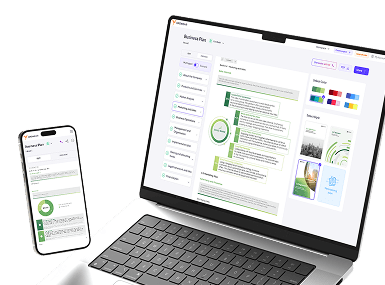
Growexa builds a complete, lender-ready business plan — with financial logic and a professionally formatted PDF
Marketing in real estate has shifted from print flyers and cold calls to digital ecosystems where attention is the currency. A real estate agency business plan must articulate how the agency will build visibility and convert it into trust.
Digital presence is critical. Search engine optimization, paid advertising, and content marketing—such as neighborhood guides or market reports—demonstrate expertise. Social media, particularly Instagram and TikTok, showcase listings through compelling visuals.
Brand positioning extends beyond aesthetics. Will the agency be known for luxury white-glove service, for affordable housing advocacy, or for corporate efficiency? Consistency across all touchpoints—from website to open house signage—cements identity.
Sales strategy must go deeper than “generate leads.” Real estate sales cycles are long and emotionally charged. Buyers and sellers may engage months before closing. The plan should describe nurturing mechanisms: drip email campaigns, check-ins, or value-added insights that keep prospects engaged until they are ready to act.
Corporate accounts add another dimension. Representing landlords, developers, or institutional investors can provide stable recurring revenue. Outlining how such relationships will be pursued strengthens the plan’s long-term credibility.
Compared to asset-heavy industries, a real estate agency business plan may appear light on capital requirements. But the reality is that startup costs can be significant. Offices, marketing campaigns, licensing fees, technology platforms, and staff salaries all require funding before the first commission check clears.
The business plan must present a transparent funding strategy. Sources may include founder equity, bank loans, angel investors, or franchising arrangements. Each has implications for growth pace and control.
Allocation of funds must be staged carefully. Initial spending often emphasizes branding and marketing, since visibility is crucial at launch. Technology investments follow closely, enabling agents to manage leads effectively. Over time, additional funds may be directed toward hiring, geographic expansion, or specialized divisions such as property management.
By showing a phased approach, the plan reassures stakeholders that funds will not be consumed too quickly, leaving the agency undercapitalized.
Financial projections are where real estate agencies demonstrate discipline. The plan must begin with assumptions: average commission per transaction, expected number of deals per agent, retention rates, and marketing cost per lead. Without these inputs, projections are unconvincing.
Revenue models vary. A residential agency relies on transaction volume, while a luxury boutique earns fewer but larger commissions. Property management services, rental leasing, and advisory work provide diversification. By detailing revenue streams separately, the plan proves that the agency is not overly reliant on a single line of business.
Costs include salaries, office leases, marketing, licensing, and technology subscriptions. Many new agencies underestimate marketing expenses, which can consume 20 to 30 percent of budgets in the first year.
Cash flow forecasts deserve particular attention. Commissions are lumpy, tied to transaction closings, while expenses such as rent and salaries are fixed. Explaining how liquidity gaps will be managed—through reserves, credit lines, or staggered hiring—builds confidence.
Break-even timelines must be realistic. Agencies rarely achieve profitability in the first year. A horizon of 18 to 30 months is common, depending on market conditions and deal flow. Presenting this timeline honestly, alongside margins and return on equity, signals maturity.
Real estate agencies often think transactionally: close deals, earn commissions, move on. But a forward-looking business plan emphasizes building enduring value. This might mean cultivating a brand that commands premium listings, investing in proprietary data analytics to anticipate market shifts, or expanding into adjacent services such as mortgage brokerage or property management.
Resilience also matters. Economic downturns will come. Agencies that survive are those with diversified revenue, disciplined cost structures, and strong cultures. By embedding resilience into the business plan, you demonstrate that the agency is not just chasing short-term gains but building a platform for decades.
A real estate agency is more than a brokerage. It is a trust-based enterprise that mediates between one of life’s most significant assets—property—and the people who buy, sell, and lease it. Success comes not from glossy storefronts or flashy listings alone but from disciplined planning, operational excellence, and a clear understanding of evolving markets. A business plan in this sector is not just a pitch deck for lenders. It is the architecture of strategy, ensuring that ambition translates into results and that trust translates into long-term revenue.
For those ready to build such an agency, the first step is clarity. Draft your own real estate agency business plan, adapt examples to your market, and explore how customizable tools at Growexa can turn ambition into execution. In a business where timing and trust define everything, disciplined planning is the foundation of enduring success.

