
Stop editing templates
Start building a plan that gets approved
Turn this template into a complete business plan with:
- Financial projections
- Loan-ready structure
- Clear repayment logic
Based on 40+ bank requirements

Opening a coffee stand may seem less complex than launching a full-service café, but the economics leave little room for guesswork. A few hundred square feet, a streamlined menu, and lower startup costs can create the impression that success comes down to serving great coffee in a busy location. In reality, profitability depends on dozens of operational decisions made long before the first customer orders an espresso.
Turn this template into a complete business plan with:
Based on 40+ bank requirements




Most business plans fail not because of the idea — but because the numbers don’t prove repayment.
Build a bank-ready business plan in minutes
(with projections, structure, and validation)
The U.S. coffee market continues to provide attractive opportunities for independent operators. According to the National Coffee Association, 66% of American adults drink coffee every day, while specialty coffee consumption continues to reach new highs. At the same time, customer expectations have shifted toward convenience. Compact drive-thru concepts, walk-up kiosks, and grab-and-go coffee stands have become some of the fastest-growing formats in the industry because they fit naturally into consumers' daily routines rather than asking customers to slow down.
That growing demand has also raised expectations from lenders and investors. A financing-ready coffee stand business plan is no longer a document that simply describes the concept. It demonstrates why a particular location will generate repeat morning traffic, how equipment capacity supports projected sales, whether labor costs remain sustainable during slower hours, and how the business reaches profitability without relying on unrealistic customer volumes.
This guide explains how to develop a coffee stand business plan that addresses those questions while meeting the expectations of banks, SBA lenders, and private investors.
Although the Executive Summary appears first, it should be completed after every other section of the business plan. By that stage, the market research, financial projections, and operating assumptions have already been validated, allowing the opportunity to be presented with confidence rather than optimism.
For a coffee stand, the Executive Summary should immediately answer three questions. Why will customers choose this location? How will the business generate consistent daily sales? Why do the financial projections reflect realistic operating conditions instead of best-case scenarios?
Unlike many food businesses, coffee stands depend heavily on repeat purchasing behavior. A customer buying coffee five mornings each week is significantly more valuable than someone making occasional visits, making location selection and customer convenience central to the business model. Visibility from major roads, efficient vehicle access, nearby office clusters, and commuter traffic often influence long-term profitability more than rent alone.
The summary should also introduce the business concept with enough specificity to distinguish it from other local operators. A drive-thru espresso kiosk serving commuters before 9 a.m. competes differently from a specialty coffee stand located beside a university campus or inside a mixed-use development. That positioning should remain consistent throughout the entire business plan, from market analysis to financial forecasting.
Financial highlights should remain concise while demonstrating commercial viability. Investors typically look for realistic startup costs, an appropriate funding request, achievable revenue assumptions, and a reasonable timeline to break even. Rather than presenting dozens of financial metrics, the Executive Summary should communicate that the numbers are supported by operational logic developed throughout the plan.
| Executive Summary Focus | Why It Matters |
|---|---|
| Business concept | Defines competitive positioning |
| Location strategy | Supports repeat customer traffic |
| Funding requirement | Explains capital needs |
| Revenue outlook | Demonstrates commercial viability |
| Growth objective | Shows long-term business potential |
A strong Executive Summary should encourage readers to continue reviewing the business plan because the opportunity appears commercially sound, internally consistent, and grounded in measurable assumptions rather than enthusiasm.
The Company Overview explains how the business is designed to operate—not simply how it is legally organized. While ownership structure and business registration should be documented, lenders are far more interested in whether the operating model matches the realities of the local market.
Coffee stands can take several forms, including permanent kiosks, modular container units, mobile espresso trailers, and drive-thru buildings. Each format carries different implications for startup investment, staffing, equipment, customer capacity, and operating hours. Selecting the appropriate model should reflect customer behavior rather than personal preference. A drive-thru location along a commuter corridor, for example, may prioritize throughput and speed, while a walk-up kiosk near a university may benefit from extended afternoon traffic and seasonal beverage promotions.
The business description should also explain what differentiates the concept in an increasingly competitive market. Competing on price alone is rarely sustainable for independent operators. Instead, successful coffee stands typically combine high-quality espresso, efficient service, carefully engineered menus, and a convenient customer experience. Many also increase average transaction values through breakfast items, specialty cold beverages, loyalty programs, or limited-time seasonal offerings rather than relying solely on higher customer volumes.
The evolution of Dutch Bros illustrates this principle well. What began as a small pushcart in Oregon developed into one of the fastest-growing beverage chains in the United States by focusing on three fundamentals: speed, product consistency, and customer experience rather than large stores or extensive food menus. While an independent coffee stand may operate on a much smaller scale, the same operating priorities remain directly relevant.
Finally, this section should establish measurable business objectives. Opening the location is only the starting point. More meaningful milestones include reaching target daily transaction volumes, achieving positive operating cash flow, maintaining customer retention through loyalty programs, or expanding into a second location once the first demonstrates stable profitability. Those objectives help transform the business plan from a startup document into a practical roadmap for sustainable growth.
A strong market analysis does more than confirm that Americans drink coffee. It explains why customers will choose this coffee stand over several established alternatives and whether the location can generate enough repeat traffic to support the financial projections.
Coffee demand in the United States remains remarkably resilient. According to the National Coffee Association, 66% of American adults drink coffee every day, while specialty coffee consumption has reached record levels. At the same time, purchasing habits continue shifting toward convenience. Nearly six in ten coffee purchases made away from home now happen through a drive-thru, highlighting how speed and accessibility have become competitive advantages rather than optional features.
The market's growth is also changing who sets the competitive benchmark. While Starbucks and Dunkin' remain dominant, much of the recent expansion has come from newer concepts such as Dutch Bros, Scooter's Coffee, and 7 Brew, all of which have built their businesses around compact formats, high throughput, and highly customizable beverages. Datassential reported that the limited-service coffee segment generated approximately $51.5 billion in sales during 2025, with drive-thru chains among the fastest-growing categories in foodservice.
For an independent operator, these trends provide an important lesson. Customers are no longer comparing a neighborhood coffee stand only with another independent café. They compare every morning coffee experience against brands that have trained consumers to expect short wait times, mobile payments, loyalty rewards, and consistent product quality.
That makes local research significantly more valuable than broad industry statistics. Instead of focusing primarily on population size, the business plan should evaluate the daily routines that create recurring demand. Morning commuter routes, office parks, hospitals, college campuses, fitness centers, and public transit stations often produce more predictable sales than retail districts dependent on weekend shopping. Likewise, visibility from the road, safe vehicle access, and efficient traffic flow can influence revenue just as much as the number of nearby residents.
Competitive analysis should be equally practical. Rather than listing every coffee shop within a three-mile radius, compare competitors on factors that directly affect customer decisions: pricing, drive-thru availability, beverage selection, service speed, online reviews, loyalty programs, and operating hours. In many markets, the opportunity is not to offer better coffee but to provide a faster, more convenient experience during the busiest hours of the day.
| Market Factor | Business Planning Impact |
|---|---|
| Morning commuter traffic | Drives peak daily revenue |
| Nearby employers and campuses | Supports repeat weekday sales |
| Drive-thru accessibility | Improves transaction capacity |
| Existing coffee brands | Defines competitive positioning |
| Household income | Influences pricing strategy |
| Local development pipeline | Indicates future demand potential |
Ultimately, lenders are less interested in the size of the coffee market than in the quality of the chosen location. A business plan becomes considerably more convincing when projected sales are linked to measurable factors such as traffic counts, expected customer capture rates, and average transaction values rather than broad assumptions about local demand.
For most coffee stands, marketing is less about attracting new customers than becoming part of someone's daily routine. A commuter who stops four mornings each week is worth far more than occasional weekend visitors, making customer retention one of the strongest drivers of long-term profitability.
That begins with location visibility but doesn't end there. Customers expect to find accurate business hours on Google, pay with Apple Pay or Google Pay, collect loyalty rewards, and receive consistent service every visit. According to recent National Coffee Association research, specialty coffee consumption continues to reach record levels, particularly among younger consumers, while digital ordering and convenience increasingly influence purchasing decisions.
Pricing strategy should also reflect local competition rather than simply matching Starbucks or Dunkin'. Independent coffee stands often compete successfully by offering premium beverages, locally roasted coffee, or faster service rather than discounting prices. A well-designed menu typically generates more profit through higher average tickets than through lower prices.
One metric deserves particular attention: average ticket value. Increasing the average order from $6.50 to $7.25 by pairing coffee with pastries, breakfast sandwiches, or premium add-ons generates approximately $38,000 in additional annual revenue for a stand serving 200 customers per day, without increasing traffic.
Local partnerships are another overlooked growth opportunity. Offices, car dealerships, medical clinics, fitness centers, and schools regularly purchase coffee for meetings and employee events. While these orders rarely dominate revenue, they improve weekday sales consistency and introduce new customers to the business.
| Marketing KPI | Typical Target |
|---|---|
| Google rating | 4.7+ stars |
| Repeat customer rate | 50–70% |
| Loyalty program participation | 30–50% of customers |
| Average ticket | $6–8 |
| Local catering sales | 5–10% of revenue |
Ultimately, a coffee stand succeeds when customers stop choosing where to buy coffee each morning. The business becomes part of their commute, and that habitual purchasing behavior creates far more predictable cash flow than constant promotional campaigns.
Unlike a traditional café, a coffee stand generates most of its revenue during a relatively short morning window. For many operators, 60–70% of daily sales occur before 10:00 a.m. That reality shapes almost every operational decision, from staffing schedules to equipment selection and inventory planning.
Preparation begins well before opening. Espresso machines require calibration, grinders must be adjusted as humidity changes, refrigeration temperatures verified, milk stocked, pastries prepared, and POS systems tested before the first customer arrives. Losing even fifteen minutes during the morning rush can translate into dozens of missed transactions that cannot easily be recovered later in the day.
Equipment should therefore be viewed as production capacity rather than simply startup expense. A commercial two-group espresso machine capable of consistently serving drinks during peak periods often delivers a stronger financial return than reducing startup costs with lower-capacity equipment. Water filtration deserves similar attention. Poor water quality not only affects beverage taste but also shortens espresso machine life and increases maintenance costs.
Inventory management presents another challenge unique to coffee businesses. Coffee beans have relatively stable shelf lives, while dairy products, pastries, and fresh ingredients require careful purchasing to minimize waste. Many first-time operators focus exclusively on food costs while overlooking spoilage, particularly during slower weekdays or seasonal demand fluctuations.
Labor planning should mirror customer traffic rather than operating hours. Scheduling three baristas throughout the afternoon may create unnecessary payroll costs, while understaffing between 7:00 and 9:00 a.m. risks longer queues and lost revenue. The objective is maximizing throughput during peak demand rather than maintaining identical staffing throughout the day.
| Operational Benchmark | Typical Range |
|---|---|
| Peak sales before 10 a.m. | 60–70% of daily revenue |
| Drink preparation time | Under 3 minutes |
| Food & beverage cost | 25–30% of sales |
| Inventory waste | Below 3% of purchases |
| Labor cost | 25–35% of revenue |
Fast-growing concepts such as Dutch Bros have demonstrated that operational efficiency itself can become a competitive advantage. The company has consistently emphasized speed, quality, and service as core operating principles while continuing rapid expansion across the United States. For independent operators, the lesson is straightforward: customers rarely notice perfectly optimized workflows, but they immediately notice slow service.
A coffee stand does not require a large management team, but it does require clearly defined responsibilities. During underwriting, lenders are often less concerned with organizational charts than with whether someone is accountable for purchasing, scheduling, inventory, financial reporting, and customer experience.
Most independent coffee stands begin with an owner-operated model. The owner typically manages supplier relationships, cash flow, payroll, marketing, and business development, while shift supervisors oversee daily operations and baristas focus on beverage preparation and customer service. Accounting, payroll processing, and tax compliance are frequently outsourced, allowing management to concentrate on operations rather than administrative tasks.
Experience should be presented honestly. Owning a coffee business is different from making great coffee. Investors generally place greater value on operational preparation than on years spent as a barista. If management lacks industry experience, the business plan should explain how that gap will be addressed through hiring, training, consulting support, or standardized operating procedures.
Training deserves its own discussion because consistency directly influences customer retention. Every drink should taste the same regardless of who prepares it. Standard recipes, portion controls, equipment maintenance procedures, and customer service guidelines reduce operational variability while making it easier to onboard new employees.
| Position | Primary Responsibilities |
|---|---|
| Owner / General Manager | Financial management, purchasing, business development |
| Shift Supervisor | Daily operations, scheduling, inventory control |
| Baristas | Beverage preparation, customer service, cleanliness |
| CPA / Bookkeeper | Accounting, payroll, tax compliance |
For lenders and investors, this section ultimately answers one question: does the management team have the structure and operational discipline to deliver the financial projections presented later in the business plan? A clear allocation of responsibilities, realistic staffing model, and commitment to standardized operating procedures make that conclusion significantly easier to support.
No connection between:
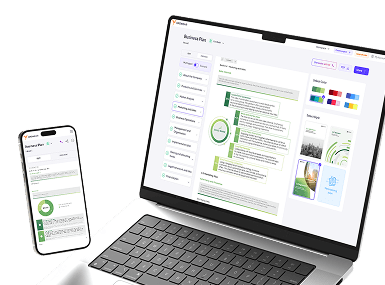
Growexa builds a complete, lender-ready business plan — with financial logic and a professionally formatted PDF
One of the biggest advantages of a coffee stand is that it can be launched with significantly less capital than a traditional coffee shop. However, "lower cost" does not mean inexpensive. A professionally equipped kiosk or permanent coffee stand in the U.S. typically requires $25,000 to $75,000 to open, while a premium drive-thru concept or a custom-built unit can easily exceed $100,000.
The businesses that run into financial trouble are rarely those that underestimate the cost of an espresso machine. More often, they underestimate everything else. Site preparation, electrical upgrades, plumbing, permits, insurance, signage, POS hardware, initial inventory, employee training, and three to six months of working capital can collectively represent nearly half of the startup budget.
Lenders pay close attention to how startup capital will be allocated because every category affects future cash flow differently. Investing in a higher-capacity espresso machine, reliable grinders, or water filtration often produces measurable operational benefits. Spending the same amount on decorative finishes generally does not.
A realistic funding request for an independent coffee stand typically resembles the following structure.
| Startup Expense | Typical Share |
|---|---|
| Espresso equipment, grinders, refrigeration, POS | 35–45% |
| Build-out, utilities, signage | 20–25% |
| Initial inventory | 5–8% |
| Licenses, permits, insurance | 3–5% |
| Marketing & grand opening | 3–5% |
| Working capital reserve | 15–25% |
Another area that receives considerable attention during underwriting is owner investment. While financing structures vary, SBA-backed and conventional small business loans commonly require entrepreneurs to contribute 10–20% of total project costs from their own funds. A meaningful equity contribution demonstrates commitment while reducing lender risk.
The business plan should also explain why the requested amount is appropriate. Simply asking for "$80,000 to open a coffee stand" is rarely persuasive. A much stronger approach is to connect every major expense to the business model. For example, allocating additional funds toward commercial equipment may allow the stand to serve 30–40 more customers during the morning rush, directly increasing revenue potential. Likewise, maintaining a healthy working capital reserve reduces the likelihood of cash shortages during the first several months, when customer traffic is still developing.
Whether funding comes from personal savings, an SBA loan, bank financing, or private investors, the allocation should clearly demonstrate that capital is being used to build a business capable of generating sustainable cash flow—not simply to cover startup expenses.
A coffee stand's financial projections are only as credible as the assumptions behind them. Lenders rarely compare a startup against perfect performance—they compare it against industry benchmarks.
A professionally prepared financial model should demonstrate how the business performs across several key indicators that investors routinely evaluate during due diligence.
| Financial Benchmark | Typical Range |
|---|---|
| Startup investment | $25,000–100,000+ |
| Average ticket | $6–8 |
| Gross margin | 65–75% |
| Food & beverage cost | 25–30% of sales |
| Labor cost | 25–35% of sales |
| EBITDA margin | 12–18% |
| Break-even period | 12–24 months |
| Payback period | 2–4 years |
| Target ROI | 25–40% annually (mature operation) |
The financial model should also explain how these results will be achieved rather than simply presenting optimistic projections. For example, improving the average ticket by adding breakfast items or seasonal beverages may have a greater impact on annual profit than increasing customer traffic by several percentage points. Likewise, reducing drink preparation time during the morning rush can increase hourly capacity without adding labor.
Banks also expect to see sensitivity analysis. A realistic business plan demonstrates how profitability changes if customer traffic falls by 10%, milk prices increase, or labor costs rise faster than anticipated. Showing multiple operating scenarios generally strengthens lender confidence because it demonstrates that management understands financial risk rather than assuming ideal conditions.
Finally, lenders evaluate liquidity alongside profitability. Metrics such as the Debt Service Coverage Ratio (DSCR)—typically expected to exceed 1.20–1.25 for small business lending—and adequate operating cash reserves often influence financing decisions as much as projected net income. A profitable business that cannot comfortably service debt represents a higher lending risk than a business with slightly lower margins but stronger cash flow.
A coffee stand may occupy only a few hundred square feet, but building a profitable business requires the same level of planning expected from much larger ventures. Success depends on selecting the right location, understanding local demand, investing in equipment that supports peak-hour throughput, and developing financial projections that reflect how the business will actually operate.
An investor-ready coffee stand business plan brings those elements together into a single document. It explains why customers will choose the business, how revenue will be generated throughout the day, what level of funding is required, and how management intends to achieve sustainable profitability.
For entrepreneurs seeking an SBA loan, commercial financing, or private investment, that level of preparation does more than improve the chances of securing capital. It provides a practical roadmap for making better decisions long after opening day—when daily transactions, operating costs, and customer loyalty ultimately determine whether a coffee stand becomes a thriving local business or simply another promising concept that never reached its full potential.
Lenders focus on realistic financial projections supported by market research. They expect to see clear revenue assumptions, startup cost estimates, cash flow forecasts, break-even analysis, and evidence that the selected location can generate sufficient customer traffic to repay the loan.
A coffee stand often has lower overhead because it requires less space, fewer employees, and a smaller initial investment. While total revenue may be lower than a full-service café, efficient coffee stands can achieve attractive profit margins by maintaining high transaction volumes and controlling operating costs.
Yes. A professionally completed coffee stand business plan can support an SBA loan application, commercial bank financing, or discussions with private investors. To maximize its effectiveness, the template should be customized with your local market research, operating assumptions, and detailed financial projections rather than relying on generic estimates.

