


AI Business Plan Generator
Create a Funding-Ready Business Plan — Free for 1 Month
Built on real requirements from 40+ US, UK & EU lenders.
Enter your email to activate your free 1-month access.

Create a Business Plan in 5 Minutes with AI
A business plan is more than just a document — it's the foundation of the entrepreneurial journey. Whether you’re launching a new start-up or scaling an established business, having a clear and well-structured plan is critical for success. However, not all business plans are created equal. Should you opt for the brevity and agility of a one-page business plan, or is the depth and comprehensiveness of a traditional business plan the better choice? This question is the base of entrepreneurial strategy, influencing everything from securing funding to shaping long-term goals.
The choice between these two formats isn’t just about length — it’s about purpose, audience, and the unique needs of your business. A one-page business plan offers clarity and adaptability, ideal for fast-moving start-ups, while a traditional plan provides the detailed roadmap often demanded by investors and stakeholders.
This article explores the merits and limitations of both approaches, guiding the right choice for the business journey.
A business plan serves as a roadmap that outlines how the business will operate, grow, and achieve its objectives. It includes key details about products or services, the target market, financial projections, and operational strategies. Beyond its role as an internal guide, a business plan is also a persuasive tool for attracting investors, securing funding, or aligning stakeholders.
Investors and partners often use a business plan to assess the company’s viability. A strong plan demonstrates its preparedness, market understanding, and commitment to success. While all business plans share this purpose, the approach they are structured and presented can vary significantly.
When most people think of a business plan, they imagine the traditional format — a detailed, formal document that delves deep into every aspect of the business. Spanning 40 to 50 pages on average, a traditional business plan is meticulously researched and highly detailed, covering sections such as the executive summary, company description, market analysis, marketing strategy, operations plan, financial projections, and team profiles.

The traditional business plan is a tried-and-true approach, widely used by established businesses and start-ups seeking significant investments. It provides a nuanced perspective of the business, offering in-depth insights into market opportunities, competitive advantages, and long-term financial viability. For stakeholders such as banks or venture capital investors, this comprehensive document is often a non-negotiable requirement.
Traditional business plans are especially valuable when it is needed to plan for the long term. They help businesses set measurable goals, define milestones, and evaluate performance over time. With its exhaustive detail, a traditional plan acts as a blueprint for execution, helping to allocate resources effectively and prepare for challenges.
However, creating such a plan demands a significant investment of time and effort. Depending on the complexity of the business, writing a traditional business plan can take weeks or even months. Moreover, the rigid structure and length of the document make it less adaptable to dynamic market conditions. Updating the plan frequently can be a cumbersome process, and in fast-paced industries, it risks becoming obsolete before it’s even implemented.
On the other hand, the One-Page Business Plan is a concise version that distils the essence of the business into a single page. It highlights the core elements of the business model — such as goals, target market, value proposition, and key strategies — presented in an easy-to-read format.

The one-page business plan is ideal for early-stage start-ups or businesses operating in rapidly changing environments. Its brevity ensures clarity and focus, allowing it to articulate ideas without overwhelming the reader with unnecessary details. This format is particularly effective for sharing with potential collaborators, internal teams, or early-stage investors who seek a quick overview of the business concept.
Unlike traditional plans, the one-page plan is highly adaptable. Its streamlined structure makes it easier to update as the business evolves, allowing it to pivot strategies or incorporate new insights without extensive rewrites. This agility is invaluable for start-ups that need to iterate quickly and validate their ideas.
However, the simplicity of the one-page business plan comes with limitations. It lacks the depth and context required to fully explain the business to investors or stakeholders. While it may grab their attention initially, they will likely request a comprehensive traditional plan to gain a complete understanding of business market potential and financial viability.
Choosing between a one-page and traditional business plan depends on your specific goals, business stage, and audience. If you’re in the early stages of developing your idea or seeking initial feedback, a one-page plan offers a practical starting point. Its focus on the essentials makes it a useful tool for brainstorming, refining your vision, and aligning your team.
For businesses seeking substantial investments or tackling complex markets, a traditional plan is indispensable. Its comprehensive nature not only reassures investors but also provides a detailed roadmap for scaling operations and achieving long-term success.
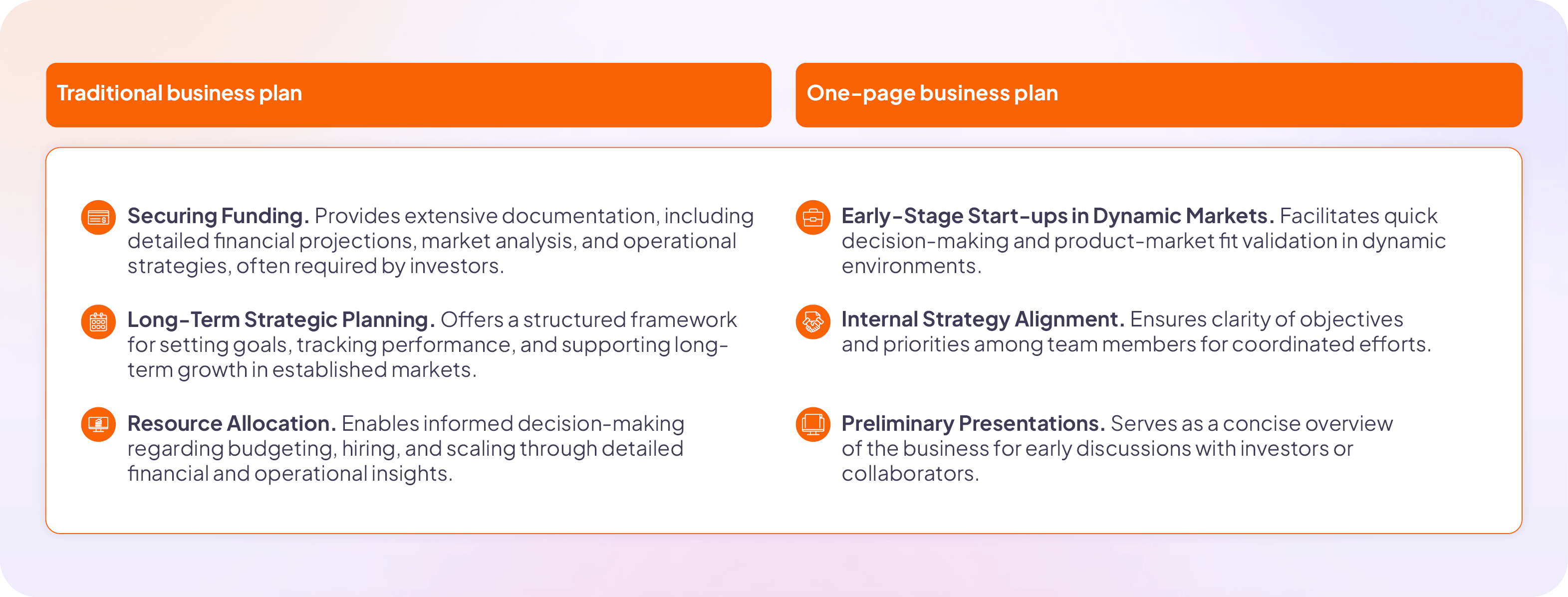
The choice between a one-page and traditional business plan depends on the specific business goals, stage, and audience. Each format serves a distinct purpose. The traditional business plan, with its comprehensive analysis and structured approach, is indispensable for businesses seeking substantial investment or navigating complex, long-term strategic challenges. Conversely, the one-page business plan excels in fostering agility and focus, making it an ideal choice for early-stage startups and fast-evolving industries.
Both formats underscore the critical role of strategic planning in entrepreneurship, but they cater to different needs and contexts. Recognizing when to deploy each approach ensures that the planning process aligns with the business’s objectives and maximizes its chances of success.
Ready to craft the perfect business plan for any situation? Growexa offers everything needed to prepare tailored business plans in various formats, from concise one-pagers to comprehensive traditional blueprints. Visit Growexa now to access expert resources, tools, and guidance designed to help businesses succeed at every stage of their journey.