
Prove the commercial need for blockchain. Investors expect a clear explanation of why decentralized infrastructure improves the product compared with conventional alternatives.
Distinguish usage from monetization. Wallet activity, transaction volume, and token demand are not substitutes for paying customers, retained revenue, and positive unit economics.
Include token economics only when relevant. A crypto startup does not automatically need a token, and token value does not necessarily accrue to equity investors.
Model treasury and runway conservatively. Volatile digital assets, security incidents, and regulatory changes can materially affect liquidity and operating capacity.
Prepare for investor due diligence. Security, custody, governance, compliance, ownership rights, and revenue quality are as important as the underlying technology.
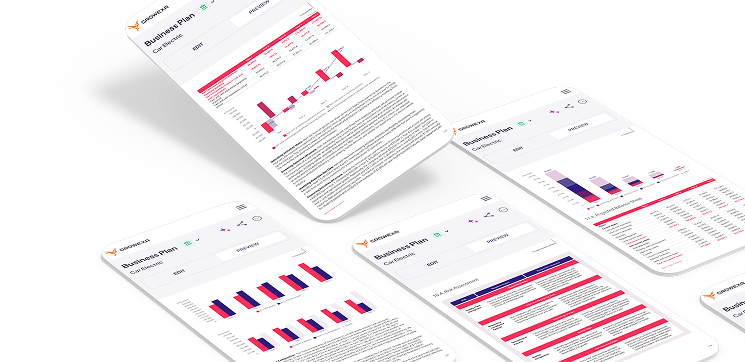

Create a Business Plan in 5 Minutes with AI

An investor-ready crypto business plan should explain how the startup creates economic value, captures a portion of that value, and converts it into sustainable cash flow.
The fundamental questions resemble those used to evaluate conventional technology companies: Who is the customer? What problem does the product solve? How large is the accessible market? How does the company generate revenue? What makes its competitive position defensible?
Crypto introduces additional complexity because the company, protocol, community, and token may have different economic interests. A decentralized network can grow without increasing revenue for the company that originally developed it. Likewise, protocol fees may flow to validators, liquidity providers, or a decentralized treasury rather than to shareholders.
A credible plan must explain these relationships explicitly. Top crypto startup investors must be able to identify the legal entity receiving revenue, the ownership rights being offered, and the mechanisms through which the business could eventually generate returns.
Technical architecture matters, but it should support the commercial thesis rather than replace it. An extensive description of consensus mechanisms or smart contracts cannot compensate for weak customer demand or an undefined monetization strategy.
The first substantive section of a blockchain startup business plan should define the customer problem independently of the proposed technology.
For example, a cross-border settlement platform might address expensive intermediary processes, delayed reconciliation, or limited transaction visibility. A blockchain-based infrastructure product might reduce coordination costs among organizations that do not share a trusted central database.
The plan should then explain why blockchain is necessary to achieve the proposed benefit. Distributed infrastructure can introduce transaction fees, latency, security dependencies, operational complexity, and regulatory exposure. These costs must be justified by measurable advantages.
A useful comparison evaluates the proposed solution against a centralized database, conventional payments infrastructure, or existing enterprise software. Investors will challenge the product if the same customer outcome can be delivered more efficiently without blockchain.
The relevant question is not whether decentralization is technologically possible. It is whether it improves cost, trust, interoperability, resilience, or another outcome that customers are willing to pay for.
Crypto market sizing requires particular discipline because broad estimates of digital asset ownership or blockchain transaction volume rarely correspond to the revenue opportunity available to an individual startup.
A crypto infrastructure company selling APIs to developers has a different addressable market from a consumer wallet, institutional custody provider, or decentralized marketplace.
The business plan should identify the actual purchasing decision-maker, expected contract or transaction value, geographic availability, and regulatory limitations affecting customer acquisition.
For a business-to-business product, the relevant market may be the number of eligible exchanges, fintech companies, payment providers, or enterprise developers with a demonstrated need for the service. For a consumer product, segmentation should distinguish active customers from wallet addresses and speculative participants.
Total addressable market should represent the potential annual revenue associated with a defined customer problem, not the aggregate market capitalization of cryptocurrencies.
The serviceable market should narrow that opportunity to customers the startup can legally and operationally serve. The obtainable market should then reflect realistic acquisition capacity, competition, and expected adoption over the planning period.
This approach produces a smaller but more credible forecast than applying an arbitrary market-share percentage to the entire crypto economy.
A crypto startup can generate revenue through conventional software pricing, transaction-based fees, infrastructure services, marketplace commissions, or specific token-related mechanisms. Utilizing a structured crypto business plan template allows founders to map these distinct cash flows to proper legal entities.
Transaction-based businesses earn revenue when customers execute qualifying activities through the platform. Examples may include payment processing, exchange services, settlement infrastructure, or other permitted transactions.
The model should distinguish gross transaction volume from net revenue. A platform processing $100 million in transactions at an effective fee rate of 0.20% generates $200,000 in fee revenue before applicable network expenses, partner payments, and other direct costs.
Investors will examine whether transaction volume represents genuine customer demand, whether pricing can withstand competition, and how much revenue remains after variable costs.
Subscription models charge customers for ongoing access to software, analytics, compliance tools, or operational services.
This structure can offer more predictable revenue than transaction-dependent pricing, provided customers continue receiving sufficient value to renew.
A SaaS business plan template can help founders structure recurring revenue, customer acquisition costs, retention, gross margin, and cash-flow assumptions. Crypto-specific security and regulatory costs should be incorporated separately.
Infrastructure providers may charge developers or enterprises based on API requests, computing resources, data access, service tiers, or contracted capacity.
Revenue quality depends on usage concentration, infrastructure costs, service reliability, and the extent to which customers can switch providers.
High request volume is not inherently profitable. The financial model should calculate contribution after hosting, node operations, data processing, third-party services, and customer support.
A blockchain-enabled marketplace may earn commissions or service fees from transactions between buyers and sellers.
Investors will evaluate marketplace liquidity, repeat usage, take rate, participant acquisition costs, and the concentration of activity among a small number of users.
Gross merchandise or transaction volume should not be reported as company revenue unless the applicable accounting treatment supports that presentation.
Some protocols use tokens for network participation, governance, access, incentives, or other functions. However, token issuance does not automatically create sustainable revenue for the operating company.
The plan must identify the token's actual function, the economic rights it provides, and how those rights relate to the company's business model. It should also distinguish token-related treasury transactions from revenue generated by delivering products or services.
Any token-based financing or distribution assumptions require legal and regulatory review before inclusion in the fundraising strategy.
Not every crypto startup requires a token. A company providing blockchain analytics, wallet infrastructure, compliance software, or enterprise development tools may operate successfully using ordinary subscription or service revenue.
Introducing a token can create additional economic, governance, accounting, security, and regulatory complexity. Investors will expect evidence that the token performs a necessary function that cannot be achieved more effectively through conventional pricing or access mechanisms.
Where a token is genuinely integral to the product, the business plan should explain its utility, supply structure, distribution, governance, incentives, and relationship to platform activity. It should also identify potential conflicts between token holders, customers, management, and equity investors.
Token economics should not depend on perpetual price appreciation. A model that requires rising token prices to fund operations or sustain participation may be highly sensitive to market conditions.
The most important distinction concerns value capture. A token may benefit from network demand without generating revenue for the company, while equity ownership may provide rights that token holders do not possess. Investors need to understand exactly which economic interest they are acquiring and what determines its potential value.
Blockchain networks provide extensive transaction data, but visibility does not guarantee meaningful commercial traction.
Metrics such as active addresses, transaction counts, total value locked, and protocol volume can help describe activity. They can also be distorted by automated transactions, repeated transfers, incentives, or activity concentrated among a small number of participants.
A credible Web3 business plan should connect on-chain indicators with customer behavior and economic outcomes.
| Metric | What investors want to understand |
|---|---|
| Active wallets or addresses | How activity relates to distinct, genuine users |
| Transaction volume | How much activity represents economically meaningful demand |
| Protocol fees | What portion becomes revenue for the business or protocol |
| Customer retention | Whether usage continues without temporary incentives |
| Paying customers | How many users generate recurring or transaction revenue |
| Total value locked | Whether deposits are durable and economically productive |
| Customer concentration | Whether revenue depends on a small number of participants |
| Incentive-adjusted growth | Whether activity persists after subsidies decline |
For example, a protocol reporting 100,000 monthly active addresses may have substantially fewer distinct users. If transaction activity is largely driven by rewards, the reported growth may decline when those incentives end.
Investors will therefore place greater weight on retained customers, recurring fee generation, genuine usage, and evidence that adoption can continue without excessive subsidies.
Unit economics reveal whether growth improves the business's financial position or merely increases operating costs. Formulating a comprehensive crypto startup financial model ensures that founders accurately stress-test these metrics against varying market liquidity scenarios.
For subscription businesses, relevant measures include customer acquisition cost, lifetime value, gross margin, churn, and payback period. For transaction platforms, the analysis should focus on net revenue per transaction, variable processing costs, contribution margin, and repeat activity.
Consider a hypothetical crypto infrastructure startup charging $500 per business customer per month. If it serves 200 paying customers, monthly recurring revenue is $100,000.
Assume infrastructure, support, and other direct service costs total $25,000. Gross profit is $75,000, producing a 75% gross margin.
If customer acquisition costs average $3,000 and monthly gross profit per customer is $375, the simple gross-profit CAC payback period is $3,000 ÷ $375 = eight months.
This calculation assumes stable revenue and direct costs per customer. It does not account for churn, customer expansion, overhead, or the time required to collect payments.
A startup with attractive gross margins may still consume substantial cash through engineering, compliance, security, and customer acquisition expenses.
Revenue quality also matters. Recurring customer payments generally provide a different level of predictability from speculative trading fees, one-time token transactions, or revenue concentrated during periods of exceptional market volatility.
Crypto startups may hold operating funds in cash, stablecoins, cryptocurrencies, or other digital assets. Treasury composition introduces liquidity, custody, counterparty, and market risks that conventional cash-only models may not face to the same degree.
The business plan should distinguish assets available for operating expenses from restricted, committed, illiquid, or volatile holdings.
For example, a company with $3 million in treasury assets and monthly net cash burn of $150,000 might report a simple runway of 20 months. However, that estimate is reliable only if the assets can be converted into spendable funds at the assumed values and without material restrictions or losses.
If half the treasury is held in volatile tokens, a significant market decline could reduce available runway even when operating expenses remain unchanged.
The financial model should therefore include cash-denominated liquidity requirements, treasury concentration limits, custody arrangements, and downside scenarios.
Runway should be calculated from realistically available liquid resources rather than headline token valuations. Management should also distinguish operating cash burn from noncash accounting adjustments and movements in digital asset prices.
A business that depends on selling its own tokens to fund recurring payroll faces a different risk profile from one financed by committed equity capital and recurring customer revenue.
Regulatory exposure is a central component of crypto startup due diligence because the legal treatment of a product can affect its business model, customer eligibility, financing, and operating costs.
The relevant framework depends on the activities performed, jurisdictions served, assets involved, and rights associated with those assets. A blockchain analytics provider, custodial wallet operator, digital asset exchange, and token issuer may face substantially different obligations.
A cryptocurrency startup business plan should identify whether the proposed activities require analysis under securities, commodities, money transmission, payments, sanctions, consumer protection, privacy, or other applicable laws. It should also address anti-money laundering obligations and customer verification requirements where relevant.
Token classification requires particular care. The legal treatment of a digital asset cannot be determined solely by calling it a utility token or describing the network as decentralized. The circumstances of issuance, distribution, promotion, and use may be material.
Custody arrangements introduce additional questions about control of customer assets, segregation, safeguarding, and legal responsibility. Fundraising structures must also be evaluated separately from the product's operating requirements.
Because U.S. federal and state digital asset rules continue to evolve, founders should verify the current position through official regulatory sources and qualified counsel. Relevant authorities may include the SEC, CFTC, FinCEN, state financial regulators, and agencies responsible for particular activities.
The financial model should incorporate realistic compliance expenses, professional fees, and potential delays associated with entering regulated markets. Regulatory uncertainty should be treated as a measurable business risk rather than addressed through a generic disclaimer.
Security is a fundamental component of the economic value proposition for any crypto startup handling digital assets, transaction infrastructure, or sensitive customer information.
Investors will examine the architecture, code review procedures, access controls, incident-response arrangements, third-party dependencies, and the extent to which the business relies on smart contracts or external protocols.
Where applicable, the plan should describe independent security assessments, testing procedures, upgrade controls, and how vulnerabilities are identified and remediated. An audit may reduce certain risks, but it does not guarantee that a protocol or application is secure.
Custody models deserve particular scrutiny. Businesses controlling private keys or customer assets may face operational and legal responsibilities different from those of noncustodial software providers.
Technology concentration can also undermine resilience. A startup dependent on one blockchain, bridge, oracle, infrastructure provider, or critical vendor may experience substantial disruption if that dependency fails. The business plan should explain the commercial consequences of an incident, including interrupted revenue, recovery expenses, customer attrition, potential liabilities, and reputational damage.
Security investment should be included in recurring operating expenses and future capital requirements, not treated exclusively as a development-stage expenditure.
Crypto investors assess whether the founding team can deliver a technically reliable product while building a commercially sustainable organization.
Technical expertise is necessary for many blockchain products, but it does not replace enterprise sales, financial management, security leadership, legal oversight, or customer support. The required combination depends on the product and its regulatory exposure.
A strong team section should connect each founder's experience with the principal execution risks. For an infrastructure startup, relevant experience may include distributed systems, developer platforms, enterprise contracts, and security operations. For a regulated financial product, compliance and risk-management capabilities may be equally important.
Defensibility should be demonstrated through factors that competitors cannot easily replicate. These may include proprietary technology, established integrations, distribution relationships, switching costs, customer trust, or network effects supported by genuine participation.
Open-source technology does not necessarily prevent competitive advantage, but the plan must explain where that advantage resides.
A token community or large social media following is not, by itself, a durable competitive moat. Investors will look for evidence that the company can retain customers and preserve its economics when incentives decline and competing products enter the market.
The funding section should specify the amount being raised, the proposed financing instrument, expected runway, and operational milestones the capital will support.
A credible funding request begins with a financial forecast rather than an arbitrary valuation target. Founders should calculate the resources required for product development, security, compliance, customer acquisition, staffing, and working capital, then add a reserve for execution delays.
For example, a startup seeking $2.5 million might propose the following allocation.
| Use of funds | Amount | Share |
|---|---|---|
| Product development and engineering | $900,000 | 36% |
| Security, infrastructure, and audits | $400,000 | 16% |
| Sales and customer acquisition | $500,000 | 20% |
| Legal, compliance, and administration | $350,000 | 14% |
| Working capital and contingency | $350,000 | 14% |
| Total funding requirement | $2,500,000 | 100% |
These allocations are illustrative. Actual requirements depend on the company's development stage, business model, jurisdiction, and staffing strategy.
Investors will expect the funding to support measurable progress. Relevant milestones may include product launch, paying customers, recurring revenue, security validation, regulatory readiness, or demonstrated improvements in unit economics.
The plan should also distinguish equity financing from token-related financing arrangements. These instruments may convey different rights, risks, and economic benefits. Any proposed fundraising structure requires appropriate legal review.
Founders preparing a startup business plan example can use a conventional technology startup framework as a starting point, then incorporate crypto-specific governance, treasury, security, and compliance requirements.
A strong investor presentation should provide direct, evidence-based answers to the questions most likely to emerge during due diligence.
| Investor question | What the business plan should demonstrate |
|---|---|
| Why does this product need blockchain? | A measurable advantage over centralized alternatives |
| Who pays for the product? | Identifiable customers, purchasing behavior, and willingness to pay |
| What is the actual market opportunity? | A bottom-up estimate based on accessible customer segments |
| How does the company generate revenue? | Clear monetization mechanics and ownership of revenue streams |
| Does the business need a token? | A necessary economic or technical function, if applicable |
| Who captures the value created? | Defined relationships among the company, protocol, investors, and token holders |
| Is the reported traction genuine? | Retained users, paying customers, and incentive-adjusted activity |
| Are unit economics sustainable? | Gross margins, acquisition costs, retention, and contribution economics |
| How much runway is available? | Liquid treasury resources and a realistic cash-burn forecast |
| What are the principal regulatory risks? | Jurisdiction-specific legal analysis and compliance responsibilities |
| How are customer assets and systems protected? | Security architecture, custody controls, testing, and incident procedures |
| What makes the company defensible? | Evidence of switching costs, distribution advantages, or other durable strengths |
| What happens in a market downturn? | Downside forecasts covering revenue, liquidity, and operating expenses |
| What will the funding accomplish? | A documented use-of-funds plan tied to measurable milestones |
The objective is not to provide an optimistic answer to every question. Investors generally place greater value on transparent assumptions and credible risk management than on projections that ignore material uncertainties.
A crypto startup should ultimately be evaluated using the same investment discipline applied to other technology businesses: demonstrable customer demand, credible monetization, efficient capital allocation, defensible operations, and a realistic path toward financial sustainability.
Blockchain architecture may create distinctive advantages, but those advantages do not automatically produce company revenue or investor returns. The strongest founders can explain where value is created, who captures it, what the business costs to operate, and how it performs when speculative activity declines.
Before approaching investors, founders should consolidate their commercial assumptions, operating requirements, and financial projections into a coherent model. Growexa can help teams create an investor-ready business plan that connects market analysis, business strategy, and financial forecasts.
The objective is not to demonstrate that a crypto project can attract attention or generate network activity. It is to establish that the company can convert a genuine technological advantage into durable economic value.
A crypto business plan should cover the customer problem, product, blockchain rationale, market size, revenue model, traction, unit economics, financial projections, treasury strategy, regulatory risks, security, team, and funding requirements. Token economics should be included when a token is integral to the business, but not treated as a universal requirement.
No. Many blockchain infrastructure, analytics, compliance, and enterprise software companies can generate revenue through subscriptions, transaction fees, or service contracts without issuing tokens. A token should have a clearly justified function and an appropriate legal and economic framework.
Crypto startups may earn revenue through transaction fees, software subscriptions, infrastructure services, marketplace commissions, and other permitted business activities. The relevant financial measure is the revenue retained by the business after direct costs, rather than the total transaction value processed by its technology.
Investors may examine recurring revenue, paying customers, retention, gross margin, customer acquisition costs, transaction activity, protocol fees, and treasury runway. On-chain metrics are useful when they can be connected to genuine customer behavior and sustainable economic activity.
A simple runway estimate divides available liquid operating funds by monthly net cash burn. Digital assets should be evaluated for volatility, liquidity, restrictions, and custody risks. Treasury balances reported at market value may overstate the funds realistically available for future operating expenses.
Yes. A crypto startup can pursue conventional equity financing where legally and commercially appropriate. Investors will evaluate the company's ownership structure, commercial prospects, financial model, competitive position, and expected returns. Token issuance is not a prerequisite for venture financing.
The most material risk depends on the business model. Weak product-market fit, unclear value capture, security vulnerabilities, regulatory exposure, insufficient liquidity, and reliance on speculative incentives can all undermine viability. Investors will focus on whether the company can manage these risks while building a sustainable revenue base.


