Ukraine
 USA
 Austria





01 Executive Summary
The Executive Summary positions the AI Startup as a technology-driven company focused on solving specific, high-value problems through artificial intelligence. The AI Startup develops proprietary models, data pipelines, or AI-powered platforms designed to improve efficiency, decision-making, or user experience within targeted industries. The business plan defines the company’s mission as delivering measurable performance improvements through intelligent automation and advanced analytics.
This AI Startup differentiates itself through specialized application rather than generalized technology. Instead of building broad-purpose tools without clear adoption pathways, the business plan emphasizes problem-solution alignment, domain expertise, and scalable deployment. The initial product offering may take the form of SaaS software, API-based services, enterprise integration solutions, or vertically focused AI platforms.
From a financial perspective, the business plan outlines development costs, infrastructure investment, revenue models, and growth projections. Revenue streams may include subscriptions, licensing, usage-based pricing, or enterprise contracts. The Executive Summary establishes the AI Startup as a commercially structured technology company guided by a rigorous business plan rather than a purely experimental venture.
02 Company Overview
The Company Overview defines the identity and structural foundation of the AI Startup. It clarifies whether the company operates as a product-focused SaaS provider, an enterprise AI solutions developer, or a platform-based ecosystem builder. This positioning informs all strategic decisions within the business plan, from product architecture to customer acquisition.
The AI Startup is built around intellectual property, data assets, and technical capability. The business plan outlines ownership structure, governance, and policies related to model development, data usage, and security. Protecting proprietary technology and maintaining regulatory compliance are core strategic priorities.
Operationally, the AI Startup is designed for scalability. Cloud infrastructure, modular architecture, and continuous model improvement form the backbone of the technology strategy. The business plan explains how engineering workflows, deployment pipelines, and monitoring systems support reliability and performance as adoption grows.
Location considerations may include access to technical talent, research partnerships, and investor ecosystems. The business plan ensures that structural decisions support long-term growth rather than short-term convenience.
03 Market Analysis
The Market Analysis examines the forces driving demand for AI Startup solutions. Organizations across sectors seek automation, predictive insight, and efficiency gains that traditional software cannot deliver. This structural demand creates opportunity, but also attracts intense competition.
The business plan evaluates market segments, adoption barriers, and purchasing behavior. Enterprise buyers prioritize reliability, integration capability, and return on investment. The AI Startup must therefore demonstrate not only technical sophistication but practical impact.
Competitive analysis includes large technology firms, specialized startups, and in-house development teams. The business plan positions the AI Startup through differentiation in domain expertise, data quality, and deployment efficiency. Market gaps such as underserved industries, high-cost manual processes, or fragmented data environments represent strategic entry points.
Customer trust is a central factor. The business plan addresses transparency, explainability, and ethical considerations, ensuring that the AI Startup aligns with evolving regulatory and societal expectations.
04 Marketing and Sales Strategy
Marketing for an AI Startup is credibility-driven. This section of the business plan outlines a strategy centered on expertise, measurable outcomes, and industry relevance. Brand positioning emphasizes technical authority and practical value rather than abstract innovation.
The AI Startup leverages thought leadership, case studies, technical content, and strategic partnerships to build awareness. Sales cycles may involve demonstrations, pilot programs, and proof-of-concept deployments. The business plan aligns marketing and sales with the complexity of enterprise adoption.
Pricing strategy reflects value delivered rather than development cost. The business plan integrates subscription tiers, usage-based models, and enterprise licensing structures that scale with customer growth.
Retention and expansion are critical. The AI Startup focuses on performance monitoring, ongoing optimization, and customer success to ensure long-term relationships.
05 Operations Plan
The Operations Plan details how the AI Startup builds, deploys, and maintains its technology. It outlines development methodologies, model training processes, data management protocols, and infrastructure oversight. Reliability and performance monitoring are treated as continuous priorities.
The business plan addresses system security, uptime management, and regulatory compliance. As AI solutions often operate within mission-critical environments, operational discipline is essential.
Talent management is a central operational factor. Engineers, data scientists, and product specialists must collaborate within structured workflows. The business plan defines processes that support innovation while maintaining delivery consistency.
06 Management and Organization
The Management and Organization section outlines the leadership structure of the AI Startup. It highlights the roles of technical leadership, product strategy, and business development. Effective governance ensures alignment between innovation and commercial viability.
The business plan emphasizes cross-functional coordination and strategic decision-making frameworks. Organizational culture prioritizes experimentation, accountability, and measurable outcomes.
As the AI Startup scales, the business plan anticipates expansion of engineering teams, customer success functions, and operational support.
07 Raising and Allocating Funds
AI Startup development requires significant capital investment. This section of the business plan outlines funding needs for research, infrastructure, talent acquisition, and market entry. The business plan emphasizes disciplined capital allocation aligned with measurable milestones.
Funding sources may include venture capital, strategic investors, and revenue reinvestment. The AI Startup prioritizes spending on technology development and market validation rather than premature expansion.
Financial governance ensures transparency and accountability for investors.
08 Financial Plan
The Financial Plan translates the AI Startup strategy into a structured economic model. Revenue projections reflect adoption rates, pricing structure, and expansion pathways. Expense assumptions include infrastructure, personnel, research, and customer acquisition.
The business plan addresses burn rate, runway, and profitability timelines. Scenario modeling accounts for growth variability and market conditions. This financial rigor demonstrates that the AI Startup is designed for sustainable scaling.
Conclusion
Building a successful AI Startup requires more than advanced algorithms. It requires strategic clarity, disciplined execution, and financial structure. In a sector defined by rapid innovation and intense competition, a comprehensive business plan provides the framework that transforms technical potential into durable enterprise value.
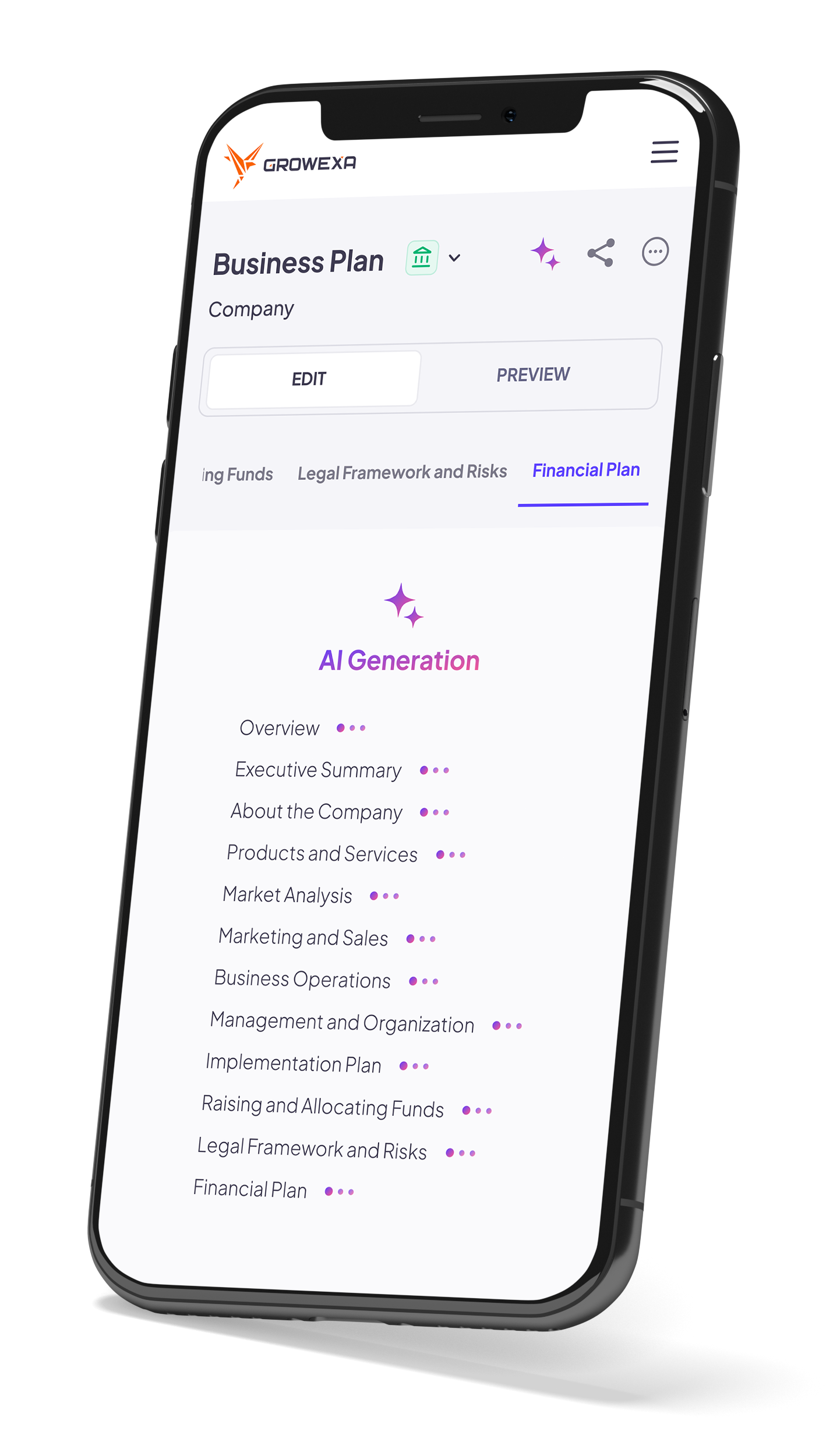
By aligning innovation with market demand, operational reliability, and financial accountability, this AI Startup is positioned for long-term impact. Strategic planning platforms such as Growexa support founders in structuring their vision, modeling growth scenarios, and developing investor-ready business plans that bring clarity to complex technology ventures. With a disciplined business plan as its foundation, an AI Startup can translate breakthrough ideas into sustainable value for customers, investors, and the broader digital economy.