Ukraine
 USA
USA
 Austria

Stop editing templates
Start building a plan that gets approved
Turn this template into a complete business plan with:
- Financial projections
- Loan-ready structure
- Clear repayment logic
Based on 40+ bank requirements


Opening a Restaurant is a collision between art, logistics, and finance. The aromas and atmosphere capture imagination, but the reality lives in spreadsheets. A Restaurant Financial Plan is the translation of taste into tables — the disciplined system that defines how a creative vision becomes a viable enterprise. It is not just a requirement for investors; it’s the management language of every successful Restaurant.
A well-built Financial Plan defines how ideas become profits, how operations sustain liquidity, and how leadership measures performance. It reveals whether your concept can withstand market volatility and still feed both customers and cash flow.
Turn this template into a complete business plan with:
Based on 40+ bank requirements
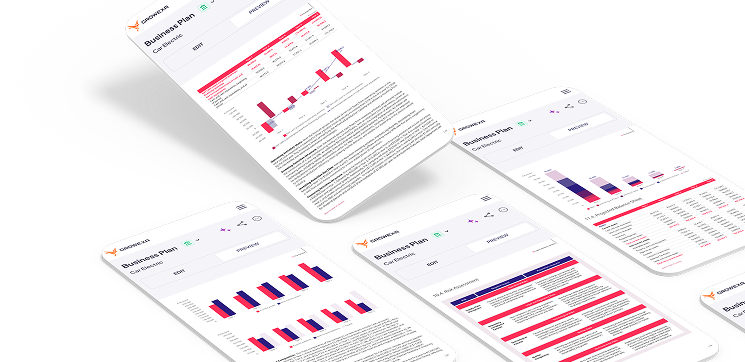


Most business plans fail not because of the idea — but because the numbers don’t prove repayment.
Build a bank-ready business plan in minutes
(with projections, structure, and validation)
Every Restaurant needs a narrative, but investors read numbers. The Financial Plan bridges those worlds. It’s a story written in figures — one that explains how design, staffing, and service translate into measurable returns. Without it, enthusiasm turns into guesswork; with it, creativity finds a financial backbone. At its core, the Restaurant Financial Plan should answer three questions:
The Restaurant operates in thin margins — 3 – 6 % net for most concepts — which means minor inefficiencies become existential threats. The Financial Plan converts intuition into quantifiable strategy, making decisions about menu, labor, and marketing testable instead of emotional.
Every Restaurant begins with outflows. Before a single guest appears, capital must fund design, permits, and equipment. The Financial Plan organizes this chaos into logic. Typical startup categories include:
Top-line optimism is common; discipline is rare. The Financial Plan transforms hunches into a defensible model. Start with capacity logic:
Seats × Table Turns × Average Check × Operating Days = Projected Revenue.
Example: a 90-seat Restaurant, two turns nightly, $55 check, 30 days → ≈ $297 000 per month before taxes.
Add modifiers: lunch service, bar program, catering, or delivery. Then factor seasonality — a 20 % dip in summer or spikes in holiday months. The Restaurant Financial Plan should map these waves to show liquidity patterns, not just yearly totals.
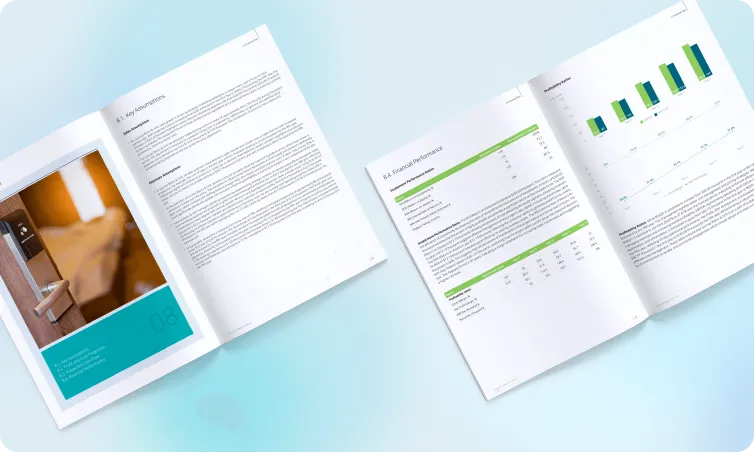
Most crucially, include a ramp-up curve. Few Restaurants hit full volume before month 6. A gradual rise from 60 % to 90 % capacity demonstrates realism and helps lenders understand working-capital needs.
Where the romance ends, accounting begins. Operating expenses reveal how efficiently a Restaurant converts sales into sustainability.
The Restaurant Financial Plan should document cost-containment systems — waste tracking, yield management, and preventive maintenance. Every dollar saved at cost level compounds into stability at profit level.
When a Restaurant knows exactly how many staff hours and ounces of product generate each dollar of revenue, it becomes more than a venue — it becomes a machine calibrated for endurance.
Investors always ask one question first: When does the Restaurant stop losing money?
The break-even analysis inside the Restaurant Financial Plan provides that answer.
Formula: Fixed Costs ÷ (1 – Variable Cost Ratio) = Break-Even Revenue.
If your fixed monthly outlay is $80 000 and variable costs run 35 %, you need ≈ $123 000 to break even.
Visualize it through a chart showing monthly revenue crossing expense lines by month 7 or 8. Demonstrating how incremental table turns or menu price adjustments shift the break-even point proves managerial control.
The Restaurant that knows its break-even threshold gains freedom: it can scale, pivot, or tighten spending with clarity rather than panic.
A projected P&L is the heartbeat of the Restaurant Financial Plan. It connects kitchen rhythm to investor ROI. Include three years of projections: monthly in year 1, quarterly thereafter. Start with gross revenue, subtract COGS → gross profit; then labor, occupancy, and admin → operating income. Finally, account for interest and taxes → net profit. Healthy full-service Restaurants achieve 8 – 12 % net; fine dining 5 – 7 %; fast-casual up to 15 %. Use narrative commentary to explain margin evolution — for instance, labor optimization through technology or supplier consolidation. A Financial Plan without explanation is math; with explanation, it becomes strategy.
Even profitable Restaurants die from poor timing. Cash inflows and outflows rarely align. The Financial Plan must detail liquidity management month by month.
Suppliers often demand weekly payment; payroll hits bi-weekly; revenue spikes on weekends. A three-month liquidity cushion is essential. Model base, best, and worst cases showing how reserves shrink and recover.
Example: if monthly expenses are $180 000, maintain $90 000 in accessible cash or revolving credit. The Restaurant Financial Plan should emphasize systems — automated invoicing, cash-flow dashboards, supplier terms — that preserve flexibility.
Cash management is not just accounting; it’s survival psychology for restaurateurs.
Beyond the P&L, a sound Financial Plan projects a balance sheet showing solvency. Assets = Liabilities + Equity — the oldest equation in business, yet the most revealing. List tangible assets (equipment, improvements), current assets (cash, receivables), and liabilities (loans, leases). Track debt-to-equity ratio — ideally below 1.5. A Restaurant leveraged beyond that risks fragility when sales dip. Maintain a current ratio above 1.2, meaning short-term assets exceed short-term liabilities. Liquidity gives a Restaurant breathing room to invest, not just react.
Raising money for a Restaurant requires precision storytelling. The Financial Plan must describe how much capital is required, where it flows, and what return investors can expect. Segment funding stages:
An investor reading a detailed Restaurant Financial Plan isn’t just seeing numbers; they’re seeing a disciplined operator who treats every dollar as a promise.
A great Restaurant Financial Plan treats forecasting not as fortune-telling, but as adaptive modeling. Revenue, cost, and margin projections should evolve with market signals.
Build at least three scenarios — base, optimistic, and downside — and simulate how each affects cash flow and profitability. For instance:

Use spreadsheet logic or software like Growexa’s financial tools to visualize elasticity. A Restaurant that can adjust assumptions dynamically gains resilience. The Financial Plan becomes less a document and more a diagnostic instrument. Include seasonality curves, holidays, and local event data to smooth revenue projections. The goal is not perfection but agility — the ability to correct course before the storm hits.
In most Restaurants, profit doesn’t come from revolution but refinement. The Financial Plan should spotlight leverage points where small operational changes create compounding results.
Menu engineering is the obvious one. Reprice or reformat low-margin dishes, bundle high-margin beverages, rotate seasonal specials strategically. A 2 % improvement in food cost across the menu can increase net profit by 20 %. Labor optimization follows the same logic: data-driven scheduling, multi-role training, and automation tools that reduce idle time. When the Restaurant syncs demand forecasting with labor deployment, cost stability becomes predictable. Even marketing spend can be reframed financially: track ROI per channel, drop vanity metrics, and focus on cost per acquisition and lifetime value. The Restaurant Financial Plan should reflect how these feedback loops convert daily operations into quantifiable growth.
No Restaurant investor cares about revenue without recovery. A detailed Financial Plan must articulate when and how capital returns to those who funded the dream.
Typically, a well-run Restaurant targets full ROI within 24–36 months. Show month-by-month cash surplus after break-even, cumulative payback, and internal rate of return (IRR).
For example, if total investment is $600 000, and the Restaurant generates $25 000 monthly net after year one, you recover principal in roughly 24 months with a 12–15 % IRR. These are the numbers that turn interest into signatures. Include visual payback curves and milestone-based investor exits. Some Restaurants offer convertible equity or profit-sharing once ROI is achieved — the Financial Plan should spell out those mechanisms. Transparency isn’t just ethics; it’s investor magnetism.
Investors don’t fund passion; they fund control. The Restaurant Financial Plan is your proof of control — and your ongoing dialogue with capital partners.
Establish a quarterly reporting rhythm: share P&L updates, cash status, and key performance ratios. Outline how decisions are made, who signs off on expenditures, and what metrics trigger reinvestment or expansion.
This transforms the Restaurant from a black box into a transparent system. A well-managed Financial Plan even anticipates investor questions: variance explanations, contingency readiness, and next-stage financing logic.
Professionalism here directly influences valuation — a transparent operator earns better terms, lower interest rates, and longer patience. Numbers build trust faster than narratives ever will.
As a Restaurant scales, its metrics must mature. Go beyond the standard prime cost ratios. A sophisticated Financial Plan tracks operational intelligence:
By quantifying culture, time, and guest loyalty alongside cash, the Restaurant Financial Plan becomes a leadership dashboard — a way to manage complexity through clarity.
The best operators build their management meetings around these KPIs, aligning chefs, servers, and accountants around one shared scoreboard.
Modern Restaurants run on data. POS analytics, inventory sensors, and financial dashboards merge in real time to inform smarter choices.
Include in the Financial Plan how these tools connect: POS to accounting, scheduling to payroll, CRM to marketing. Automation not only saves labor hours but eliminates data lag. Investors increasingly expect Restaurant operators to demonstrate digital fluency, treating finance as a live stream, not a monthly report.
Predictive analytics can even model demand by weather, daypart, or event — allowing precise inventory control and staffing. When the Financial Plan quantifies the ROI of technology itself, it frames innovation as investment, not expense.
No connection between:
Growexa builds a complete, lender-ready business plan — with financial logic and a professionally formatted PDF

A single Restaurant is a craft; multiple are a system. Once operations stabilize, the Financial Plan must evolve into a scalable model.
Describe how capital and processes replicate: shared vendors, centralized purchasing, and brand management efficiency. Multi-unit scaling demands an overhead plan — accounting, HR, marketing — that can support growth without collapsing margins.
Model two versions:
Each carries different cost structures and returns, which the Restaurant Financial Plan should articulate transparently. Scalability is not about speed — it’s about consistency under pressure. The investors who see discipline in the numbers will fund your next location before you ask.
Every Restaurant has two financial lives: the one that earns and the one that sells. A mature Financial Plan should anticipate valuation logic even before the first profit.
Common valuation methods include EBITDA multiples (3–6× for stable operations) and revenue multiples (0.4–1×). A Restaurant with clean books, recurring customers, and brand equity commands the higher range.
Document what factors increase valuation — repeat business ratios, management depth, proprietary recipes, tech adoption. The Financial Plan should tie these intangibles to financial outcomes, showing that culture and systems aren’t just stories; they’re assets.
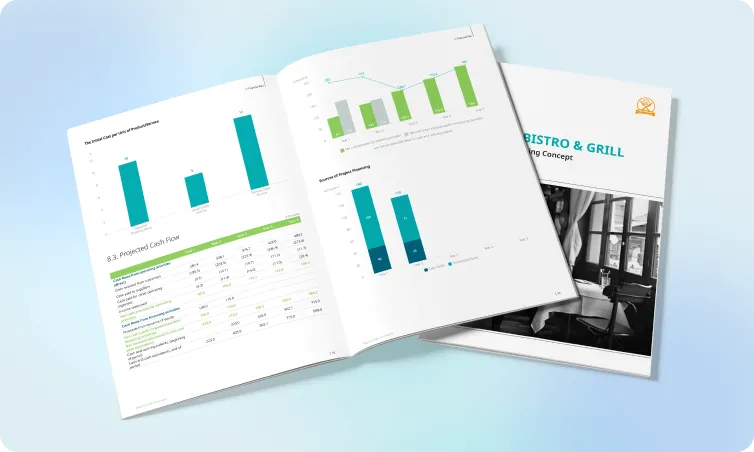
Exit doesn’t mean abandonment — it means optionality. When your Restaurant has an updated Financial Plan, it can sell, franchise, or attract strategic partners on its own terms.
The Restaurant Financial Plan is not a static document; it’s a process of ongoing reflection. Monthly reviews test reality versus projection. Quarterly reviews recalibrate budgets. Annual reviews redefine strategy. Build governance routines — weekly cash meetings, KPI dashboards, rolling forecasts. A Restaurant that embeds financial review into its culture evolves faster than market shifts.
Managers should learn to interpret numbers as fluently as recipes. When everyone understands gross margin or labor ratio, accountability decentralizes. The Financial Plan becomes an educational tool, not a punishment chart. A data-literate team is the ultimate competitive edge in a volatile industry.
Financial success today includes moral arithmetic. The Restaurant Financial Plan should quantify sustainability goals — energy use, waste reduction, sourcing ethics.
Beyond compliance, these initiatives generate measurable savings and brand loyalty. A Restaurant that reduces waste by 20 % lowers food costs by 3–5 %. Transparent supplier relationships prevent hidden liabilities.
Modern investors favor ESG-aware operations. Including social and environmental metrics in your Financial Plan not only strengthens reputation but broadens funding access.
Profitability without conscience is short-lived; the Restaurant with ethics built into its Financial Plan will always attract deeper loyalty.
Once profitable, reinvestment strategy becomes the next test. Should surplus cash expand the Restaurant, pay down debt, or strengthen reserves? The Financial Plan must answer this dynamically.
Model capital efficiency: return on reinvested profit versus cost of borrowed capital. Demonstrate discipline — expansion only when unit economics exceed 20 % cash-on-cash return. Investors trust restraint as much as ambition.
Transparency sustains partnerships. A Restaurant Financial Plan that outlines communication frequency, data access, and strategic decision rules ensures trust even during downturns. Capital confidence is a renewable resource when managed well.
No Restaurant is immune to disruption — economic shocks, pandemics, or supply breakdowns. The Financial Plan should map contingency liquidity, insurance coverage, and pivot mechanisms (delivery, catering, digital orders).
Show resilience in modeling: if revenue falls 40 %, how many weeks of cash remain? What triggers cost freezes or renegotiations? A crisis-ready Restaurant earns investor confidence because it transforms uncertainty into protocol. Crisis management is not pessimism; it’s realism in spreadsheet form.
Ultimately, the Restaurant Financial Plan is not about accounting — it’s about control. It turns culinary artistry into economic architecture, ensuring that passion survives pressure.
When every member of the Restaurant — from chef to investor — can read and act on the numbers, the business transcends chaos. The Financial Plan becomes the language of alignment: between art and discipline, between ambition and execution.
The restaurants that last a decade aren’t those with perfect food; they’re those with perfect feedback loops — financial systems that detect, adapt, and evolve faster than the market. A truly living Financial Plan isn’t a binder on a desk. It’s the pulse of the Restaurant, beating in real time, reminding everyone why structure is the highest form of creativity.
The first year should focus on liquidity over profit. Include a month-by-month cash-flow forecast, realistic sales ramp-up, inventory rotation logic, and payroll cycles. Investors expect to see survival modeling — not just revenue dreams. A credible Restaurant Financial Plan shows that management can fund operations until break-even without relying on luck.
At minimum, review the Financial Plan quarterly, updating assumptions with real performance data — food cost variance, labor ratios, and guest frequency. Monthly cash reviews prevent surprises, while annual revisions reset long-term goals. A static plan dies; a living plan compounds insight and credibility.
Translate passion into precision. Replace vague optimism with KPIs: break-even by seat count, ROI timelines, and downside recovery levers. Use visuals — payback curves, cost structures, and profit sensitivity charts. The Restaurant Financial Plan that blends story and math earns not just funding, but respect.