Ukraine
 USA
 Austria




A clothing line can sell well and still create a cash problem.
The reason is structural. Apparel founders often commit money to design, samples, manufacturing deposits, packaging, freight, and inventory months before customers buy the finished product. If the first collection sells slowly, cash stays trapped in stock. If it sells quickly, the brand may need to fund the next production run before enough cash has returned from the first.
That is why a clothing line business plan should not read like a generic retail plan. It needs to explain how the brand develops products, manages manufacturing minimums, prices each SKU, acquires customers, controls returns, and finances inventory through the production cycle.
This also separates a clothing-line plan from a clothing-store plan. A store is primarily a retail operation built around merchandising, channel economics, and store or ecommerce operations. A clothing line creates and finances proprietary products. The central risks are therefore different: product development, MOQ, fit, inventory allocation, supplier lead times, margin, and working capital matter far more.
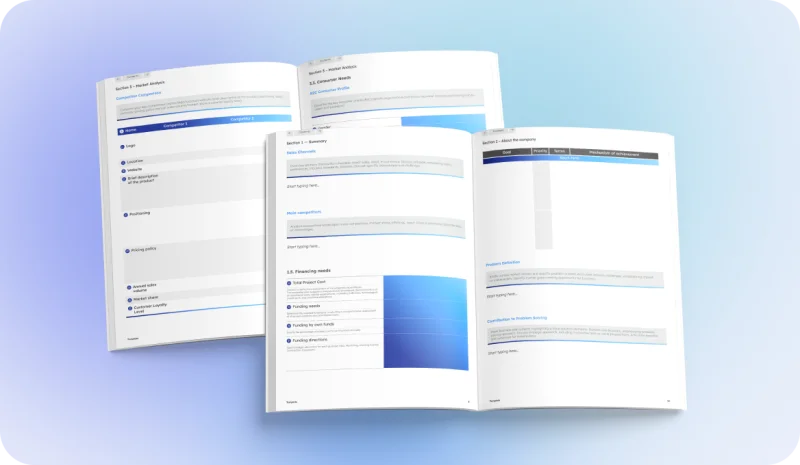
Free Clothing Line Business Plan Template + PDF
If you are figuring out how to start a clothing line business plan, begin with the operating model rather than the document structure. Define what the brand will sell, who it will serve, how the products will be manufactured, how much inventory must be purchased, and how the business will acquire customers before turning those assumptions into financial projections.
A practical clothing line business plan example should connect the creative concept to the financial model.
The plan should establish who the brand serves, what products it will launch, how those products will be manufactured, how much inventory must be purchased, what the products will cost once delivered, where they will be sold, and how much contribution remains after customer acquisition, fulfillment, returns, and other selling expenses.
That is particularly important when the plan will be used for financing. A lender or investor should be able to trace revenue back to the collection itself: units available for sale, expected sell-through, average selling price, channel mix, inventory replenishment, and customer acquisition.
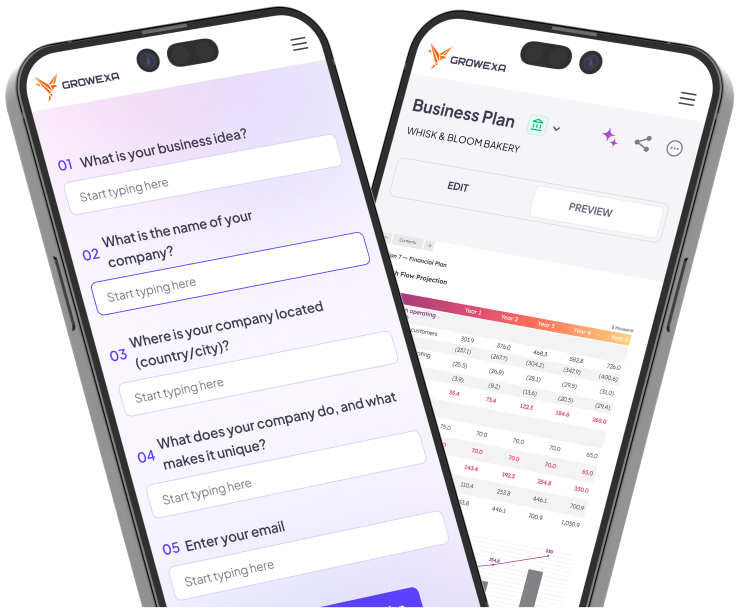
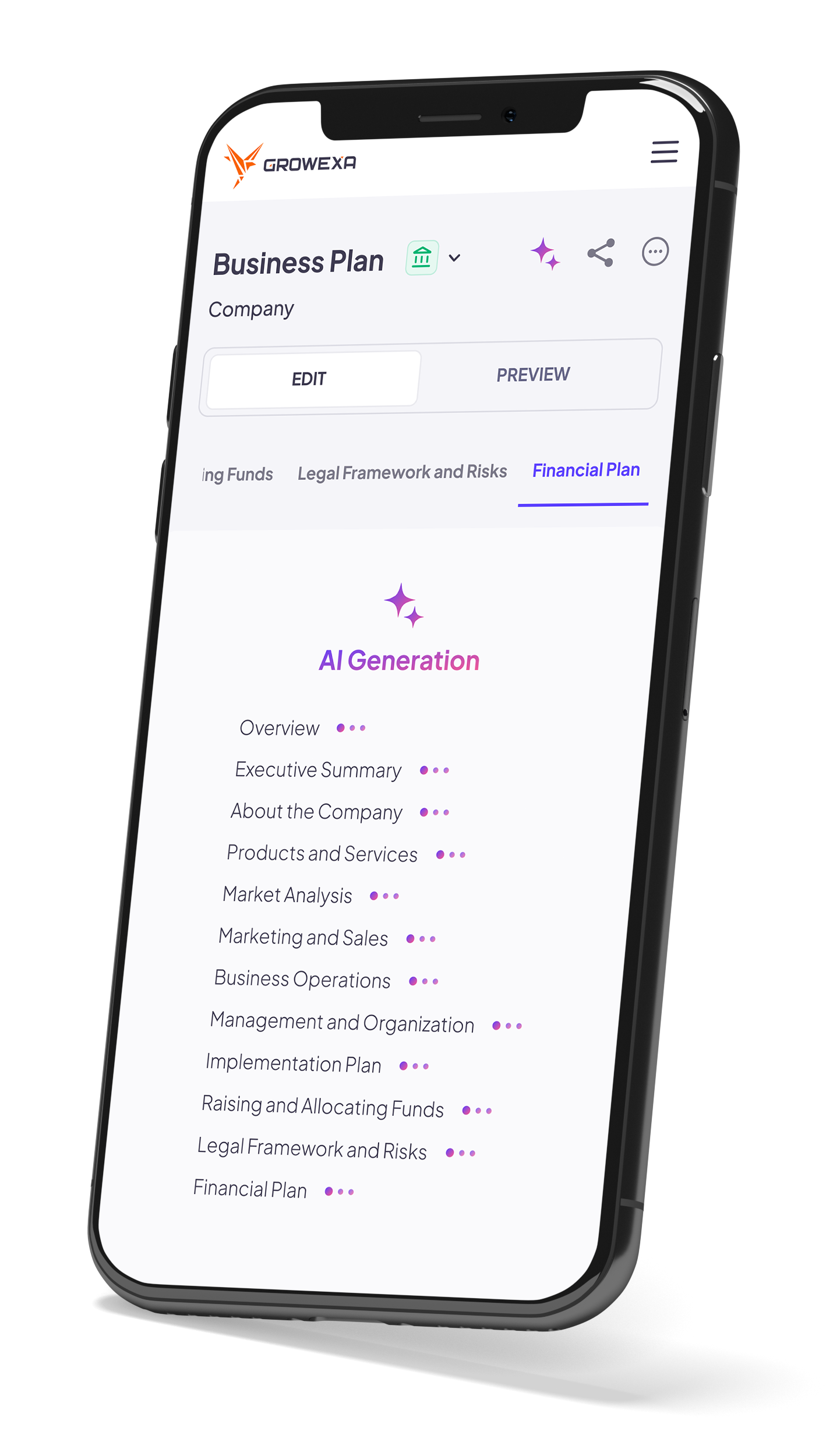
A completed plan can then be exported as a clothing line business plan PDF for financing or internal planning. Growexa's AI Business Plan Generator can help structure the narrative and financial assumptions in one model rather than treating the written plan and projections as separate documents.
The output matters, but the operating assumptions matter more. A polished PDF cannot compensate for a forecast that assumes unrealistic margins, ignores returns, or underestimates the amount of cash tied up in the first production run.
Clothing Line Key Facts
There are no universal startup-cost, margin, MOQ, or return-rate assumptions that apply to every apparel company. A made-to-order designer label, a wholesale streetwear brand, and a DTC basics company operate with very different economics.
The figures below are therefore illustrative planning assumptions, not industry averages.
| Variable | Illustrative Planning Assumption | Why It Matters |
|---|---|---|
| Design and development | $1,500–$8,000+ | Tech packs, patterns, grading, design work |
| Samples and revisions | $1,000–$5,000+ | Product quality must be validated before production |
| Clothing MOQ | 100–500+ units/style or order | Determines initial inventory exposure |
| First production run | $8,000–$40,000+ | Often the largest pre-launch cash commitment |
| Initial inventory | 30%–50%+ of startup capital | Ties up cash until products sell |
| Packaging and labels | $500–$3,000+ | Adds to landed product cost |
| CAC | $20–$60+ example range | Must be supported by contribution margin |
| Gross margin | Model-specific | Should be calculated, not assumed |
| Return rate | Category-specific | Reduces realized revenue and creates processing cost |
| Working-capital reserve | Several months of operating needs | Supports reorders, marketing, payroll, and delays |
Shopify notes that founders working with manufacturers typically face higher upfront costs because production runs require minimum order quantities, while made-to-order and lower-inventory models can reduce the amount of stock that must be financed upfront.
MOQ itself also needs careful interpretation. A supplier may quote a minimum per style, color, size, or total order. A 100-unit minimum per style can become a much larger inventory commitment once multiple colors and size runs are introduced.
Returns are equally important. NRF estimated that 19.3% of online retail sales would be returned in 2025, although the appropriate assumption for a clothing brand should be based on its own category, fit, channel, and customer behavior rather than this broad ecommerce figure.
Choose Your Clothing Business Model
The business model determines where margin is created, how much inventory is required, and which risks dominate the plan.
DTC Brand
A DTC apparel brand sells directly to consumers through its own website, social channels, pop-ups, or other owned channels.
The attraction is control. The brand controls merchandising, pricing, customer data, and the full customer relationship. The trade-off is that it must also fund customer acquisition.
A DTC plan therefore needs to connect gross margin with CAC, conversion rate, return rate, fulfillment cost, and repeat purchasing. A strong product margin can disappear quickly if the business has to spend aggressively to acquire each customer.
Wholesale
Wholesale clothing brands sell to boutiques, department stores, specialty retailers, or other resellers.
The economics are different because the brand gives up part of the retail price in exchange for distribution. That makes wholesale pricing a product-development issue, not something to decide after production.
A garment that works at a $120 DTC retail price may not support a healthy wholesale channel if landed cost is already $45 and the retailer needs sufficient margin of its own.
Wholesale can reduce direct acquisition pressure, but it introduces purchase-order cycles, retailer terms, showroom or sales-rep costs, and concentration risk if a small number of accounts represent a large share of revenue.
Streetwear
A streetwear brand business plan often depends more heavily on brand identity, community, collaborations, limited releases, and controlled scarcity.
That can reduce the need to maintain a broad permanent assortment, but it also makes demand timing more important. A drop that underperforms can leave the business with inventory that is hard to reposition without damaging the brand.
Streetwear economics should therefore be modeled by release, not just by year. Production quantity, drop cadence, sell-through, markdown exposure, and customer acquisition all need to be visible.
Sustainable Brand
A sustainable clothing line business plan usually carries additional sourcing and supply-chain considerations.
Certified materials, traceability requirements, specialized factories, lower-volume suppliers, recycled fabrics, local manufacturing, or more demanding packaging standards can increase cost or reduce sourcing flexibility.
The commercial case cannot rely on sustainability as a slogan. The plan should show whether the target customer values those attributes enough to support the resulting price and margin structure.
A sustainable brand that cannot recover its higher cost through pricing, customer loyalty, or operating efficiency still has a financial problem.
Kids Clothing
A kids clothing line business plan has its own inventory complexity because sizing can expand the number of SKUs quickly.
A basic design offered across multiple age ranges and several colors can produce dozens of variants before the brand adds a second style. That makes inventory allocation and replenishment particularly important.
Parents also buy around growth stages, seasons, school cycles, gifts, and durability requirements. The plan should reflect those purchase patterns rather than treating children's apparel as a smaller version of adult fashion.
Boutique/Small Batch
A boutique or small-batch clothing model uses limited quantities, short production runs, local manufacturing, preorders, or more frequent product drops to reduce inventory exposure.
Unit costs may be higher, but the founder buys flexibility.
For an unproven brand, paying $24 per garment for 150 units can be economically better than paying $18 for 500 if the larger order creates excess stock.
That trade-off—unit cost versus inventory risk—is one of the central decisions in any fashion business plan.
Target Market and Brand Positioning
A clothing line is not defined by the garment alone. It is defined by who wants it, why they choose it, and what alternatives they reject.
“Women 18 to 35” is not enough.
A useful target market describes lifestyle, use case, price sensitivity, buying frequency, preferred channels, style expectations, and the competitive alternatives already available to the customer.
Consider two brands selling women's trousers. One targets professionals who want machine-washable office clothing at a premium price. The other targets fashion-conscious buyers looking for low-priced seasonal styles.
The category is the same. The product requirements, fabric, fit, price, marketing, inventory strategy, and reorder cycle are not.
Market sizing should reflect that specificity. A strong plan moves from total apparel demand to the segment the company can realistically serve. Competitive analysis should compare price, positioning, channel mix, product range, brand strength, and customer acquisition—not just aesthetic similarity.
The most useful positioning question is commercial: what does this brand need to be better at for a customer to switch?
If the answer is unclear, the marketing budget will have to work harder to compensate.
Product Development, MOQ and Suppliers
Apparel founders often focus on the quoted factory price. The more consequential decision is usually how much product must be purchased to obtain it.
The product-development cycle may include sketches, tech packs, fabric selection, patterns, grading, prototype samples, fit samples, revisions, pre-production samples, and production approval.
Each stage resolves uncertainty before capital is committed at scale.
A factory quote should therefore be evaluated alongside MOQ, lead time, payment terms, quality-control process, production capability, communication, and the consequences of changing fabrics, colors, or specifications.
Assume Supplier A quotes $17 per unit at a 500-unit MOQ. Supplier B quotes $21 at 200 units.
The first option requires $8,500 in product commitment. The second requires $4,200.
Supplier A offers the better unit price. Supplier B puts $4,300 less cash at risk before demand is proven.
Neither is automatically better.
Shopify similarly advises founders to examine whether MOQs apply per style, color, size, or total order because the structure of the minimum can materially increase upfront inventory cost.
The business plan should show the actual production logic: order quantity, size curve, colors, landed cost, supplier terms, production lead time, and when the next order must be placed.
That is where apparel inventory begins—not when finished garments arrive at the warehouse.
Collection Revenue Calculator
Pricing and Unit Economics
A clothing brand can have a strong fashion gross margin and weak economics at the same time.
Suppose a jacket sells DTC for $140 and has a landed product cost of $52.
The product-level gross profit is $88, or roughly 63%.
Now include the costs required to make the sale.
| Illustrative DTC Unit Economics | Amount |
|---|---|
| Selling price | $140.00 |
| Landed product cost | ($52.00) |
| Gross profit | $88.00 |
| Payment processing | ($4.50) |
| Fulfillment/shipping subsidy | ($9.00) |
| Returns/discount allowance | ($10.00) |
| CAC | ($35.00) |
| Contribution before fixed overhead | $29.50 |
The gross margin looks attractive. The contribution margin tells a different story.
If CAC rises to $50, contribution falls to $14.50. If returns also increase, the product can remain profitable at the gross-margin level while contributing very little toward payroll, software, creative, warehousing, and other fixed costs.
That is why unsupported statements such as “fashion brands should target a 60% margin” are not useful planning guidance. Shopify cites NYU Stern January 2026 industry data showing an average apparel gross margin of 56.88%, but that is a broad public-company benchmark, not a target every startup should adopt.
Pricing should be built from the business's own landed cost, channel structure, customer acquisition, return behavior, and overhead requirements.
Inventory and Seasonal Collections
Inventory is where fashion combines creative risk with financial risk.
Every new style, color, and size creates another demand forecast. A collection with six styles, four colors, and five sizes can generate 120 style-color-size combinations before inventory quantities are assigned.
That complexity matters because demand rarely distributes evenly.
A brand can be “sold out” in the most popular sizes while still holding significant total inventory. Revenue is constrained because the products customers want are unavailable, while cash remains trapped in variants they do not.
Seasonality adds another layer. Summer inventory that arrives late may have a much shorter full-price selling window. Holiday products ordered too aggressively may need to be discounted immediately after the season.
The plan should therefore model product launch dates, supplier lead times, reorder points, sell-through, markdown assumptions, and inventory aging.
Shopify specifically recommends using inventory data to understand what is and is not selling and adjusting production and design cycles accordingly. It also highlights GMROI—gross margin return on inventory—as a useful measure of whether inventory investment is generating sufficient gross profit.
The relevant objective is not simply to avoid stockouts. It is to earn an adequate return on the cash invested in stock.
Marketing and Customer Acquisition
A clothing brand needs more than attention. It needs economically viable demand.
Paid social, creators, affiliates, search, organic social, email, SMS, PR, pop-ups, wholesale accounts, referral programs, and collaborations can all generate sales, but they produce different customer economics.
The plan should connect each meaningful channel to measurable assumptions.
For a DTC brand:
Traffic × Conversion Rate = Orders
Orders × Average Order Value = Revenue
CAC then needs to be measured against contribution and customer value, not revenue.
Suppose the brand spends $40,000 on acquisition and generates 1,000 new customers. CAC is $40.
If each customer's first order contributes only $30 after product cost, fulfillment, returns, and other variable expenses, the first purchase does not recover acquisition spend. That can still work if repeat purchasing is strong. It becomes dangerous if repeat purchasing is only assumed.
Brand marketing belongs in the plan too, but financial projections should not turn “brand awareness” into unexplained revenue growth. The model needs a credible mechanism through which marketing creates customers and sales.
Clothing Line Startup Costs
Clothing line startup costs vary more by operating model than by the fact that the business sells apparel.
A founder sewing made-to-order products can avoid a large first production run. A custom DTC label may need significant capital before launch. A wholesale brand may require samples, line sheets, showroom activity, and enough inventory or production capacity to support retailer orders.
The table below provides planning ranges rather than market averages.
| Startup Cost | Lean Small-Batch Launch | Custom DTC Launch | Larger Brand Launch |
|---|---|---|---|
| Design/tech packs | $500–$2,000 | $2,000–$6,000 | $5,000–$12,000+ |
| Samples/development | $500–$2,000 | $1,500–$5,000 | $4,000–$10,000+ |
| Initial production | $3,000–$8,000 | $10,000–$30,000 | $25,000–$75,000+ |
| Labels/packaging | $300–$1,000 | $1,000–$3,000 | $2,500–$7,500+ |
| Freight/import setup | $300–$1,500 | $1,500–$5,000 | $4,000–$12,000+ |
| Website/ecommerce | $300–$1,500 | $1,000–$4,000 | $3,000–$10,000+ |
| Photography/content | $500–$2,000 | $1,500–$5,000 | $4,000–$12,000+ |
| Launch marketing | $1,000–$4,000 | $4,000–$15,000 | $10,000–$30,000+ |
| Business/admin/insurance | $500–$2,000 | $1,000–$3,000 | $2,000–$6,000+ |
| Working capital | $2,000–$5,000 | $5,000–$15,000 | $15,000–$40,000+ |
| Illustrative total | $8,900–$29,000+ | $28,500–$91,000+ | $74,500–$214,500+ |
These assumptions should be replaced with actual supplier, freight, platform, insurance, creative, and marketing quotes.
The most common budgeting error is treating the first production run as the finish line. It is not. The company still needs capital for marketing, returns, fulfillment, operating expenses, and potentially the deposit on the next production run.
Clothing Line Financial Projections
Strong clothing line financial projections should begin with units, not top-line growth percentages.
Assume the company launches with four core styles and projects the following:
| Financial Driver | Year 1 | Year 2 | Year 3 |
|---|---|---|---|
| Units sold | 10,000 | 17,000 | 25,000 |
| Average realized price | $72 | $76 | $80 |
| Net revenue | $720,000 | $1.29M | $2.00M |
| Gross margin | 58% | 60% | 61% |
| Marketing/CAC spend | $150,000 | $240,000 | $340,000 |
| Fulfillment/returns/variable selling costs | $90,000 | $150,000 | $220,000 |
| Operating expenses | $130,000 | $200,000 | $285,000 |
| Illustrative operating profit | $47,600 | $184,400 | $375,000 |
These numbers are illustrative. A real model should explain why unit sales rise, why average selling price changes, and what operational improvement supports margin expansion.
The forecast also needs inventory purchases and cash timing.
Suppose the company recognizes $40 of COGS when a garment sells but has to pay a 40% production deposit four months before delivery and the remaining 60% before shipment. The income statement records expense when the product sells. Cash leaves much earlier.
That timing difference is why an apparel company can report accounting profit while facing a working-capital shortage.
Use linked financial projections to connect the income statement, cash flow statement, and balance sheet. Inventory purchases, supplier deposits, financing, and stock remaining at period-end should not disappear simply because the P&L looks healthy.
The model should also include a downside case. Test what happens if sell-through slows, CAC increases, returns rise, or the next production run must be funded before the first one has cleared.
Those scenarios reveal more about financial resilience than an optimistic three-year growth rate.
Business Plan for Clothing-Line Financing
A clothing line business plan for loan financing should make the use of funds specific.
A $75,000 request might allocate $35,000 to production, $8,000 to samples and product development, $7,000 to freight and packaging, $10,000 to launch marketing, and $15,000 to working capital.
The exact figures are less important than the causal link between capital and repayment.
The plan should show how financed inventory becomes sales, how those sales create gross profit, how operating expenses are covered, and whether sufficient cash remains for debt service.
A lender is likely to care more about downside repayment capacity and working capital than the brand's long-term cultural potential. An investor may accept greater short-term uncertainty if the brand can demonstrate differentiated positioning, strong customer economics, repeat demand, and substantial growth potential.
Founders seeking equity can emphasize market scale, unit economics, brand differentiation, and expansion in an investor business plan. Borrowers should place more emphasis on use of funds, inventory conversion, liquidity, and repayment capacity in a clothing brand business plan for a bank loan.
The same operating model supports both documents. The emphasis changes because the capital provider is underwriting a different outcome.
A clothing line does not scale when production gets larger. It scales when larger production creates more economic value without creating disproportionate inventory or cash-flow risk.
That is the standard the boutique clothing business plan should impose.
Before increasing MOQ, adding styles, or committing to the next collection, model what happens to cash if sales are slower than expected. Then compare that downside with the upside from a lower unit cost or larger launch.
If the economics still work, the brand has a basis for allocating more capital. If they do not, the plan has already done something valuable: it identified the problem before the factory produced it.