
| # | Section | What It Should Answer |
|---|---|---|
| 1 | Executive Summary | What is the business, why can it succeed, and what does it need? |
| 2 | Company Description | What company is being built and how will it make money? |
| 3 | Products or Services | What does the company sell, at what price, and why will customers buy it? |
| 4 | Market Analysis | Who are the customers, how large is the opportunity, and who are the competitors? |
| 5 | Marketing and Sales Strategy | How will the business attract, convert, and retain customers? |
| 6 | Operations Plan | How will the company produce and deliver what it sells? |
| 7 | Management and Organization | Who will run the business and what capabilities do they bring? |
| 8 | Funding Request | How much capital is required and how will it be used? |
| 9 | Financial Projections | Can the business generate enough revenue and cash flow to support the plan? |
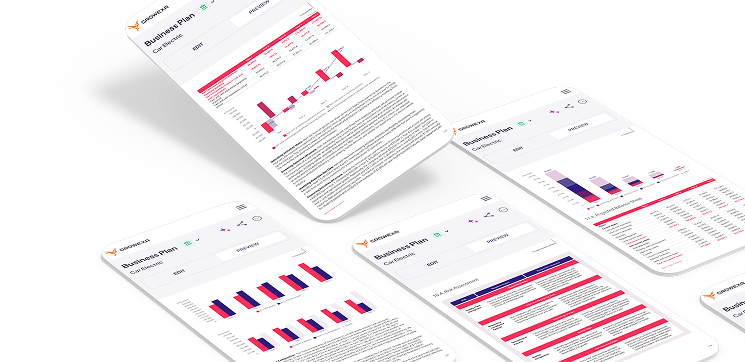

Create a Business Plan in 5 Minutes with AI

A business plan outline gives structure to the questions every serious plan eventually has to answer: What does the company sell? Who will buy it? Why will they choose it? How will the business deliver the product or service? How much capital does it need? And do the economics support the strategy?
The nine sections below provide a practical framework for a traditional business plan template. They are not nine independent writing assignments. A strong plan connects them. Market demand supports the sales forecast; the sales strategy explains customer acquisition; operations establish the resources required to deliver projected sales; and those resources ultimately appear in the financial statements.
There is also no universal business plan format. The U.S. Small Business Administration (SBA) distinguishes between traditional plans, which are detailed and commonly requested by lenders and investors, and lean startup plans, which summarize the core elements of a business more briefly. The SBA also notes that businesses do not have to follow an exact outline and should use the sections appropriate to their needs.
For founders creating a first comprehensive plan, however, the following nine-section structure provides a workable starting point.
A business plan outline template is the framework used to organize the information that will eventually become a completed business plan. It identifies the major sections and establishes what each one needs to explain.
An outline is therefore different from a completed plan. “Market Analysis” may be a heading in the outline; the completed section needs to identify the target customer, quantify demand, assess competitors, and explain why the company can compete. “Financial Projections” is another heading; the completed section needs assumptions, revenue and expense forecasts, cash flow, and a balance sheet.
The distinction matters because filling every heading does not necessarily produce a coherent plan. The sections have to use compatible assumptions. A company cannot describe a premium positioning strategy and then forecast mass-market pricing without explaining the change. It cannot project 10,000 customers while budgeting for an operation capable of serving 3,000.
The outline provides the architecture. The completed plan provides the evidence and economics.
The executive summary gives the reader a compressed view of the entire business plan. It normally identifies the company, product or service, target market, competitive position, business model, management, major financial expectations, and funding requirement where financing is being sought.
The SBA recommends including basic information about the company, leadership, employees, location, products or services, and—when financing is involved—financial information and high-level growth plans.
Although it appears first, the executive summary is often easier to write after the other sections have been completed. By that point, the writer knows the assumptions and numbers that deserve emphasis.
The example works because it gives the reader concrete information rather than promising that Northline will become “a leading destination for coffee lovers.”
The company description establishes what the business is, who it serves, how it is structured, and what it intends to accomplish.
This section should cover the business model, ownership and legal structure, location, development stage, and near- to medium-term objectives. It should also explain the customer problem the company is built to solve and the advantages that make the business credible. The SBA specifically recommends identifying the customers or organizations the company plans to serve and explaining its competitive strengths.
For Northline Coffee, that means going beyond “a coffee shop in Raleigh.” The description might explain that the business will operate a single company-owned location, generate revenue from beverages and prepared food, and target a trade area with a mix of residential and weekday office demand. It would also state the ownership structure and define objectives such as reaching monthly operating break-even and establishing a stable base of repeat customers.
That tells the reader how the company will operate rather than merely what industry it belongs to.
The products or services section explains exactly what customers are paying for and why the offer is commercially viable.
For a retailer or restaurant, this means the core product categories, pricing, product mix, and expected purchasing behavior. A service business should define the scope of each service, delivery model, pricing method, and recurring versus one-time revenue. A software company may need to explain subscriptions, pricing tiers, implementation fees, or other revenue streams.
Differentiation belongs here as well, but it should be specific. “High quality,” “excellent customer service,” and “competitive prices” are weak differentiators because almost any competitor can make the same claims.
For Northline, the plan could establish a beverage-led model supported by higher-ticket food purchases.
The operational consequence is already visible: a limited menu affects equipment, inventory, staffing, waste, and ultimately margins. That connection should carry into later sections.
The market analysis tests whether enough customers exist to support the sales assumptions in the plan.
A useful section identifies the target customer, geographic market, market size, relevant demand trends, competitors, and the company's position relative to those competitors. The SBA recommends examining industry outlook, target-market characteristics, competitive behavior, and the strengths of existing businesses.
For a local business, a national industry statistic provides context but does not establish local demand. Northline needs to understand its trade area: residential density, nearby offices, pedestrian and vehicle traffic, competing cafés, customer spending patterns, and demand by daypart.
The analysis should eventually connect to revenue. If the café projects 220 daily transactions, the market section needs to make that volume plausible.
This is more useful than stating that the U.S. coffee industry is worth billions of dollars. National market size does not determine whether one location can attract enough customers.
The marketing and sales section explains how market opportunity becomes revenue.
It should identify customer acquisition channels, positioning, pricing, sales process, promotional spending, conversion assumptions, and retention strategy. The SBA explicitly connects this section with financial projections: the sales strategy should be detailed enough to support the numbers used later in the forecast.
That connection is often missing from first-time business plan example. A plan may project aggressive revenue growth while allocating almost no resources to customer acquisition. Conversely, a business may budget heavily for advertising without identifying the number or value of customers the spending is expected to generate.
Northline does not need a long list of every available marketing channel. It needs a small number of channels that fit a local café.
The strategy is measurable: management can later compare acquisition spending, transaction volume, repeat visits, and average ticket with the assumptions in the plan.
The operations plan explains whether the business can physically deliver the sales described elsewhere in the document.
For a product business, that may involve production, inventory, suppliers, warehousing, logistics, and quality control. For a service company, the important variables may be staff utilization, scheduling, service capacity, software, and subcontractors. A physical retail or food-service operation needs to address premises, equipment, suppliers, opening hours, staffing, and workflow.
This section is particularly important because operating capacity places a ceiling on revenue. A café cannot project 500 transactions during a morning peak if its layout, equipment, and staffing can process only a fraction of that volume.
Those decisions should later appear financially as equipment investment, inventory purchases, labor costs, utilities, and other operating expenses.
This section identifies who is responsible for executing the plan.
A simple organization chart can show reporting lines, but job titles alone are not enough. The relevant question is whether the team has the capabilities required by the business model. The SBA recommends explaining the legal structure, identifying who will run the company, and showing how key team members' experience contributes to the business.
For a small startup, the management plan should also distinguish between roles covered by founders and capabilities that still need to be hired or outsourced. That makes staffing assumptions more realistic.
This example establishes responsibilities and simultaneously creates assumptions for the staffing and expense forecasts.
A funding request should explain three things clearly: how much money the company needs, what it will finance, and why that amount is sufficient for the proposed plan.
The SBA advises businesses seeking financing to specify the amount required, intended use of funds, financing type, relevant terms, and future financial plans. It also emphasizes that projections should match the funding request.
A request for “$180,000 to grow the business” gives a lender or investor very little to evaluate. Breaking the amount into specific uses demonstrates how the capital requirement was calculated.
For example:
| Use of Funds | Amount |
|---|---|
| Leasehold improvements | $65,000 |
| Coffee and kitchen equipment | $55,000 |
| Furniture, POS, and signage | $20,000 |
| Opening inventory and supplies | $10,000 |
| Working-capital reserve | $30,000 |
| Total funding request | $180,000 |
Northline's plan would then explain that the founders are contributing an additional $120,000 of equity. The combined $300,000 capitalization must be sufficient not only to open the café but also to finance operations until cash generation becomes adequate.
That final point matters. Startup budgets often focus on the cost of opening the doors while underestimating the cash required after opening.
Financial projections convert the preceding eight sections into numbers.
At minimum, a comprehensive forecast typically includes a projected income statement, cash-flow statement, and balance sheet. The SBA recommends prospective financial statements for the next five years and more detailed monthly or quarterly projections for the first year. Established businesses seeking financing should also provide historical financial statements.
The statements should not be built independently. Sales assumptions from the marketing section drive revenue. Product mix influences cost of goods sold. Staffing from the operations and management sections drives payroll. Equipment purchases affect cash flow, fixed assets, and depreciation. Financing affects cash, debt, and interest expense.
For Northline, the first-year forecast might start with 170 daily transactions at a $10.00 average ticket and 365 operating days, producing approximately $620,500 in annual sales before any additional catering revenue. The plan would then apply assumptions for food and beverage costs, payroll, rent, utilities, marketing, insurance, payment-processing fees, and other operating expenses.
The purpose is not to produce a perfectly accurate five-year prediction. It is to demonstrate that the business model has been translated into internally consistent assumptions and that management understands the conditions required for the company to remain solvent.
With all nine sections completed, the business plan should read as one model rather than nine separate documents. Growexa's business planning framework can be used to develop the narrative and financial sections within the same planning process.
The basic business plan structure can remain similar for different funding audiences, but the emphasis should change. A bank primarily needs to understand repayment capacity and credit risk. An equity investor is evaluating the potential return on invested capital and the company's ability to grow in value.
| Area | Bank Business Plan | Investor Business Plan |
|---|---|---|
| Primary question | Can the business repay the financing? | Can the business create sufficient enterprise value? |
| Market analysis | Evidence of stable, sufficient demand | Market scale, growth, and expansion potential |
| Management | Operating experience and ability to execute | Team quality and ability to scale |
| Financial focus | Cash flow, debt service, leverage, downside resilience | Revenue growth, margins, unit economics, scalability |
| Funding section | Loan amount, use of funds, repayment logic | Capital sought, use of proceeds, milestones funded |
| Risk emphasis | Ability to continue servicing debt under weaker performance | Execution risk and potential return relative to risk |
The distinction should not be exaggerated. Banks still care about growth and market demand, while investors still care about cash and financial discipline. The difference is the decision each reader ultimately needs to make.
That is why changing the cover page from “Bank Business Plan” to “Investor Business Plan” is not enough. The same underlying business may need different emphasis, evidence, and financial interpretation for each audience.
Before treating the document as complete, check whether the nine sections actually connect:
A useful final review is to change one important assumption—sales volume, pricing, payroll, or opening date—and identify every section that should change with it. If the answer is “only the financial projections,” the plan is probably not sufficiently integrated.
The value of a business plan outline is not that it makes a long document easier to organize. Its real value is that it forces different parts of the business to confront one another.
A market opportunity that cannot support the sales forecast is a problem. So is a growth strategy unsupported by marketing resources, an operating plan without sufficient capacity, or a funding request that leaves the company short of cash three months after launch. Discovering those inconsistencies while building the plan is considerably cheaper than discovering them after capital has been committed.
For a first-time founder, the nine sections provide a disciplined way to move from an idea to a business model that can be examined financially. The objective is not to fill every heading with text. It is to reach the final page with one coherent explanation of how the company intends to compete, operate, finance itself, and generate cash.
A traditional business plan commonly covers an executive summary, company description, products or services, market analysis, marketing and sales, operations, management, funding requirements, and financial projections. Some frameworks combine or reorder these areas, while others add appendices or implementation schedules. The SBA explicitly allows businesses to adapt the traditional outline to their needs.
There is no universal page requirement. The appropriate length depends on the complexity of the business and the purpose of the document. The SBA describes traditional plans as detailed and potentially dozens of pages long, while lean startup plans are typically much shorter and may fit on a single page. The better test is whether the plan contains enough evidence and financial detail for its intended reader.
Not necessarily. An internal operating plan may not require a formal funding request, while a lender-facing plan may require detailed financial information and supporting documentation. The nine-section outline is a comprehensive starting framework, not a mandatory universal format.
It appears first in the final document, but writing it after the rest of the plan is usually more efficient. Once the market analysis, strategy, funding requirement, and projections are complete, the writer can summarize actual conclusions rather than drafting an executive summary around assumptions that may later change.
A comprehensive plan generally includes projected income statements, cash-flow statements, and balance sheets. The SBA recommends a five-year prospective outlook, with monthly or quarterly detail during the first year, and advises businesses to explain the assumptions behind the forecast.
To outline a business plan, start with the nine core sections: executive summary, company description, products or services, market analysis, marketing and sales strategy, operations, management, funding request, and financial projections. Under each heading, define the specific questions the section must answer before drafting the full text. This keeps market, operational, and financial assumptions consistent as the plan develops.


