
Loan purpose and use of funds: How much money is required, exactly where it will go, and why the expenditure makes business sense.
Repayment capacity: Whether operating cash flow can reasonably support principal and interest payments.
Financial credibility: Whether revenue, margins, expenses, working capital, and growth assumptions are supported and internally consistent.
Management and financial commitment: Whether the owners have relevant execution capability and an appropriate financial stake in the business.
Market and risk evidence: Whether demand supports the forecast and management understands what happens if important assumptions miss.
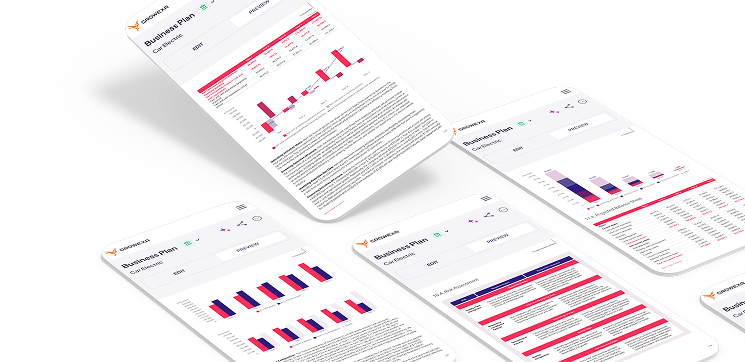

Create a Business Plan in 5 Minutes with AI

A business plan does not become bank-ready because it is polished, detailed, or optimistic. From a lender’s perspective, its value is more practical: the document should make the financing request understandable and the repayment case credible.
That changes the emphasis of a business plan for bank loan financing. A lender is not reading the document as an investor evaluating maximum upside. The lender needs to understand why the business needs capital, what the money will finance, whether the operating assumptions are reasonable, and whether expected cash flow can support the proposed debt.
For most small-business loans, business cash flow is generally expected to be the primary source of repayment. Federal banking guidance also identifies factors such as management strength, borrower equity, collateral, creditworthiness, and secondary repayment sources as relevant to prudent underwriting.
The implication for borrowers is straightforward: understanding what banks look for in a business plan means focusing less on presentation and more on whether the economics are easy to evaluate.
One of the most common mistakes in preparing a bank loan business plan is treating it primarily as a persuasive document.
Persuasion has a role, but banks evaluate a different proposition from equity investors. An investor may accept substantial uncertainty in exchange for significant upside. A lender’s return is largely defined by the loan agreement. The lender therefore has a stronger incentive to understand downside exposure and the reliability of repayment.
That makes the central question relatively simple:
What will generate the cash required to repay this loan?
Every important section of the plan should help answer that question.
The market analysis supports the sales forecast. The operating plan explains whether the company has enough capacity to deliver those sales. Management experience addresses execution risk. The funding request explains how borrowed capital will be deployed. Financial projections bring those assumptions together and show their expected effect on cash flow.
This is why narrative quality matters only when it supports a credible business case. A beautifully written market section cannot compensate for revenue projections that have no measurable drivers. Likewise, a sophisticated financial model becomes less useful when staffing, capital expenditures, or working-capital requirements contradict the written plan.
Business plan requirements for bank loan applications vary by lender, but the underlying review logic is remarkably consistent: the assumptions, operating plan, funding request, and financial projections need to support the same repayment case.
Borrowers preparing a business plan for a bank loan should therefore review the document as a connected financing case rather than a collection of independently written sections.
A lender should not have to infer why the business needs money.
Requests such as “$300,000 for expansion” or “$150,000 for working capital” identify an amount but provide little information about the underlying financing requirement.
A stronger use-of-funds explanation connects capital to specific expenditures. A manufacturer might need $180,000 for production equipment, $45,000 for installation and facility modifications, and $75,000 in additional working capital while production increases. A service company may need capital to fund payroll and customer acquisition before new contracts begin generating sufficient cash.
Specificity matters because the use of funds should connect to the operating model.
If equipment increases capacity, the sales forecast should show how that additional capacity is monetized. If financing supports new employees, the payroll forecast should include them. If the request is primarily for working capital, the cash flow forecast should demonstrate the timing mismatch between operating expenditures and customer receipts.
The consistency test is simple:
Financing need → use of funds → operational effect → financial impact.
When one part of that chain is missing, the lender has to make assumptions on the borrower’s behalf.
Repayment capacity is the core economic issue in lender review.
Profitability matters, but profit and cash are not interchangeable. A company can report positive net income while experiencing significant liquidity pressure because cash is tied up in receivables, inventory, equipment purchases, or other working-capital needs.
Growth can make that problem more pronounced.
Consider a distributor that expects revenue to increase 30%. If inventory must be purchased before customers order and buyers receive 30- or 60-day payment terms, additional sales may consume cash before they generate it. The income statement can show higher profit while the cash flow forecast shows increasing financing pressure.
That is why a lender needs to understand the actual source of debt service.
A credible plan shows how cash generated by normal operations relates to principal and interest obligations. It should incorporate realistic collection periods, inventory requirements, payroll timing, capital expenditures, taxes, and other material cash demands.
Borrowers should also avoid presenting collateral as a substitute for repayment capacity. Collateral can provide additional protection to a lender, and its importance varies by transaction. But a viable operating business should not depend on liquidation of assets as its basic repayment strategy.
The stronger question is not, “Will the company be profitable?”
It is, “Will the company generate sufficient cash, at the right times, to operate the business and support the proposed debt?”
Revenue projections often receive disproportionate attention because small changes at the top of the income statement can materially change profitability, cash flow, and apparent debt-service capacity.
The percentage growth rate itself is not enough.
Suppose an established service company generated $2 million last year and projects $2.8 million next year. Saying that management expects 40% growth because the market is expanding does little to support the forecast.
The plan should identify the operating drivers behind the additional $800,000.
Perhaps the company is adding four revenue-producing employees. Maybe an existing contract is expanding. A new location may increase capacity. Prices could rise. Customer retention might improve. The sales pipeline may already contain qualified opportunities.
Each explanation can be tested against other parts of the plan.
Four additional employees should affect payroll. A new location creates rent, utilities, equipment, and startup costs. A major contract should be consistent with available capacity. Higher prices should reflect competitive conditions and customer behavior.
Historical performance also matters for established companies. If revenue has grown 5% annually for three years and suddenly increases 40% in the forecast, the plan needs to identify what has structurally changed.
The objective is not to make projections conservative for the sake of appearing cautious. It is to make them traceable.
A lender should be able to move backward from projected revenue to the business assumptions that produced it.
Financial projections translate the written business case into numbers. Their usefulness depends less on spreadsheet complexity than on whether the statements work together.
| Financial Statement | What It Tells a Lender |
|---|---|
| Profit & Loss Statement | Whether projected revenue and operating costs produce sustainable earnings and margins |
| Cash Flow Forecast | Whether cash is available when operating expenses, investments, and debt payments come due |
| Projected Balance Sheet | How financing affects cash, receivables, inventory, assets, liabilities, and owner equity |
| Capital Expenditure Forecast | When major investments occur and how much capital they require |
| Debt Schedule | How principal, interest, and outstanding debt obligations change over time |
The relationships between these statements are particularly important.
If the company purchases $200,000 of equipment, that transaction should affect cash flow and the balance sheet. If the equipment is debt-financed, liabilities should change as well. If projected sales increase substantially, receivables or inventory may need to increase depending on the business model.
The same principle applies to payroll, capital expenditure, financing, depreciation, and owner contributions.
A forecast becomes difficult to rely on when the statements describe different versions of the company.
For an established business, historical results also provide an important reference point. Forecast margins, working-capital requirements, overhead, and growth should reconcile with recent performance or explain why future economics will be materially different.
Complete business financial projections are therefore not simply a lender requirement to satisfy. They are the numerical test of whether the business plan actually works as written.
Owner investment can matter because lenders evaluate how a proposed transaction is capitalized and how financial risk is distributed among the parties involved.
There is no universal equity percentage that applies to every bank loan. Required contributions can differ materially by lender, product, transaction, business stage, and financing program. Borrowers should be cautious with generic online claims that banks always require a particular percentage.
The relevant concept is financial commitment.
A business funded entirely with debt may present a different risk profile from one in which owners have already committed meaningful capital. Equity can also provide additional capacity to absorb cost overruns, slower-than-expected revenue, or other operating volatility.
For a startup, this may mean documenting cash already invested in equipment, leasehold improvements, inventory, professional fees, or other startup costs. For an established company, retained earnings and accumulated equity may provide additional context.
The business plan should present the capital structure accurately rather than attempting to make the requested financing appear artificially small.
A lender needs to understand the full economic requirement: what the project costs, how much the owners are contributing, how much debt is requested, and whether other sources of capital are involved.
Financial projections contain assumptions about management even when management is not explicitly mentioned.
A company forecasting rapid expansion is implicitly claiming that its team can sell more, hire effectively, manage additional working capital, preserve service quality, control costs, and operate at a larger scale.
That makes management experience economically relevant.
A useful management section should focus on experience connected to the forecast. A contractor pursuing larger commercial projects should demonstrate estimating, project-management, labor, and cost-control capability. A restaurant group opening another location should show who has experience managing multi-unit operations. A manufacturer expanding production should identify who understands procurement, quality control, maintenance, and production economics.
Length is not the objective.
A two-page biography that does not address the capabilities required by the forecast may contribute less than three paragraphs that establish exactly who is responsible for sales, operations, finance, and execution.
Gaps should not necessarily be hidden. If the company needs a CFO, operations manager, salesperson, or technical specialist to execute the growth plan, identifying the hiring need can make the plan more credible—provided the associated timing and payroll costs also appear in the forecast.
Market analysis matters to a bank because revenue assumptions require demand.
That is a narrower purpose than demonstrating that the company operates in a large or attractive industry.
A national market may be worth billions of dollars without providing meaningful evidence that one local company can achieve its projected sales. A smaller market with documented contracts, repeat customers, identifiable demand, and a defensible competitive position can support a stronger forecast.
The market section should therefore move from broad context to specific evidence.
Who buys the product? Where are those customers located? How do they currently solve the problem? What alternatives do they have? What does the company charge? Why should customers switch or remain? How does the sales process convert market demand into revenue?
Competitive analysis should perform the same function.
Claiming that the company has “no direct competitors” often creates more questions than confidence. Most businesses compete for customer budgets even when their exact product is unusual. A credible analysis identifies alternatives and explains where the company can compete on price, specialization, location, speed, service, distribution, expertise, or another relevant dimension.
The market section earns its place in a loan ready business plan when it provides evidence for the revenue model—not when it simply demonstrates that the industry exists.
A forecast is a management estimate, not a promise.
Banks understand that actual performance will differ from projections. What matters is whether the borrower understands which variables create the greatest financial exposure and has considered what happens when those variables move.
A useful risk analysis starts with the assumptions that materially affect cash flow.
What happens if revenue is 15% below forecast? What if a new location opens three months late? What if gross margin falls by four percentage points? What if customers take longer to pay? What if payroll increases faster than expected?
The purpose is not to produce an artificially pessimistic plan. It is to identify the point at which operating flexibility begins to disappear.
Contingency planning should then focus on decisions management can actually make.
A company may delay hiring, reduce discretionary capital expenditures, change inventory purchasing, postpone expansion, adjust marketing spending, or preserve additional working capital. Other costs may be substantially harder to change.
This distinction gives the lender—and management—a more realistic view of downside capacity.
A plan that acknowledges uncertainty can be more credible than one in which revenue always arrives on schedule, margins never deteriorate, and every expansion milestone occurs exactly as forecast.
Before submission, review the plan for inconsistencies that can weaken the financing case:
These issues do not automatically result in a declined application. They create unanswered questions. In lender review, unanswered questions usually mean additional documentation, clarification, or scrutiny.
Lender business plan requirements differ by institution and transaction, so the lender’s own documentation request should always take precedence. Beyond those specific requirements, a final review should test whether the complete plan supports one consistent financing case.
Borrowers who want to compare these elements against a structured financing format can use Growexa’s bank-ready business plan framework as a reference before finalizing the application.
A strong bank loan business plan ultimately connects four elements:
the financing need, the deployment of capital, the resulting operating performance, and the cash available to support debt.
That is the standard worth applying before submission. A longer document is not necessarily a stronger one, and a more optimistic forecast is not necessarily more persuasive. What matters is whether an independent lender can trace the logic, test the assumptions, and understand where repayment is expected to come from.
Before submitting the plan, review it from that perspective. If the funding request, operating assumptions, and financial model cannot be reconciled quickly, revise them before the lender has to ask.
Build and review your bank-ready business plan around the financing case—not simply the document format—before approaching a lender.
Banks generally want to understand the financing purpose, repayment capacity, financial assumptions, management capability, owner commitment, market demand, and material risks. The exact emphasis varies by lender and transaction.
The underlying question is whether the business case supports the requested debt.
No universal rule applies to every bank and every business loan. Documentation requirements vary by lender, loan product, amount, business stage, and underwriting process.
A startup seeking financing may need to rely heavily on projections and a detailed operating plan because little historical financial information exists. An established company may be evaluated more heavily on historical performance, although forward-looking information can still be required.
Always confirm the current document requirements directly with the lender.
A bank-focused business plan typically explains the company, management, market, operating model, financing request, use of funds, financial history where available, and forward-looking projections.
The sections should not operate independently. Market demand should support revenue; revenue should correspond to capacity; capacity should correspond to staffing and investment; and the resulting cash flow should support the financing structure.
Cash flow is central because debt payments require cash rather than accounting profit.
A company may be profitable but still experience liquidity problems if substantial cash is tied up in receivables, inventory, equipment, or rapid expansion. A lender therefore needs to understand both profitability and the timing of cash generation.
Generally, no. Collateral may provide additional lender protection and can be important in underwriting, but it does not make operating performance irrelevant.
The business plan should establish how the company expects to service debt through normal operations rather than relying on asset liquidation as the primary strategy.
There is no universal projection period for all bank loans. Requirements vary by lender and transaction.
For SBA-related traditional business planning, SBA guidance recommends prospective financial statements covering five years, with monthly or quarterly detail during the first year. That should not be treated as a universal requirement for every conventional bank loan.
No. A strong business plan can make the financing purpose, assumptions, operating economics, and repayment logic easier for a lender to evaluate. It cannot guarantee approval.
Credit decisions depend on the lender’s underwriting standards and the complete borrower and transaction profile.


