


Create a Business Plan in 5 Minutes with AI

Most business plans fail in the same predictable way: they are written to impress, not to govern. Founders treat the plan as a fundraising artifact or a bureaucratic requirement, while operators treat it as a one-time exercise that disappears the moment execution begins. That approach produces a document that may look complete yet remains strategically useless—because it never becomes the company’s decision system.
If you want to understand how to write a business plan at a level that would survive institutional scrutiny, start by adopting a more demanding definition. A plan is not a story about the future. It is a control mechanism for how leadership will allocate capital, manage volatility, and convert assumptions into measurable performance. In other words, the plan’s job is not to predict outcomes. It is to prevent avoidable mistakes.
Research supports this discipline. A Harvard Business Review study found that entrepreneurs who write formal plans are more likely to achieve venture viability than those who do not—because planning forces structure, milestone thinking, and earlier exposure of flawed assumptions. A broader evidence base—including meta-analysis—also finds a positive relationship between planning and performance, with context and execution quality determining how large the benefit becomes. More recent academic review work summarizes similar patterns, linking business plans to stronger employment growth and more deliberate scaling choices.
That’s the real agenda here. This is not a “template walkthrough.” This is how to write a business plan as an executive instrument: precise enough for lenders, credible enough for investors, and operational enough for leadership teams to run against it.
A business plan is a structured argument that your business is economically coherent—and that management can execute under uncertainty. It clarifies the company’s goals, its operating model, the market reality it must navigate, and the financial mechanics that translate strategy into cash flow.
Critically, the plan is not a substitute for traction, and it is not a marketing brochure. High-quality planning does something less glamorous and more valuable: it forces explicit trade-offs. It answers uncomfortable questions early—before the market answers them for you.
When executives talk about how to write a business plan, they mean a document that connects five moving parts into one system:
You can call that a “plan,” but in practice it behaves like a governance tool. Counter-intuitive reality (the myth to kill): the best business plan is not the one that makes growth look inevitable. It is the one that makes failure look difficult—because it identifies fragile assumptions and replaces them with controllable decisions.
A full-service restaurant group drafted a plan centered on concept differentiation—menu narrative, chef profile, “experience.” Investors were unconvinced, not because the brand was weak, but because the plan was economically thin: labor productivity was not modeled, table turns were treated as static, and seasonality was ignored. The revised plan cut two pages of concept language and added a capacity model: covers per hour by daypart, labor scheduling by demand curve, and sensitivity on food inflation. The business didn’t become “more inspiring.” It became investable.
Most guides reduce the process to headings. That’s not wrong, but it is incomplete. The real work is not filling sections—it is converting ambiguity into explicit assumptions and then forcing those assumptions to reconcile with math, operations, and market behavior.
So when someone asks how to write a business plan, the practical answer is: build an integrated model of decisions, not a pile of paragraphs.
The steps below follow your structure, but with deeper analysis, stronger cause-and-effect logic, and one decision-driven case per step drawn from the business types you showed (car wash, trucking, laundry, daycare, food truck, beauty salon, coffee shop, restaurant, etc.). If you use this as a pillar page, you can link each case to your niche plan examples naturally.
How to write a business plan step by step

Weak plans describe ambition. Strong plans define commitments. The difference matters because stakeholders do not finance ambition—they finance controllable pathways to returns.
Goal-setting should do three things at once: establish the target outcome, define the time horizon, and impose measurement discipline. The SMART framework is useful, but only if the metrics are economic, not cosmetic. “Grow followers” is not a business goal. “Increase subscription penetration to 35% of revenue within 12 months while holding churn under 4%” is.
The strategic reason this comes first is simple: every subsequent section must justify the goal. Market analysis must show the goal is plausible. Operations must show the goal is executable. Financials must show the goal is fundable.
If you want business plan writing tips that actually improve outcomes, start here: convert goals into constraints. What must be true for the goal to happen? What can management control? What is exposed to volatility?
A suburban car wash owner set a goal of “opening a second location within a year.” The plan looked confident, but lenders pushed back because cash flows were not stable enough to service new debt. The revised goal shifted from expansion to capital discipline: “raise monthly membership revenue to $42K, maintain chemical and utility cost per wash under a threshold, and achieve a DSCR buffer before committing to a second site.” The operator delayed expansion by six months, improved membership economics, and then qualified for better financing terms. The business did not “slow down.” It removed fragility.
(And yes: lenders often look hard at cash-flow coverage such as DSCR, although thresholds and underwriting standards vary by lender and product. )
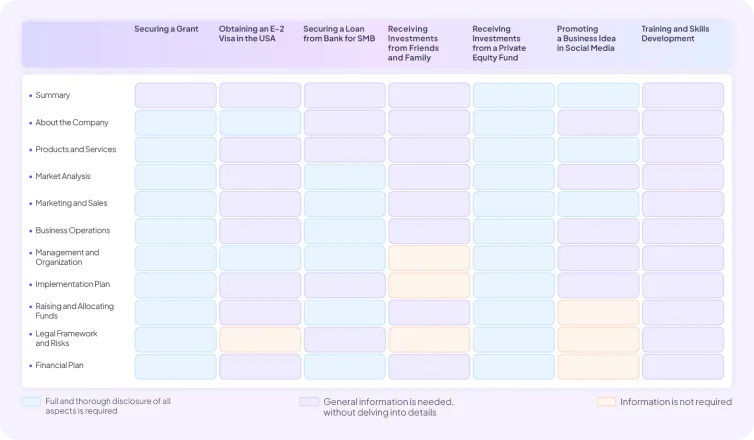
The most common planning error is writing one plan for “everyone.” Investors, lenders, and internal leadership read with different incentives.
| Lenders prioritize downside protection | Cash flow stability, collateral, repayment capacity, conservative assumptions |
| Equity investors prioritize upside and scalability | Growth levers, market power, unit economics expansion, credible execution speed |
| Internal teams need operational clarity | What changes Monday morning, what KPIs define success, what decisions are gated. |
So if you’re serious about how to write a business plan, you design the narrative architecture around the reader’s decision. That does not mean three different plans. It means one integrated plan with emphasis and ordering that match the audience. The inverted pyramid matters here. Lead with what drives the decision: unit economics, market reality, and execution risk. “About us” belongs later—if at all.
A regional trucking startup wrote a plan like a pitch deck: big market, “fragmented industry,” ambitious fleet growth. Banks rejected it because cash flows were speculative. The company rewrote the plan for a lending audience: lane strategy, contract structure, fuel risk management, driver retention economics, and break-even per mile. The revised plan also included a downside scenario: diesel spike + driver turnover. Financing still wasn’t easy, but the conversation changed from “we don’t believe this” to “let’s price the risk.”
This is also where you can naturally integrate the phrase write a business plan without sounding like SEO—because the concept is literally about who you are writing for.
Investors and lenders do not reward creativity in facts. They reward quality of evidence. Gathering information is not “research” in the casual sense. It is a credibility engineering process. The goal is to reduce the gap between what you claim and what a skeptical reader can verify.
Internal sources typically include: unit-level performance, pricing history, conversion funnels, churn and retention, staffing productivity, procurement costs, utilization, customer feedback, and operational constraints.
External sources provide context: category growth, local demand, competitor density, pricing bands, regulation, and macro volatility. Industry research outlets and credible databases help, but the most convincing data is often local and specific: lease comps, wage data in your county, competitor foot traffic patterns, and realistic customer acquisition costs.
Academic and professional evidence also reinforces the value of planning itself. Planning is associated with better outcomes partly because it forces earlier confrontation with reality rather than late-stage improvisation.
A daycare operator projected rapid enrollment growth based on population trends. The plan failed because it used “market size” as a proxy for demand. The revised plan pulled sharper data: number of competing daycare seats within a 15-minute radius, waitlist dynamics, staffing ratios mandated by regulation, and parent willingness to pay for extended hours. That evidence changed the business model from “premium pricing” to “capacity utilization + add-on services.” Enrollment became slower but more predictable; staff scheduling became the lever for margin stability.
This is where most plans become fiction—not due to dishonesty, but due to structural naïveté.
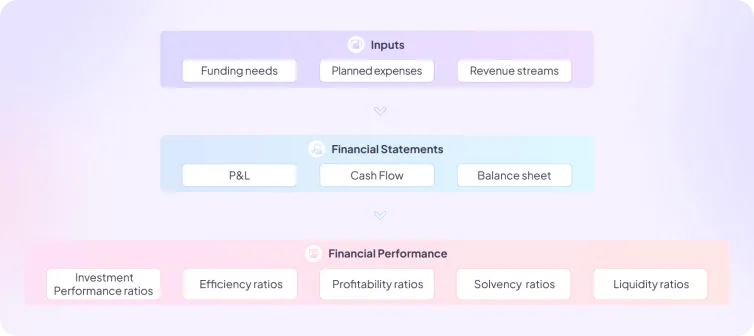
A professional plan treats financials as a translation layer between operations and outcomes. The question is not “how much revenue can we imagine?” It is “what must the business physically do to produce that revenue, at what cost, with what capital, and with what risk?”
Start with operating drivers, then build statements:
If you’re dealing with debt, cash coverage matters more than accounting profit. This is why DSCR-style thinking shows up in lending, even when definitions vary.
If you’re dealing with equity, unit economics and contribution margin trajectory matter more than top-line. Investors want to know whether scale improves economics—or merely enlarges losses.
A self-service laundry projected profitability based on “average daily customers.” The plan collapsed when investors asked a simple question: what happens when machines break, utility rates rise, and the owner must staff the store to reduce theft and improve cleanliness? The revised model added downtime rates, maintenance capex, and utility sensitivity. Net margin shrank on paper, but the plan became credible—and the operator raised capital at better terms because the downside case was already priced in.
This is the core of how to write a business plan that can withstand scrutiny: your financial story must be the inevitable consequence of your operational reality.
This step is not “make it pretty.” It is “make it readable under pressure.” Executives and financiers read quickly. They scan for signals: coherence, discipline, realism, and command of trade-offs. So the writing must behave like a high-end business publication: dense with insight, not adjectives; clear in structure; restrained in formatting.
A strong plan reads like this: each section states a claim, supports it with evidence, and ties it to the economic model. Design supports comprehension—tables for unit economics, charts for demand seasonality, and compact visuals for scenario sensitivity. Avoid decorative charts that do not influence a decision.
If you want how to write a business plan to mean something in the real world, the document must make decisions easier. That is the test.
A beauty salon expansion plan looked visually polished—photos, branding, lifestyle language. It still failed investor review because the story did not tie to economics: stylist utilization, chair turnover, retention, and service mix. The rewrite cut visuals by half, added a utilization dashboard (hours booked per stylist per week), and modeled revenue by service category. The result looked less like a brochure and more like an operator’s manual. Funding followed.
This is also where business plan writing tips matter in a non-obvious way: sophisticated readers associate over-designed documents with weak substance unless the numbers do the heavy lifting.
A plan review is not proofreading. It is adversarial stress-testing.
Treat your own assumptions as hostile. Where are you overconfident? Which variables can move against you? What breaks first: demand, pricing, labor, supply chain, financing costs?
Professional review includes three layers:
Keep checklists short and outcome-driven. Don’t drown in formatting.
A food truck operator planned a second truck based on strong summer sales. Review revealed the hidden risk: seasonality and event dependency. The revised plan built a winter strategy—corporate lunch contracts, limited menu, and a catering pipeline. The downside case was no longer “winter kills revenue.” It became “winter shifts the revenue mix.” The operator avoided a cash crunch and expanded later from a position of strength.

The plan is not primarily a fundraising tool. It is a risk document.
This is where most “startup plans” fail editorially and economically. They describe markets as if competitors are passive and customers are frictionless. Harvard Business Review has repeatedly challenged the glossy-fiction approach to planning—highlighting that fantasy markets do not pay invoices.
The disciplined view is sharper: your plan should identify what you do not control and show how you reduce exposure. That is why planning correlates with better outcomes: it surfaces failure modes early, when they are cheaper to fix.
If you internalize that, how to write a business plan stops being a writing exercise and becomes a management practice.
The difference between a plan that sounds good and a plan that performs is whether it governs decisions after the PDF is finished. The best answer to how to write a business plan is not “follow a template.” It is: build an integrated decision system that links goals, audience expectations, evidence, operating mechanics, and financial reality—then stress-test it until optimism becomes discipline.
For founders, that discipline protects against expansion that destroys unit economics. For operators, it protects against complacency that allows volatility to erode margins. For leadership teams, it creates alignment around measurable outcomes rather than narratives.
If you need to write a business plan that holds up in boardroom conversations, treat it like an instrument of capital control. If you are writing a business plan to raise funds, show how you manage downside, not just how you dream about upside. And if you are writing business plans as a repeatable operating practice, your competitive edge will compound—not because the plan is perfect, but because the organization becomes structurally harder to surprise.
If your current plan reads like a pitch, rebuild it as a governance system. Recast every claim as an assumption, every assumption as a driver, and every driver as a financial consequence. Then decide what you will stop doing—because serious planning is as much about refusing low-return growth as it is about pursuing scale. Tools can accelerate formatting and collaboration, but rigor remains the differentiator. If you want a workflow that supports disciplined planning end-to-end, consider streamlining the process with Growexa while keeping the strategic logic under executive control.


