
Validate demand before investing heavily. Test the niche, competition, pricing, margins, customer problem, and repeat-purchase potential before committing significant capital.
Choose the business model around economics and resources. Inventory vs dropshipping, private label, print-on-demand, marketplace selling, and digital products create different capital requirements and operating risks.
Budget for the business, not just the website. Inventory, fulfillment, payment processing, marketing, returns, and working capital can outweigh ecommerce platform costs.
Understand what an order is worth. Average order value, gross margin, customer acquisition cost, conversion rate, and contribution margin determine whether sales translate into profit.
Model the business before scaling it. An ecommerce business plan should connect customer demand, acquisition costs, inventory, operating expenses, and cash requirements.
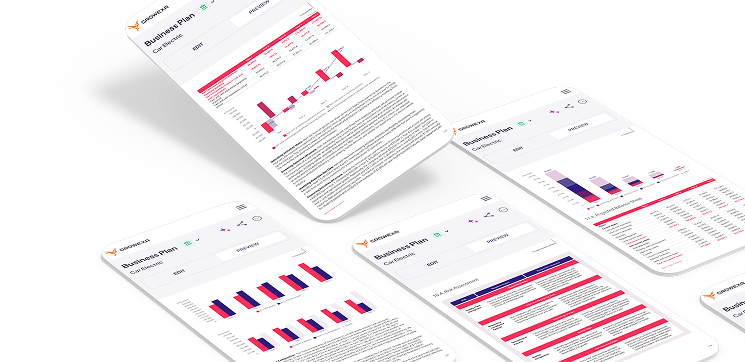

Create a Business Plan in 5 Minutes with AI

Opening an online store is no longer the difficult part. The difficult part is building one that can acquire customers, fulfill orders, and still make money after the full cost of each sale is counted.
That distinction matters heading into 2027. U.S. retail e-commerce sales were estimated at $340.2 billion in the second quarter of 2026, up 12.2% from the same quarter a year earlier. On a seasonally adjusted basis, e-commerce represented 17.1% of total U.S. retail sales. A growing market creates opportunity, but it does not fix weak ecommerce profit margins, expensive customer acquisition, excess inventory, or poor cash-flow planning.
For founders researching how to start an ecommerce business in 2027, the first decision should therefore come before choosing a platform or designing a storefront: determine whether the proposed business model can work economically.
An e-commerce business sells goods or services through digital channels, but businesses that fit that definition can operate in fundamentally different ways.
A traditional online retailer purchases or manufactures inventory and then sells it to customers. That model gives the company greater control over stock, packaging, and fulfillment, but it also puts capital at risk before the products are sold.
Private-label businesses take that logic further by selling products under their own brand. The potential advantages include stronger differentiation and greater control over pricing, while the trade-offs can include supplier commitments, minimum order quantities, and longer lead times.
Dropshipping shifts inventory and fulfillment to a third party. Print-on-demand uses a similar structure for customized merchandise. Both can reduce upfront inventory requirements, but founders generally surrender some control over delivery and unit economics. Marketplace sellers gain access to established shopping environments but become more dependent on platform rules and fees. Digital products remove physical inventory and shipping from the equation, although they still require product development and customer acquisition.
Choosing an ecommerce business model is therefore not just a question of how orders will be fulfilled. It determines where capital is tied up, how much control the founder retains, which costs increase with sales, and what the company needs to manage as it grows.
A store should be the result of business decisions, not the starting point for them. A practical ecommerce startup guide begins by testing the product and economics, then builds the systems required to sell it.
Product selection should begin with a customer problem and an economic case.
Research demand, competitors, prevailing prices, differentiation, shipping characteristics, likely returns, and repeat-purchase behavior. A product that attracts attention but cannot support the cost of reaching customers is unlikely to become a durable business.
Consider a product priced at $60 with a landed cost of $18. On the surface, the 70% gross margin looks strong. Now include $8 for fulfillment, approximately $2 for payment costs, $4 for expected returns and discounts, and $22 to acquire the customer. The economics look very different.
This is why niche validation should go beyond asking whether people will buy. The more important question is whether enough customers can be acquired repeatedly at a cost that leaves a viable contribution margin.
The best model depends on available capital, operational capability, product characteristics, and how much control the founder needs.
| Model | Upfront Capital | Operational Control | Inventory Risk | Typical Strategic Trade-Off |
|---|---|---|---|---|
| Own inventory | Medium to high | High | High | Better control, more cash tied up |
| Dropshipping | Low | Low | Low | Easier entry, less control over fulfillment and margins |
| Private label | Medium to high | High | Medium to high | Differentiation potential, supplier and MOQ exposure |
| Print-on-demand | Low | Medium | Low | Minimal inventory, higher unit production costs |
| Marketplace selling | Low to medium | Medium | Varies | Built-in traffic, platform dependence and fees |
| Digital products | Low | High | None | High scalability, but demand creation remains critical |
None is inherently superior. An entrepreneur starting with $3,000 has different constraints from an established retailer bringing an existing catalog online.
Holding inventory increases exposure but can improve control. An asset-light model reduces the initial capital requirement, but it does not automatically produce attractive margins.
Good market research should answer questions that affect an investment decision.
Look at who already serves the target customer, how competitors price and position their products, what buyers praise or complain about, delivery expectations, return policies, and the channels competitors appear to use for acquisition.
Customer evidence matters just as much. Marketplace reviews, search behavior, interviews, existing sales information, online communities, and small advertising tests can all help establish whether demand exists before the founder makes a larger commitment.
The SBA recommends using market research to identify customers and competitive analysis to establish a competitive advantage. In e-commerce, that advantage must eventually become specific enough for a customer to recognize: better product, price, selection, convenience, expertise, service, brand, or another meaningful difference.
Before deciding how much money to put into the launch, identify what the business actually needs.
The budget should account for product development or initial inventory, platform and technology ecommerce startup costs, packaging, fulfillment, payment processing, professional expenses, marketing, and working capital. Separate expenses incurred before launch from recurring monthly costs.
SBA guidance similarly recommends identifying startup expenses and distinguishing one-time expenses from monthly ones. Its examples for businesses include inventory, advertising and marketing, professional costs, ecommerce niche research, and website expenses.
Revenue should then be built from measurable drivers:
Revenue = Website Traffic × Conversion Rate × Average Order Value
Those sales assumptions should feed into product cost, fulfillment, payment fees, customer acquisition, payroll, overhead, and cash flow.
This is where an ecommerce business plan becomes useful: the operating assumptions and ecommerce financial projections can be evaluated as one model rather than two separate exercises.
Platform selection should start with requirements rather than brand preference.
Compare the total cost of running the store, payment options, inventory and product management, checkout functionality, mobile experience, integrations, analytics, SEO capabilities, security, scalability, and technical support.
A low subscription price does not necessarily produce the lowest total cost. A store that requires several paid applications or substantial custom development to handle basic workflows may become more expensive as sales increase.
The storefront itself has a simpler job: remove unnecessary friction from the purchase decision. Customers should be able to understand the product, price, shipping expectations, and return terms and complete checkout without confusion.
Extensive optimization can wait until the business has evidence that it can attract and convert buyers.
Checkout is only one part of the transaction.
Before accepting orders, map the complete process: payment authorization, inventory updates, picking and packing, carrier handoff, tracking, customer support, returns, refunds, and financial reconciliation.
These systems also affect margins. For example, Stripe's current U.S. standard pricing lists 2.9% plus 30 cents for a successful domestic card transaction. Actual costs depend on the processor, payment method, geography, and merchant arrangement.
Shipping creates another economic decision. Offering customers “free shipping” simply means the merchant absorbs or incorporates that expense elsewhere. Return policies work similarly: more generous terms may improve conversion but can reduce margins when return rates are high.
Operations therefore need to support two objectives at once—customer experience and viable unit economics.
Putting a store online makes products available. It does not create customers.
An ecommerce marketing strategy should specify where buyers will come from, how much the company expects to spend to acquire them, and how the economics change when customers make subsequent purchases.
SEO can capture existing search demand but typically requires time. Paid search and social advertising can deliver traffic faster, while also revealing quickly whether acquisition costs are sustainable. Email and SMS become more useful as the customer base grows. Influencers and affiliates can work where audience and product fit are strong. Marketplaces provide access to existing demand but give the merchant less control over the customer relationship.
What matters is not traffic in isolation but its economics.
If one channel acquires customers for $15 and another requires $60 to produce an equivalent order, the two channels support very different growth models. Repeat purchases can change that equation because subsequent orders may not carry the full original acquisition cost.
There is no meaningful single answer to how much does it cost to start an ecommerce business. The capital requirement follows the model.
A digital-product seller can begin with relatively little capital. A private-label retailer that needs inventory, custom packaging, and several months of marketing may require tens of thousands of dollars before cash flow becomes stable.
The figures below are planning ranges, not market averages or guaranteed 2027 prices. Vendor costs should be checked again before publication and before committing capital.
| Cost Category | Lean / Low-Inventory Model | Inventory-Heavy Model |
|---|---|---|
| Domain | $10–$30/year | $10–$30/year |
| E-commerce platform | $0–$100/month | $30–$300+/month |
| Theme/design/setup | $0–$1,000 | $1,000–$10,000+ |
| Initial inventory | $0–$1,500 | $5,000–$50,000+ |
| Apps/software | $0–$150/month | $100–$500+/month |
| Packaging/samples | $100–$500 | $500–$3,000+ |
| Initial marketing tests | $500–$2,500 | $2,500–$15,000+ |
| Legal/admin/insurance | $200–$2,000+ | $500–$5,000+ |
| Working capital | $1,000–$5,000+ | $5,000–$30,000+ |
Illustrative planning ranges, not universal 2027 market prices. Costs vary by product, platform, geography, inventory strategy, service providers, and acquisition model.
Payment processing and fulfillment usually behave differently from one-time startup expenses because they are partly driven by transaction volume. They should be modeled separately.
For inventory-heavy businesses, the largest issue is often timing rather than technology. Inventory may be paid for months or weeks before the related customer cash arrives. Marketing can create a similar gap.
As a result, ordering $5,000 of merchandise does not imply that $5,000 is enough to launch. The company also needs enough working capital to keep operating until inventory turns back into cash.
Sales are only the first layer of the model. The economics of each order determine whether those sales are worth generating.
Begin with:
Revenue = Traffic × Conversion Rate × Average Order Value
Assume the store receives 10,000 monthly visits, converts 2.5%, and generates an $80 average order value.
10,000 × 2.5% × $80 = $20,000 monthly revenue
Now examine the order itself. Assume $28 of product cost, $9 of fulfillment and shipping subsidy, $2.60 of payment costs, and $3.40 of expected discounts and returns.
The contribution before customer acquisition is:
$80 − $28 − $9 − $2.60 − $3.40 = $37
At a $25 customer acquisition cost (CAC), approximately $12 remains to cover fixed operating expenses and profit.
For management purposes, that $12 can matter more than the headline $80 sale.
If monthly fixed costs are $3,000:
$3,000 ÷ $12 = 250 orders per month
Under these assumptions, 250 orders at an $80 AOV equal $20,000 in monthly revenue.
The SBA defines break-even as the point where total costs and total revenue are equal and provides the basic formula of fixed costs divided by price minus variable cost for calculating break-even units.
Repeat purchases can improve the model because an existing customer may place another order without incurring the full original CAC. But repeat purchase rate should be supported by evidence rather than inserted into the model to produce an attractive lifetime value.
Many costly mistakes happen before meaningful scale is reached.
A founder does not necessarily need a lengthy document to test how to start an online business. The founder does need a coherent model.
A useful online store business plan connects decisions that are easy to make separately: target customer, product, positioning, pricing, marketing channels, inventory, fulfillment, staffing, startup capital, and financial projections.
The SBA describes a business plan as a roadmap for structuring, operating, and growing a company, while also noting its role in raising funding or bringing in business partners.
For an e-commerce startup, one of the biggest benefits is finding contradictions before money has been committed.
Premium positioning may conflict with a strategy built around constant discounts. Forecast growth may require inventory purchases the business cannot finance. Strong gross margins can turn weak after fulfillment and acquisition costs. Dropshipping may lower inventory exposure but create delivery times that undermine the customer proposition.
A structured e-commerce business plan gives founders a place to test those relationships before they become operating problems.
Its value is not that every forecast will prove correct. Its value is that management knows which assumptions the business depends on.
In either case, the core questions remain the same: Who is the customer? Why will that customer buy? How will the company acquire customers? What does each order contribute? How much capital is required? What happens to cash as sales increase?
Before making a major commitment to inventory or customer acquisition, those assumptions should be connected in an ecommerce business plan and tested together.
The central challenge in starting an e-commerce business in 2027 is not getting a store online. It is establishing a commercial system in which demand, product economics, acquisition, operations, and cash can support one another.
A storefront provides the infrastructure for transactions. The business exists in the economics behind those transactions. Validate them first, model their interaction, and increase investment only when the numbers support doing so.
It depends largely on the operating model. Digital products, print-on-demand, and dropshipping can reduce initial inventory requirements, while private-label and inventory-based businesses can require substantially more capital.
Estimate product development or inventory, technology, marketing, fulfillment setup, professional expenses, and working capital instead of relying on a generic startup figure.
Yes. Dropshipping, print-on-demand, digital products, and certain marketplace models allow a founder to operate without holding conventional inventory.
That does not eliminate startup costs or risk. Customer acquisition, technology, payments, operations, and viable supplier economics still have to be funded and managed.
Individual e-commerce businesses can be profitable, but industry growth does not determine whether a particular store will make money.
The latest available Census Bureau figures before 2027 show that U.S. retail e-commerce sales increased 12.2% year over year in Q2 2026. That demonstrates continued market activity, not guaranteed profitability for new entrants.
A viable store still needs sufficient contribution margin after product costs, fulfillment, customer acquisition, and other expenses.
The technical storefront can be created quickly. Preparing the business can take considerably longer.
Product sourcing and samples, validation, branding, payment configuration, inventory, fulfillment, policies, content, and acquisition testing all affect launch timing. A business is ready when its essential commercial and operating systems work—not merely when the website is online.
The required level of planning depends on the business. A bootstrapped side project may need a relatively lean internal model, while a company approaching lenders or investors will generally need substantially more detail.


