
AI can be used as a business-planning tool, but SBA does not publish a blanket policy declaring AI-generated plans automatically accepted or rejected.
Use AI for structure, drafting, organization, and scenario analysis—not as a source of unverified business facts.
The applicant remains responsible for the numbers. Revenue, costs, historical results, funding needs, and operating business plan assumptions must reflect the actual business.
Financial consistency matters more than polished prose. A lender should be able to trace the logic from sales assumptions through expenses, cash flow, financing needs, and repayment.
Review the final plan as if AI had never been involved. Every material claim should be supportable, every major assumption explainable, and every financial statement reconcilable.
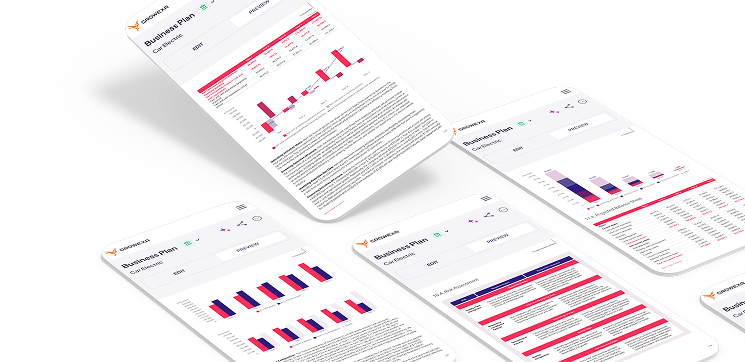

Create a Business Plan in 5 Minutes with AI

Yes, AI can help prepare a business plan for an SBA loan application. But that answer needs an important qualification: AI can help build the document; it cannot establish that the underlying facts, assumptions, or financial case are correct.
There is also an important regulatory distinction. The U.S. Small Business Administration publishes guidance on what a traditional business plan can contain, but its current guidance does not establish a special category of “AI-approved” or “AI-prohibited” business plans. SBA says there is no single right or wrong way to write an AI business plan for SBA loan and notes that traditional plans are commonly requested by lenders and investors.
For a borrower, that makes the practical question less about authorship and more about reliability.
If AI helps organize the company description, turn operating assumptions into a first draft, or connect a forecast to a written plan, it can materially reduce preparation time. If it invents market data, fills gaps with plausible-sounding numbers, or produces projections the owner cannot explain, it creates risk rather than removing it.
An AI business plan SBA loan should therefore be treated as assisted work: faster to produce, but still requiring management-level verification before it reaches a lender.
The useful role for AI begins well before it writes a paragraph.
Business planning requires a founder to take information that often exists in different places—pricing assumptions, customer estimates, payroll plans, equipment quotes, marketing budgets, historical financials—and turn it into one coherent financing case. AI can accelerate that organization.
What it cannot do is transfer responsibility for the business case.
SBA's current Lender Match guidance tells prospective borrowers to know how much capital they need and how it will help the business. It also says AI financial projections should demonstrate an understanding of the company's finances, use of funds, and how the loan will be repaid.
Those are management questions, not writing questions.
Suppose AI generates a forecast showing first-year revenue of $1.4 million. The number may look reasonable in a spreadsheet. But where did it come from? If the owner cannot explain it through customers, transaction values, contracts, capacity, pricing, or another measurable revenue driver, the sophistication of the software is irrelevant.
The same applies to expenses. AI may suggest a reasonable payroll ratio for an industry, but the actual plan needs to reflect the company's hiring schedule, compensation, payroll taxes, benefits, and operating requirements.
AI can perform calculations. The borrower has to own the assumptions being calculated.
The strongest use case for AI business planning is not “write my plan.” It is reducing the mechanical work between raw business information and a document that can be reviewed.
Structure is an obvious advantage. AI can organize fragmented notes into sections, identify missing information, and help a founder move from a blank page to a workable framework.
First drafts are another. A founder who already knows the business model, customer, competitive position, and operating process can use AI to turn those inputs into readable prose. The owner then edits for precision rather than spending hours creating basic sentences.
Formatting and consistency checks can save time. Names, dates, terminology, funding amounts, and other details often drift during multiple revisions. Software can help surface those discrepancies.
The more interesting use case is scenario modeling. A useful planning system can test what happens when a business opens two months late, customer acquisition is slower than expected, gross margin declines, or payroll rises. Those scenarios expose how sensitive the financing case is to assumptions that management may otherwise treat as fixed.
Finally, some dedicated business-planning platforms can connect written assumptions with financial projections. That is fundamentally different from asking a text generator to invent a five-year forecast. When narrative and financial model share the same inputs, changing a hiring date or revenue assumption can flow through the plan rather than leaving multiple disconnected versions.
This is where AI adds the most value: not by pretending to know the business, but by making the consequences of management assumptions easier to see.
The most dangerous AI output is often not obviously wrong. It is plausible.
A fabricated statistic claiming that a local market will grow 8.7% annually may fit perfectly into a market-analysis paragraph. A fictional licensing requirement may sound like standard regulatory language. A 15% annual sales-growth assumption may appear conservative simply because the number is not extreme.
None of that makes the information true.
AI should not be treated as the primary authority for current market facts, regulatory requirements, licenses, historical financial results, existing customer evidence, contracts, debt balances, or lender-specific SBA business plan requirements.
Financial assumptions require the same discipline.
Consider a startup restaurant. AI can help build a model using seats, table turns, average check, operating days, food cost, labor, rent, and other expenses. It should not independently decide that the restaurant will average 220 transactions per day because that number produces an attractive result.
The owner needs to establish why the volume is achievable.
SBA's own planning guidance makes the connection between research and projections explicit. Its traditional business-plan framework calls for market analysis and states that the marketing and sales strategy will later be referenced when preparing financial projections.
That sequence matters. Evidence should produce assumptions; assumptions should produce projections. AI should not reverse the process by creating the desired projections first and manufacturing a story around them.
Whether the first draft was written manually or with AI, the final document needs to withstand the same basic questions.
| Plan Area | AI Can Help With | What the Applicant Must Verify |
|---|---|---|
| Business description | Organizing and editing company information | Legal structure, ownership, locations, history, current operations |
| Market analysis | Structuring research and comparing information | Market data, source dates, local demand, competitors, customer evidence |
| Products and services | Explaining the offer and revenue model | Actual pricing, margins, product mix, contract terms |
| Marketing and sales | Turning a strategy into a clear narrative | Channel costs, conversion assumptions, sales capacity, retention |
| Operations | Mapping processes and dependencies | Staffing, suppliers, equipment, capacity, licenses and timelines |
| Management | Editing biographies and clarifying responsibilities | Experience, roles, qualifications and planned hires |
| Funding request | Organizing the use of funds | Amounts, quotes, timing and actual financing need |
| Financial projections | Building formulas, scenarios and linked statements | Revenue drivers, costs, margins, cash timing and financing assumptions |
SBA's traditional business-plan guidance follows a similar logic. It recommends matching financial projections to the funding request and explaining the assumptions rather than simply presenting forecast statements.
The practical standard is straightforward: if a lender asks where an important number came from, the answer should never be “the AI generated it.”
For borrowers who want the narrative and financial sections organized within one financing-oriented framework, Growexa's SBA business plan provides a structured starting point. The underlying facts and assumptions still need to come from the business.
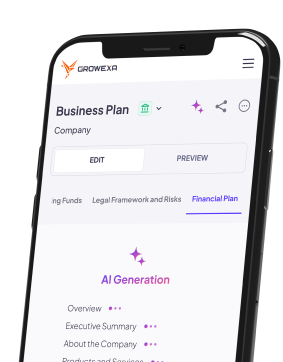
There is a meaningful difference between using a general-purpose conversational AI to draft text and using software designed specifically around business planning. It is not that one can “write” and the other cannot. Both can produce polished prose.
The difference is structure and data relationships.
A generic AI conversation is fundamentally flexible. That makes it useful for brainstorming, rewriting, challenging assumptions, summarizing research, or exploring scenarios. But the user is generally responsible for maintaining consistency across prompts, versions, spreadsheets, and sections of the plan.
Structured business-planning software can impose a persistent model around the information.
| Task | Generic AI Chat | Structured AI Planning Software |
|---|---|---|
| Draft and rewrite prose | Strong | Strong |
| Brainstorm assumptions | Strong | Strong |
| Maintain a fixed plan structure | User-managed | Typically built into workflow |
| Connect assumptions to projections | Usually requires manual setup | Can be integrated where supported |
| Update linked financial statements | Usually external or manual | Possible in finance-enabled platforms |
| Maintain one version of plan data | Requires user discipline | Easier in a structured workspace |
| Verify real-world facts | Still required | Still required |
Neither approach eliminates verification.
A purpose-built system can reduce the risk that a revenue number is changed in one place but forgotten in another. It cannot know that management's expected conversion rate is realistic unless the company has evidence to support it.
Conversely, generic AI can be effective when an experienced founder already has a financial model and needs help testing the logic or improving the narrative.
The right comparison is therefore not “smart AI versus basic AI.” It is open-ended generation versus a controlled planning workflow.
The most effective business plan review does not begin with grammar. It begins with provenance: Where did each important fact and number come from?
Use this review sequence before the plan reaches a lender:
This last test is particularly useful. SBA describes a lender ready business plan as a tool for thinking through how a company will be structured, operated, and grown—not simply a document produced to complete an application.
The review should therefore focus less on whether the document “sounds professional” and more on whether its conclusions can be reconstructed from evidence.
Some AI-generated weaknesses can be identified quickly. Four patterns deserve particular attention.
| Red Flag | What It Usually Means | Fix |
|---|---|---|
| Numbers change between sections | Different drafts or assumptions were generated independently | Establish one source of truth for financial inputs |
| Market section could describe almost any company | AI filled space without business-specific evidence | Replace generic claims with sourced, relevant market evidence |
| Revenue grows faster than operating capacity | Forecast was created independently of staffing or operations | Model the resources required to deliver projected sales |
| Funding request uses broad categories with no logic | Capital need was estimated before its uses were calculated | Build the request from specific costs and operating needs |
A fifth red flag is subtler: the plan is unusually certain.
Real businesses operate with ranges, dependencies, and risks. If every market trend is favorable, every sales target is achieved, costs remain stable, and execution proceeds exactly on schedule, the plan may be internally neat but economically weak.
Scenario analysis is one of the places where AI can improve the work instead of merely accelerating it. Use the tool to challenge the base case, not just to make the base case look persuasive.
The value of AI SBA business plan template is therefore not that it can replace the founder, accountant, lender, or underlying evidence. Its value is that it can shorten the distance between those inputs and a coherent financing document.
Used well, AI can expose gaps earlier, connect assumptions more systematically, and make scenario analysis practical for a small-business owner who would otherwise maintain several disconnected spreadsheets and drafts. Used poorly, it can produce exactly the opposite: a polished document whose numbers nobody can defend.
Before submitting an AI-assisted plan, remove one question from the review process entirely: Does this sound as though AI wrote it?
Replace it with a harder question:
Can I prove where the important numbers came from, explain why they are reasonable, and show how they connect to the financing request?
If the answer is yes, AI has done its job as a planning tool. The business case still belongs to you.
Yes. AI can help draft, organize, edit, and analyze a business plan intended for SBA-related financing. SBA itself lists drafting a business plan among the ways small businesses can use AI. The agency also advises businesses to review AI-generated products because using AI introduces risks.
SBA publishes guidance recognizing AI as a tool that small businesses can use to draft business plans, but this should not be interpreted as a formal SBA policy that an AI-generated financing application is automatically acceptable. SBA's business-plan guidance focuses on the substance and usefulness of the plan rather than prescribing how every sentence must be produced.
AI-enabled software can assist with formulas, forecasting, scenarios, and connected financial statements. But management needs to verify the inputs. A technically correct model built on unrealistic sales, margin, payroll, or working-capital assumptions is still a weak model.
SBA's traditional business-plan guidance recommends prospective income statements, balance sheets, cash-flow statements, and capital expenditure budgets and specifically says projections should be explained and matched to the funding request.
The more important issue is whether the lender can verify and understand the information. Generic prose, inconsistent numbers, invented sources, or assumptions the owner cannot explain are substantive problems regardless of whether they originated with AI, a template, a consultant, or the borrower.
It depends on the job. A general AI assistant is flexible and useful for research support, drafting, rewriting, and challenging ideas. Dedicated software can be more useful when the priority is maintaining a structured plan and connecting financial assumptions across sections.
Neither removes the need to verify external facts and management assumptions.
AI can improve the preparation process, but using AI does not itself improve eligibility or guarantee financing. Its value comes from helping the borrower create a clearer, more internally consistent business case.


