
Cash flow matters more than projected sales growth. Lenders need evidence that the business can meet debt payments after covering operating expenses and other obligations.
Every major financial assumption needs support. Revenue forecasts, startup costs, margins, and working capital should be connected to historical results, market evidence, or documented estimates.
The funding request must reconcile with the financial plan. Loan proceeds, owner contributions, equipment purchases, and operating reserves should form one consistent financing structure.
Internal inconsistencies undermine credibility. Differences between the narrative, financial statements, and supporting documents can raise questions about management's financial controls.
Prepare for underwriting, not just presentation. A lender-ready business plan should explain repayment capacity, financial risks, management capability, and the proposed use of funds.
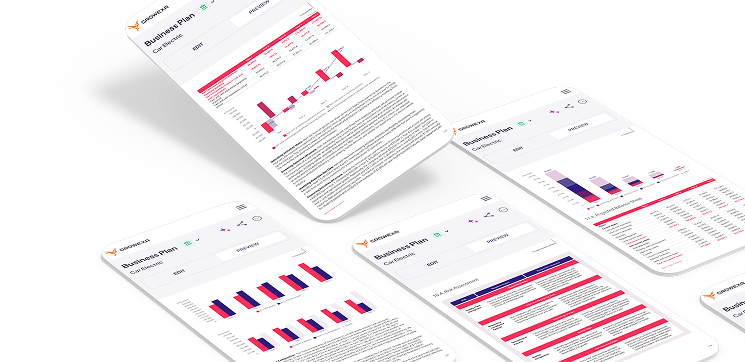

Create a Business Plan in 5 Minutes with AI

A business loan application is fundamentally a credit decision. The lender evaluates the borrower's ability and willingness to repay, the financial condition of the business, the purpose of the financing, and the risks associated with the proposed transaction. Understanding why business loan applications get rejected helps founders avoid common pitfalls during underwriting.
A business plan supports that evaluation by explaining how the company operates and how the financing will affect its financial performance. However, it is only one component of underwriting. Lenders may also consider credit history, collateral, guarantees, industry exposure, historical financial results, and applicable lending policies.
The distinction between profitability and repayment capacity is particularly important. A company can report positive net income while experiencing cash shortages caused by inventory purchases, accounts receivable, equipment expenditures, or existing debt payments.
Likewise, a business may project substantial future profits without demonstrating that it can survive the period before those profits materialize.
The purpose of a bank-ready business plan is to connect the business strategy with measurable financial outcomes and the proposed repayment structure. Knowing what banks look for in a business plan ensures all financial models align directly with credit criteria.
The following ten mistakes are especially relevant because they interfere with that connection.
What the lender sees. The business plan forecasts rapid sales growth but provides little explanation of how the company will acquire customers, increase transaction volume, or achieve its pricing assumptions. A projection showing revenue doubling within twelve months may appear attractive, but without supporting evidence it remains an unsupported estimate.
Why it creates risk. Revenue is the starting point for projected profitability and cash flow. If sales assumptions are overstated, the entire repayment forecast may be unreliable. Lenders may question whether management understands its sales cycle, customer acquisition capacity, and competitive environment.
How to fix it. Build revenue projections from measurable operating drivers. For a service business, forecast the number of customers, average contract value, retention, and delivery capacity. For a retailer, use transaction volume, average purchase value, and expected operating days. Existing businesses should reconcile projections with historical performance, signed contracts, customer pipelines, and seasonality.
For example, a company forecasting $600,000 in annual revenue at an average transaction value of $500 must generate approximately 1,200 transactions annually. The plan should explain whether the business has the customer demand, staffing, and capacity to support that volume.
A conservative scenario should demonstrate the financial effect of slower sales growth rather than assuming that every forecasted customer will materialize. Addressing this directly reduces common business plan mistakes for bank loan submissions.
What the lender sees. The financial projections show accounting profits, but the business plan does not demonstrate sufficient cash availability to cover principal and interest payments. Alternatively, the plan presents a profit-and-loss statement without a cash-flow forecast or existing debt obligations.
Why it creates risk. Loan repayment depends on available cash, not revenue or accounting profit alone. Depreciation, receivables, inventory investment, taxes, capital expenditures, and debt principal payments can cause cash flow to differ materially from net income.
Lenders may assess debt-service coverage using a measure of cash flow available for debt service divided by required debt payments. The exact definition and acceptable coverage threshold depend on the lender and financing product.
Consider a business with $150,000 in annual cash flow available for debt service and $120,000 in annual debt payments. Its debt-service coverage ratio is $150,000 ÷ $120,000 = 1.25. If available cash flow falls to $105,000, coverage declines to 0.88, indicating a shortfall under that simplified measure.
How to fix it. Prepare integrated profit-and-loss, cash-flow, and, where appropriate, balance sheet projections. Include existing and proposed debt payments, working-capital movements, taxes, and capital expenditures. Test whether repayment remains feasible under lower revenue or higher costs.
The business plan should make the repayment source explicit and show how the proposed financing affects monthly and annual liquidity.
What the lender sees. The borrower requests $250,000 for business expansion but provides only broad categories such as equipment, marketing, and working capital. The application does not identify specific purchases, their costs, or the amount funded by the owner.
Why it creates risk. Without an itemized use-of-funds schedule, the lender cannot clearly assess whether the loan amount is justified, whether expenses are eligible under the financing product, or whether the proposed investment will generate sufficient financial benefit.
An unclear request can also suggest that management has not completed the operational planning necessary to execute the project.
How to fix it. Prepare a sources-and-uses statement supported by supplier quotations, contractor estimates, lease terms, and working-capital calculations.
| Use of funds | Amount |
|---|---|
| Equipment purchases | $120,000 |
| Facility improvements | $65,000 |
| Initial inventory | $40,000 |
| Working capital | $55,000 |
| Total project cost | $280,000 |
| Owner equity contribution | $30,000 |
| Requested loan | $250,000 |
The financing request should reconcile with the startup or expansion budget and the financial projections. If the business expects equipment to increase production capacity, the revenue forecast should reflect the corresponding operational assumptions.
The objective is to demonstrate not merely where the money will be spent, but how the investment supports future repayment capacity.
What the lender sees. The written business plan describes one operating strategy while the financial model reflects another. For example, the narrative states that the company will hire five employees, but payroll projections include only two. A proposed second location appears in the growth strategy without corresponding rent, equipment, or staffing expenses.
Why it creates risk. Inconsistencies weaken confidence in the forecast and may raise questions about the borrower's financial controls. Even when individual assumptions appear reasonable, they cannot support a reliable credit assessment if they do not describe the same business.
How to fix it. Reconcile every major operating assumption across the narrative, financial statements, and supporting schedules. Revenue should reflect stated pricing and capacity. Payroll should reflect staffing plans. Capital expenditures should match the proposed investment program.
A practical review is to trace each material claim to its financial consequence. If the plan proposes opening a new location in month seven, the model should reflect its development costs, opening date, operating expenses, and expected revenue ramp-up.
The lender should not have to determine which version of the business strategy is correct.
What the lender sees. The startup budget covers major equipment and property expenses but omits installation, permits, insurance deposits, professional fees, initial marketing, training, or contingency.
Why it creates risk. An incomplete budget can create a funding gap before the business reaches commercial operations. If the borrower cannot cover unexpected costs, the project may be delayed, operations may begin with insufficient resources, or additional financing may become necessary.
Underestimated startup costs can also distort projected returns. A business expected to generate $80,000 in annual operating cash flow on a $300,000 investment has different economics if the actual investment rises to $400,000.
How to fix it. Develop a detailed startup budget using verified estimates wherever possible. Separate capital expenditures, one-time launch expenses, and working capital. Include a contingency based on the project's uncertainty rather than assuming that every quoted cost will remain unchanged.
For construction, equipment-intensive operations, and regulated businesses, obtain professional estimates before finalizing the financing structure. The business plan should also explain which costs are fixed by contract and which remain provisional.
What the lender sees. The borrower allocates nearly all available funding to equipment, inventory, or facility improvements. The plan assumes that customer revenue will immediately cover payroll, rent, suppliers, and debt payments.
Why it creates risk. Businesses often incur expenses before receiving customer payments. Seasonal demand, delayed collections, inventory purchases, and slower-than-expected customer acquisition can create liquidity shortages even when the business is economically viable over the longer term.
A company may therefore fail to meet obligations not because its business model is fundamentally unprofitable, but because it lacks sufficient cash to finance the operating cycle.
How to fix it. Prepare monthly cash-flow projections that show opening cash, customer receipts, operating payments, inventory purchases, debt service, and closing cash balances.
For example, if a startup expects unavoidable monthly cash outflows of $35,000 and may require four months to reach stable collections, it should evaluate a reserve of approximately $140,000 before adjusting for actual expected inflows, payment timing, and other available liquidity.
The appropriate reserve depends on the business model and forecast uncertainty. It should be calculated from projected cash shortfalls, not selected solely as a generic percentage of startup costs.
What the lender sees. The plan cites broad industry growth, national market size, or favorable demographic trends without demonstrating demand in the company's actual service area or customer segment.
Why it creates risk. National industry performance does not establish that an individual business can acquire enough customers to support its forecast. Local competition, purchasing behavior, pricing, and distribution constraints may differ substantially from national averages.
A restaurant cannot justify its projected sales solely by citing the size of the U.S. food service market. Similarly, a contractor needs evidence of demand for its specific services, not just general construction spending.
How to fix it. Define the relevant geographic or customer market, identify competitors, assess pricing, and connect market evidence with realistic customer acquisition assumptions.
For an existing business, historical sales, customer retention, contracts, and referral activity may provide stronger evidence than broad industry statistics. For a startup, local demand research, pilot sales, customer interviews, and documented commercial interest can support the forecast.
The market analysis should explain how the business expects to win customers and what limits its potential market share.
What the lender sees. The business plan requests financing without clearly identifying the owner's equity contribution, outstanding loans, personal guarantees, or other financial commitments.
Why it creates risk. Lenders need to understand the borrower's existing obligations and the complete financing structure. Undisclosed or poorly documented debt can affect repayment capacity, collateral availability, and the assessment of financial leverage.
The owner's contribution may also be relevant to the lender's evaluation of project funding and financial commitment. Requirements vary by lender and loan program.
How to fix it. Provide a clear schedule of funding sources, existing business debt, repayment terms, and relevant owner contributions. Reconcile the information with financial statements and other application documents.
If the project requires $400,000 and the borrower proposes a $300,000 loan, the plan should explain how the remaining $100,000 will be funded and whether those funds are available.
The same transparency should apply to outstanding obligations. Existing debt payments must appear in cash-flow projections so the lender can assess the total repayment burden.
What the lender sees. The business plan contains financial claims that cannot be verified because supporting records are incomplete, outdated, or unavailable.
Depending on the application, missing materials may include tax returns, financial statements, bank records, debt schedules, equipment quotations, lease documents, business registrations, licenses, or relevant contracts.
Why it creates risk. Underwriting depends on reliable information. Missing documentation can delay review, prevent verification of financial assumptions, or leave material credit questions unresolved.
A strong narrative cannot replace evidence of historical revenue, existing liabilities, or the proposed use of loan proceeds.
How to fix it. Obtain the lender's documentation requirements before submitting the application. Prepare consistent financial records and ensure that supporting documents correspond to the figures presented in the business plan.
A startup and an established business may need different materials. Existing companies can often provide historical operating results, while startups may rely more heavily on owner financial information, verified project costs, market evidence, and detailed forecasts.
An SBA business plan checklist can help organize the planning process, but borrowers should use the actual lender's requirements as the authoritative submission checklist.
What the lender sees. The plan devotes extensive space to the founder's vision, product features, or growth ambitions but provides limited discussion of financial risks, repayment sources, management controls, and downside scenarios.
Why it creates risk. The lender is not primarily purchasing the business's future upside. Its central concern is whether the borrower can meet contractual obligations under the proposed financing arrangement.
A compelling growth story may support the business case, but it does not replace evidence of cash generation, liquidity, and operating discipline.
How to fix it. Organize the plan around the questions relevant to a credit decision. Explain what the company does, why customers will pay for its products or services, how the financing will be used, and how operations will generate cash for repayment.
Include the principal financial risks and demonstrate management's response to them. A lender may place greater confidence in a conservative forecast with transparent assumptions than in an aggressive forecast that ignores adverse conditions.
The strongest loan-oriented plans translate business strategy into credit-relevant evidence.
Before submitting a loan application, borrowers should review the plan as an underwriter would. The objective is to identify unsupported assumptions, inconsistent figures, and missing information before they affect the credit decision.
| Review area | Pre-submission question |
|---|---|
| Revenue forecast | Can projected sales be traced to customers, pricing, demand, and capacity? |
| Cash-flow projections | Does the business generate enough cash to meet operating and debt obligations? |
| Debt-service coverage | Has repayment capacity been tested under realistic assumptions? |
| Funding request | Is every material use of loan proceeds itemized and supported? |
| Sources of capital | Do loan proceeds and owner contributions cover the full project cost? |
| Financial consistency | Do the narrative, financial statements, and operating assumptions agree? |
| Startup budget | Are launch expenses, contingency, and preopening costs included? |
| Working capital | Can the business fund operations during a slower-than-expected period? |
| Market analysis | Does the evidence support demand in the actual target market? |
| Existing obligations | Are outstanding debt and relevant financial commitments disclosed? |
| Supporting documents | Are required records complete, current, and consistent? |
| Downside scenario | Can the business remain financially viable if performance falls below plan? |
The checklist should be supplemented by the lender's specific requirements. A bank, credit union, SBA participating lender, or other financing provider may apply different underwriting standards and request additional information.
A final review should focus on the relationship between the requested loan, the investment it will finance, and the cash flow available for repayment.
A business plan does not strengthen a loan application simply by being comprehensive or professionally formatted. Its value comes from the quality of the financial assumptions, the consistency of the supporting information, and the clarity with which it explains repayment capacity.
The most damaging business plan mistakes often arise when founders treat the document as a sales presentation rather than a financial decision-making tool. Revenue growth, market opportunity, and expansion potential matter, but they must be connected to operating costs, liquidity, existing obligations, and the proposed financing structure.
Before approaching a lender, borrowers should evaluate their plan against the questions that determine creditworthiness: Is the investment justified? Are the financial projections credible? Can the business generate sufficient cash flow? What happens if performance falls below expectations?
Growexa can help founders create a lender-ready business plan that connects business strategy with financial projections and supporting assumptions. The next step is to validate those figures against actual operating information, verified cost estimates, and the lender's documentation requirements.
A credible loan application does not eliminate business risk. It demonstrates that management understands the risk, has quantified its financial implications, and has a realistic plan for meeting its obligations.
Important mistakes include unsupported revenue forecasts, incomplete cash-flow projections, unclear funding requests, underestimated startup costs, insufficient working capital, and inconsistencies between the business narrative and financial statements. Missing supporting documentation can also delay or weaken an application.
Loan applications may be declined for several reasons, including insufficient repayment capacity, credit concerns, excessive leverage, inadequate collateral where required, weak financial performance, or failure to meet a lender's eligibility standards. A weak business plan can contribute to the decision when it does not adequately support the proposed financing, but it is not the only factor.
Banks generally want to understand the business model, management capability, market demand, financial performance, proposed use of funds, and repayment capacity. They may also assess financial risks, owner contributions, existing obligations, and the reliability of supporting information. Specific requirements depend on the lender and financing product.
No. A business plan can improve the clarity and credibility of an application, but approval depends on the lender's underwriting standards and the borrower's overall financial and credit profile. A well-prepared plan cannot compensate for every weakness in repayment capacity, credit history, or eligibility.
The appropriate level of detail depends on the financing request and the lender's requirements. Startups and expansion projects often benefit from monthly forecasts showing revenue, expenses, cash flow, and debt payments. Established businesses may also need historical financial statements and explanations of material changes.
The underlying business planning principles are similar, but an SBA-related loan application may require information relevant to the particular program and participating lender. Borrowers should verify current documentation and eligibility requirements rather than assume that one standard business plan format satisfies every SBA loan application.
Begin by verifying revenue assumptions, reconciling financial statements, itemizing the use of funds, and calculating repayment capacity. Review working-capital needs and downside scenarios, then confirm that supporting documents are complete. Eliminating common business loan application mistakes before submission ensures the final plan makes the connection between business operations and loan repayment explicit.


