Ukraine
 USA
 Austria




Opening a bookstore is less about predicting how many books people will buy than deciding how much inventory, space, and working capital should be committed to generating those sales.
That distinction matters because bookstores combine relatively high inventory requirements with a retail cost structure that continues regardless of how quickly individual titles sell. Rent, payroll, utilities, insurance, software, and marketing are paid every month, while cash can remain tied up in books that sit on shelves for weeks or months. A store can appear busy and still produce weak cash flow if inventory turns slowly or occupancy costs are too high.
The market itself remains substantial. U.S. print book unit sales reached 762.4 million copies in 2025, up 0.3% from 2024, according to Circana BookScan data reported by Publishers Weekly. During the first half of 2026, print units were essentially flat, down 0.3%, while adult fiction increased 5.7%. At the same time, the American Booksellers Association reported that 605 new brick-and-mortar, pop-up, and mobile stores opened in the U.S. in 2025 and that most member stores reported year-over-year sales growth. The association also continues to describe thin margins and rising operating costs as major challenges for independent booksellers.
A credible bookstore business plan therefore needs to do more than demonstrate demand for books. It should show how the specific store will convert inventory and floor space into enough gross profit to support its fixed-cost base.
Bookstore Business Plan Template
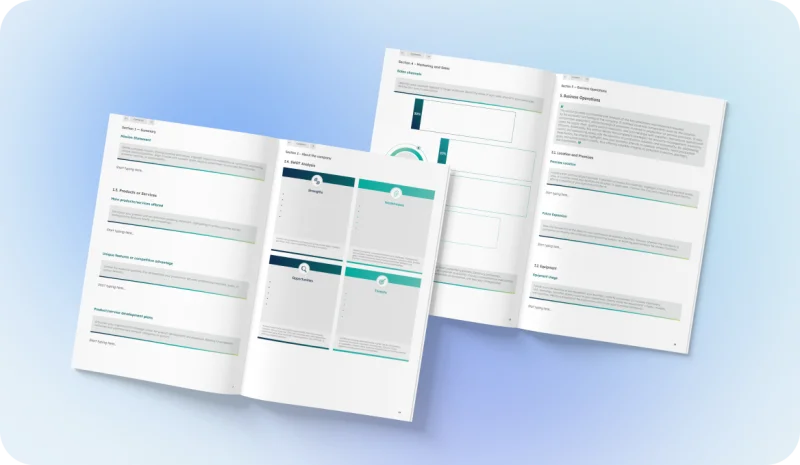
A bookstore business plan template provides a structured way to test the concept before signing a lease or committing heavily to inventory. It should define the store format, target customers, location or online model, inventory strategy, suppliers, pricing, additional revenue streams, staffing, startup investment, marketing approach, and financial projections.
The economics will differ substantially between an independent neighborhood bookstore, a used-book operation, a bookstore café, and an online-first seller. A useful template should accommodate those differences rather than force every concept into the same assumptions.
Founders can use a downloadable bookstore business plan PDF to organize the plan or build the assumptions through a business-plan generator. Unlike a finished bookstore business plan example, which shows how another hypothetical or existing business might be presented, the template should function as a working model: the founder supplies the actual location, inventory budget, rent, staffing requirements, sales assumptions, and financing needs.
The central question is whether the planned store can generate enough gross profit from a realistic level of sales to cover its operating expenses while maintaining sufficient cash to replenish inventory.
Bookstore Key Facts and Financial Drivers
There is no single set of economics that applies to every bookstore. A used-book store buying inventory locally may have a very different merchandise cost structure from a new-book retailer, while adding a café changes both revenue potential and operating complexity. The table below is therefore a planning framework rather than a set of industry averages.
| Financial Driver | What to Model | Why It Matters |
|---|---|---|
| Inventory investment | Opening stock plus replenishment needs | Determines how much cash is tied up before and after opening |
| Rent and occupancy | Rent, CAM where applicable, utilities, deposits | Creates a fixed cost that sales must support every month |
| Average transaction | Books plus additional items per purchase | Determines how much revenue each customer visit produces |
| Inventory turnover | How quickly merchandise sells and is replenished | Affects cash flow and shelf productivity |
| Gross margin | Sales less merchandise cost | Determines how much revenue remains for operating expenses |
| Café contribution | Sales less food, packaging, and direct operating costs | Shows whether the café improves overall economics |
| Events/services | Tickets, memberships, subscriptions, rentals | Can diversify revenue beyond book inventory |
| Working capital | Cash available for payroll, rent, replenishment and other expenses | Protects the store during the sales ramp and seasonal swings |
The counter-intuitive point is that carrying more books does not automatically create a stronger bookstore. Breadth of selection can improve discovery and customer experience, but every additional title consumes purchasing capital and shelf capacity. Inventory that does not sell is not simply unsold revenue; it is cash that cannot be used elsewhere in the business.
Choose Your Bookstore Model
The appropriate business plan for bookstore operations depends heavily on what the store is designed to sell beyond the basic idea of “books.” Each model produces different inventory requirements, customer behavior, and operating constraints.
Independent Retail Bookstore
A traditional independent bookstore usually competes through curation, customer service, local identity, events, specialist knowledge, and convenience rather than price alone. The model may include broad general-interest inventory or concentrate on particular categories such as children's books, fiction, art, politics, or specialist nonfiction.
The financial challenge is balancing assortment with inventory productivity. A larger selection can make the store more useful to customers, but slow-moving categories consume cash and floor space. Purchasing therefore needs to respond to actual local demand, seasonal patterns, new releases, events, and demonstrated category performance.
Independent bookselling remains an active channel. ABA reported 19% membership growth in 2025, alongside the opening of hundreds of new stores. That growth should not be interpreted as evidence that any location can support another bookstore. A new independent bookstore business plan still needs to establish why its particular market, assortment, and cost structure can work.
Used Bookstore
A used bookstore business plan has different inventory economics because merchandise may be acquired through customer purchases, trade-ins, estate collections, library sales, bulk acquisitions, or other local sources.
Lower acquisition costs can create attractive gross profit on individual books, but condition, sorting, storage, cataloging, and uncertain demand add labor. Buying cheaply does not help if the store accumulates thousands of low-demand titles that occupy valuable space.
The purchasing process therefore becomes part of the competitive advantage. Management needs criteria for what the store will buy, what it will reject, how inventory will be priced, how quickly slow stock will be marked down or removed, and whether valuable titles should be sold online rather than locally.
Bookstore Café
A bookstore cafe business plan combines two businesses with different operating requirements.
Coffee, pastries, light food, and other beverages can increase customer dwell time and revenue per visit. A customer who would have purchased one paperback may also buy coffee, while the café can attract customers during dayparts when book purchasing alone would be weaker.
The complication is that food service adds equipment, inventory spoilage, food-safety requirements, cleaning, staffing, and potentially substantial build-out costs. It also consumes floor area. If 25% of the store is converted to café seating, that space needs to produce enough contribution to justify reducing book display capacity.
A business plan for bookstore cafe should therefore model book and café economics separately before combining them into one forecast.
Online/Hybrid Bookstore
An online bookstore business plan removes some dependence on expensive retail space but introduces fulfillment, shipping, packaging, customer-acquisition, returns, and technology costs.
A hybrid model can use a physical store as both a retail destination and a fulfillment point. It may also expand the addressable market for specialist inventory, signed editions, rare or used books, subscriptions, and gift products.
Online sales should not simply be added to store revenue without modeling fulfillment capacity. Photographing or cataloging books, updating inventory, packing orders, handling customer service, and shipping all require labor. For low-priced books, those costs can consume a meaningful share of the transaction value.
Market and Customer Analysis
A bookstore's theoretical market is everyone who reads. Its practical market is much narrower.
The analysis should begin with the geographic trade area for a physical store and then examine the types of readers the concept intends to serve. Relevant factors include population, household composition, schools and universities, office activity, pedestrian traffic, competing bookstores, libraries, cafés, gift retailers, and local cultural organizations.
Category demand also matters. National sales data can provide context but should not be treated as a substitute for local research. For example, adult fiction sales increased 5.7% in the first half of 2026, while young adult fiction declined sharply compared with a year earlier. A store still needs to determine whether those national patterns resemble its own customer base.
Customer analysis should ultimately influence inventory. A bookstore near families and schools may devote substantial space to children's books. A store near a university may support academic-adjacent nonfiction and events. A specialist store can operate with a narrower audience if customers have strong purchase intent and the business can extend its reach online.
The goal is not to stock something for everyone. It is to make enough of the inventory relevant to the customers the store can actually reach.
Inventory and Supplier Strategy
Inventory is simultaneously the product, a merchandising tool, and one of the bookstore's largest uses of working capital.
A new store should build its opening inventory from the planned assortment rather than choosing an arbitrary dollar budget. Management can allocate shelf capacity across categories, estimate the number of titles and copies required, obtain actual supplier terms, and calculate the resulting opening purchase.
Supplier terms matter because discounts, freight, payment timing, minimum orders, returnability, and publisher policies influence cash flow. ABA reported in 2026 that its publisher discussions included additional discounts, extended dating, minimum-order policies, and other commercial terms that can affect independent-store performance.
Inventory turnover should then become an operating KPI. Consider two categories that each generate $60,000 in annual sales. If one requires an average of $12,000 in inventory while another requires $30,000, they place very different demands on capital even before differences in gross margin are considered.
Slow inventory is not necessarily bad. A specialist title can strengthen the store's identity even if it sells infrequently. The mistake is allowing too much of the assortment to behave that way without understanding the financial cost.
Annual Bookstore Revenue Calculator
Store Layout and Customer Experience
A bookstore layout should support both discovery and sales productivity.
High-demand categories need enough visibility to help customers find what they came for, while tables, endcaps, staff recommendations, new-release displays, and themed merchandising can encourage discovery. Children's areas, event spaces, café seating, checkout, storage, and receiving all compete for limited square footage.
The book shop business plan should therefore connect floor space with the revenue model. A large event area may strengthen community engagement but generate little direct revenue outside programmed periods. Café seating can increase dwell time but reduce shelving. Storage supports efficient replenishment but does not directly produce sales.
These are not arguments for maximizing shelves. A cramped store can undermine browsing and customer experience. The objective is to understand the commercial purpose of each major space allocation.
For a 2,500-square-foot store, management should know approximately how much space is devoted to selling books, café operations, events, checkout, storage, offices, and circulation—and why that mix supports the projected sales volume.
Revenue Streams Beyond Book Sales
Books can remain the core product without being the only source of revenue.
Stationery, puzzles, games, cards, gifts, branded merchandise, subscriptions, book clubs, paid events, workshops, café sales, corporate orders, school partnerships, and online sales can all broaden the revenue base. The right mix depends on the store's customer and positioning.
Additional revenue streams are valuable when they use existing customer traffic or capabilities efficiently. A customer already visiting to buy a children's book may also purchase a puzzle or birthday card. A popular author event may increase book sales before and after the event itself. A curated subscription can convert occasional purchases into recurring revenue.
Diversification becomes less attractive when it creates operational complexity disproportionate to its contribution. Adding dozens of low-volume gift categories can simply create another layer of inventory. A café can generate meaningful sales while also adding a completely new cost structure.
Each additional category should therefore be evaluated on sales, gross profit, inventory investment, labor, and space—not revenue alone.
Marketing and Community Events
Independent bookstores can compete in areas where scale is less decisive: local relevance, curation, relationships, and community.
Author events, book clubs, children's programming, school partnerships, reading groups, launch parties, workshops, and collaborations with local organizations can generate store traffic while reinforcing positioning. The American Booksellers Association itself operates programs such as Independent Bookstore Day, Indie Next, and Indie Bestseller initiatives that reflect the community and discovery role of independent stores.
Events should still be measured commercially. Attendance is useful, but management should also track book sales, new email subscribers, repeat visits, event costs, and whether programming attracts the target customer.
Digital marketing should support the same strategy. Local search can capture customers already looking for a bookstore, while email can promote new releases, events, preorders, staff selections, and seasonal products to existing customers. Social media can extend discovery, but follower growth should not become a substitute for measuring transactions.
A bookstore's strongest marketing asset can eventually become its customer base itself: readers who return because they trust the store to help them discover what to read next.
Startup Costs and Funding
Bookstore startup costs vary dramatically with store size, location, opening inventory, build-out requirements, and whether the concept includes a café.
A planning budget might look like this:
| Startup Category | Illustrative Range |
|---|---|
| Lease deposit and pre-opening occupancy | $5,000–$20,000+ |
| Build-out, signage and improvements | $15,000–$75,000+ |
| Shelving, fixtures and furniture | $10,000–$35,000+ |
| Opening book inventory | $25,000–$100,000+ |
| POS, computers and technology | $3,000–$10,000 |
| Licenses, insurance and professional costs | $2,000–$7,500+ |
| Website/e-commerce setup | $1,500–$10,000+ |
| Opening marketing | $3,000–$10,000 |
| Working capital | $20,000–$75,000+ |
| Café equipment, if applicable | Additional, concept-specific |
These are illustrative planning ranges, not national averages.
The largest mistake is calculating enough capital to open the doors but not enough to operate after opening. Inventory needs replenishment precisely when the business begins selling. Payroll and rent arrive even when first-month sales miss the forecast. Seasonal inventory may need to be ordered before the corresponding revenue appears.
A funding request should therefore separate physical startup investment from working capital and explain how long the cash reserve is expected to support the store under both base and downside sales assumptions.
Financial Projections
A bookstore forecast should begin with transactions rather than an arbitrary annual revenue target.
Assume a store expects an average of 75 transactions per day at a $32 average transaction value and operates 310 days per year. That produces approximately $744,000 in annual retail revenue. If events, online sales, subscriptions, and other categories contribute another $90,000, total modeled revenue reaches $834,000.
The next question is how much gross profit remains after merchandise cost. Rather than assuming a universal bookstore margin, the plan should model the actual supplier discounts and merchandise mix available to the store. New books, used books, gifts, café items, and other categories can have different economics, so a weighted gross-margin assumption is more useful than applying one percentage to every sale.
Operating expenses then need to reflect the real location and staffing model: rent, payroll, payroll taxes, utilities, insurance, software, merchant fees, marketing, professional expenses, maintenance, shipping, and other overhead. Inventory purchases must also be modeled through cash flow because an income statement alone does not show when cash leaves the business to replenish stock.
A downside scenario is particularly important. If the base case assumes 75 daily transactions, management should know what happens at 60. The lower-sales case may reduce inventory purchases somewhat, but rent and much of payroll remain. That operating leverage explains why modest forecasting errors can have a disproportionate effect on profitability.
For an independent bookstore, financial strength is therefore not defined simply by sales growth. The more revealing measures are gross profit, inventory turnover, occupancy cost, payroll productivity, operating cash flow, and the minimum cash balance required to survive slower periods.
The economics of bookselling create an unusual strategic tension. Customers value selection, discovery, atmosphere, and community, yet all four can encourage a founder to invest more heavily in inventory and space. Those investments strengthen the concept only when the resulting sales and customer retention justify the capital they consume.
A strong business plan for bookstore operations makes that tradeoff explicit. It shows how much inventory the store needs, how quickly that inventory must move, what each customer transaction contributes, and how much fixed cost the resulting gross profit can support.
The objective is not to build the bookstore with the most titles on opening day. It is to build one that can keep buying the right titles, serving its customers, and financing its next year of operations after the excitement of opening has passed.