
Startup capital varies widely. A financed one-truck operation may require roughly $25,000–$60,000 or more in upfront cash, while purchasing equipment outright can push the requirement well above $100,000.
Federal registration depends on how and where you operate. Many interstate for-hire carriers need a USDOT number and operating authority, but requirements differ for private carriers, exempt commodities, intrastate operations and specialized cargo.
Insurance is a major fixed cost. Progressive reported a 2025 national average of about $926 per month for new for-hire transport truck policies, but a new authority or higher-risk operation can face materially different pricing.
Cost per mile matters more than gross revenue. Fuel, truck payments, maintenance, tires, insurance, tolls and deadhead must all be reflected in the rate required to operate profitably.
Cash flow can fail before the income statement does. Freight invoices may be collected weeks after fuel, insurance and loan payments are due, making working capital essential.
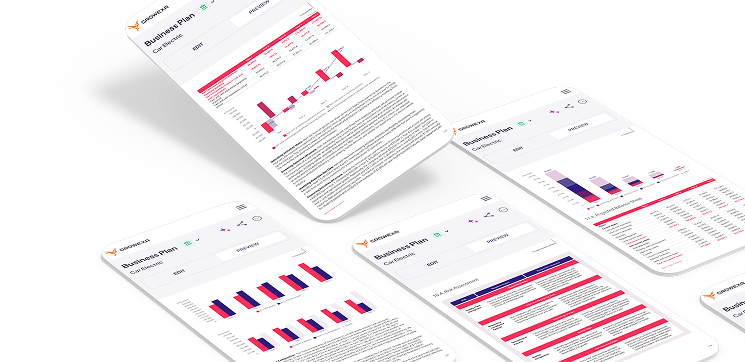

Create a Business Plan in 5 Minutes with AI

Starting a trucking company is often framed as an equipment decision: buy a truck, get authority, find loads and start driving. The financial reality is less forgiving. A truck can be moving every week and still destroy cash if its rate per mile does not cover fuel, maintenance, trucking insurance costs, truck financing, deadhead and the owner’s compensation.
For entrepreneurs researching how to start a trucking company, the critical number is therefore not the price of the truck. It is the spread between revenue per loaded mile and the true cost of every mile the business operates.
That distinction matters in 2026. Owner-operators remain exposed to volatile spot rates, fuel costs, insurance premiums and expensive maintenance, while financing introduces fixed monthly obligations regardless of how much freight is available. OOIDA’s 2024 freight-rate survey found an average reported operating cost of about $2.00 per mile among respondents who knew their costs. More importantly, owner-operators who knew their operating cost earned, on average, $0.26 more per mile than those who did not.
The lesson is straightforward: trucking is not primarily a revenue-maximization business. It is an asset-utilization and cost-control business.
A realistic answer is approximately $25,000 to $60,000 or more in upfront capital for a financed one-truck operation, before considering unusually large insurance deposits, premium equipment or specialized trailers. Buying a tractor outright can take total startup investment beyond $100,000.
These are planning estimates, not official industry fees. Trucking company owner operator startup costs change dramatically depending on whether the founder owns equipment already, purchases used or new equipment, finances the truck, leases it, needs a trailer and operates under an established carrier or obtains independent MC authority.
The following example assumes a first-time carrier starting a one-truck general-freight operation with financed equipment.
| Startup Item | Illustrative Range | Key Assumption |
|---|---|---|
| Truck down payment | $10,000–$30,000 | Financed used or newer tractor |
| Trailer/down payment if required | $3,000–$12,000 | Depends on equipment and freight type |
| Registration, authority and permits | $1,000–$3,000+ | Federal plus applicable state/route registrations |
| Initial insurance payment | $2,500–$8,000+ | Coverage, driver profile and financing terms vary |
| ELD, GPS and technology | $500–$2,000 | Hardware, setup and initial subscriptions |
| Initial fuel | $1,500–$3,000 | Operating pattern and tank capacity |
| Maintenance reserve | $5,000–$15,000 | Higher reserve advisable for older equipment |
| Accounting, legal and administration | $500–$2,500 | Entity setup and professional support |
| Working capital | $10,000–$30,000+ | Fuel, payments and overhead during collection delays |
This is why asking how much does it cost to start a trucking company without defining the operating model produces misleading answers.
A founder who already owns a paid-off tractor may have low acquisition costs but significant repair exposure. Another founder may put relatively little cash into a newer financed truck but accept a large monthly debt obligation. A third may lease equipment and preserve capital while paying more for flexibility.
The financing structure changes the risk; it does not eliminate it.
The business model determines what equipment you need, who controls the freight, how volatile trucking company revenue will be and how much administration the company must absorb.
A one-truck owner-operator model offers the lowest level of organizational complexity. The owner may drive the truck, manage dispatch and oversee administration personally.
The economic advantage is the absence of a separate employed-driver wage. But that does not mean driver labor is free. Owner compensation needs to be recognized when assessing the true return on the business.
This distinction is important. A truck that produces $80,000 in annual cash after operating expenses but requires the owner to drive 60 hours a week has not necessarily generated $80,000 in business profit. Part of that amount represents compensation for driving labor.
Adding trucks creates operating leverage but also changes the economics.
A two- or five-truck company needs more capital, insurance and working capital. It also introduces driver recruitment, payroll, safety management, equipment scheduling and additional maintenance exposure.
Fleet growth only improves returns if the company can keep equipment utilized at attractive rates. Adding a second truck that sits idle or runs low-margin freight is not scale. It is additional fixed cost.
Dedicated routes and contracted freight can reduce revenue volatility because the carrier has greater visibility into volume, lanes and rates.
That predictability improves equipment planning and cash forecasting. It can also reduce empty miles if routes are structured efficiently.
The trade-off is dependence on a smaller number of customers. Losing one major shipper can create an immediate utilization problem, particularly for a small fleet.
General dry-van freight offers a broad market and relatively standardized equipment. Specialized categories—refrigerated freight, flatbed, oversized loads, hazmat or certain high-value cargo—can command different rates but introduce additional equipment, insurance, training or compliance requirements.
Higher revenue per mile should never be interpreted automatically as higher profit. Specialized freight is attractive only when the rate premium exceeds the additional operating and capital cost.
The regulatory sequence depends on the type of operation, but a new carrier will generally begin by creating the business entity, obtaining an EIN where appropriate and determining which federal and state registrations apply.
For federal purposes, companies operating qualifying commercial motor vehicles in interstate commerce generally need a USDOT number. A USDOT number serves as FMCSA’s identifier for monitoring safety information, including inspections, crash investigations and compliance reviews.
Many interstate for-hire carriers also need operating authority. FMCSA notes that companies transporting federally regulated commodities owned by others for compensation in interstate commerce generally require operating authority in addition to a USDOT number. Private carriers and certain exempt operations may not.
The federal filing fee for permanent operating authority remains $300 for each type of authority requested.
First-time applicants register through the federal registration process. FMCSA states that new applications can take approximately 20–25 business days, although applications requiring further review can take substantially longer.
Do not treat obtaining an MC number as the final step. Authority becomes operational only after the other required filings and insurance evidence are completed.
There is no universal package of trucking company licenses that applies identically to every carrier. Requirements depend on vehicle weight, state, interstate versus intrastate activity, cargo, routes and business structure.
A typical interstate operation may need to evaluate:
The ELD requirement is a good example of why blanket statements are risky. FMCSA requires ELD use for most drivers who must keep hours-of-service records of duty status, but limited exceptions exist, including certain short-haul operations and other defined cases.
As of August 2026, FMCSA also continues to maintain and update its official list of registered ELDs, which matters because carriers can be cited for using a device that is no longer compliant.
Regulatory assumptions should therefore be checked against the actual route, truck and cargo before operations begin.
Equipment acquisition is one of the largest capital-allocation decisions in a trucking startup. The lowest upfront payment does not necessarily produce the lowest long-term cost.
| Approach | Upfront Cost | Monthly Commitment | Maintenance Responsibility | Flexibility | Best Suited For |
|---|---|---|---|---|---|
| Buy outright | High | Low/no loan payment | Owner | High after purchase | Well-capitalized operators |
| Finance | Moderate down payment | Fixed loan payment | Owner | Moderate | Operators preserving some cash |
| Lease | Lower initial capital | Recurring lease payment | Depends on agreement | Often higher | Operators prioritizing flexibility |
Buying equipment outright eliminates monthly debt service but ties up capital that could otherwise fund fuel, repairs and working capital.
Financing preserves cash but makes utilization more important. A $3,000 monthly truck payment remains $3,000 whether the truck runs 11,000 miles or sits in the shop for two weeks.
Leasing can reduce the initial capital burden and may simplify equipment replacement, but lease terms, mileage restrictions, maintenance responsibilities and end-of-term conditions require close review.
The comparison should therefore be made on total cost per productive mile, not monthly payment alone.
Insurance is one of the largest barriers for a new trucking authority because the premium reflects not only the truck but also the risk profile of the operation.
Common coverage categories can include primary auto liability, physical damage, motor truck cargo, general liability and coverage associated with trailers or non-trucking use, depending on the business model and contractual requirements.
Pricing varies significantly.
Progressive’s 2025 data for newly purchased policies showed a national average of approximately $926 per month for for-hire transport truck insurance and $734 for specialty truckers. The insurer notes that actual pricing varies based on factors including driving history, inspection history, vehicle type, cargo, coverage requirements and operating radius.
A startup should not simply insert that average into its forecast. New authorities, particular cargo classes or driver profiles can receive quotes well above an industry average.
Get actual insurance quotes before purchasing equipment. Otherwise, the business can commit to a truck only to discover that the operating model no longer works once the real premium is known.
For most small carriers, the most important operating metric is cost per mile.
A useful framework is:
Fixed monthly costs ÷ monthly miles + variable cost per mile = total operating cost per mile
Assume the following simplified one-truck model:
The resulting operating cost is approximately $2.10 per mile.
That figure becomes the starting point for freight decisions.
OOIDA’s latest published survey data found an average operating cost of $2.00 per mile in 2024, down from $2.08 in 2023. The survey also found that operators who understood their costs earned materially higher rates.
But even that calculation requires one adjustment: deadhead.
If a carrier gets paid $2.60 per loaded mile but drives 15% of its total miles empty, its revenue per total mile is lower than $2.60. Profitability therefore depends not just on the rate shown on a rate confirmation, but on the complete trip.
A new carrier can access freight through load boards, brokers, direct shippers and dedicated contracts. Each channel solves a different problem.
Load boards provide fast access to freight and can help a new authority establish operating history. They also expose the carrier to spot-market volatility. When truck capacity exceeds freight demand, rates can compress quickly.
Brokers reduce the sales burden because they aggregate shipper demand. The trade-off is that another party participates in the economics of the shipment.
Direct shippers are strategically attractive because a carrier can build customer relationships and negotiate lanes around its equipment network. Winning those accounts, however, requires sales capability, service consistency and credibility.
Dedicated contracts provide better revenue visibility but can create customer concentration.
For a one-truck business, depending heavily on spot freight may be unavoidable at the beginning. For a growing fleet, it becomes increasingly dangerous. Debt payments, payroll and insurance are fixed commitments; spot-market revenue is not.
The strategic objective should be to shift at least part of the revenue base from transactional freight toward repeatable lanes and direct commercial relationships.
A trucking company can report strong revenue and still fail because revenue does not tell you when cash arrives.
Fuel may be purchased today. A truck payment can be due next week. An unexpected repair may require several thousand dollars immediately. A customer or broker may not pay an invoice until weeks later.
That timing difference makes working capital a core part of the business model.
A credible forecast should connect expected loaded miles, rate per mile, deadhead percentage and utilization to fuel, maintenance, insurance, equipment payments and owner or driver compensation. It should also establish a maintenance reserve rather than treating major repairs as unpredictable anomalies.
A trucking business plan template can help structure these assumptions into revenue forecasts, operating trucking business expenses, cash flow, financing requirements and financial statements.
The downside case deserves as much attention as the base case. What happens if rates fall 10%? If the truck is down for 12 days? If fuel increases by $0.50 per gallon? If an invoice is paid two weeks late?
Those questions are more useful than an optimistic five-year revenue CAGR.
A complete business plan for a trucking company should show how much financial runway exists when actual operations deviate from forecast.
There is no reliable universal trucking business profit margin because operators often use the term “margin” to describe different things.
Gross margin may look attractive before truck payments, insurance, administrative costs and owner compensation are included. Net profit is what remains after the full economic cost of running the business.
Consider two one-truck carriers producing the same $250,000 in annual revenue.
Carrier A runs dense, repeatable lanes, limits deadhead, has a manageable truck payment and controls maintenance. Carrier B accepts inconsistent spot freight, drives more empty miles and carries a heavier debt load.
Identical revenue does not produce identical profit.
The strongest drivers of margin are usually rate per total mile, equipment utilization, deadhead, fuel efficiency, maintenance, insurance, debt service and driver compensation.
This creates a counter-intuitive result: more miles can reduce profit.
If additional miles are purchased with weak rates, excessive deadhead or expensive maintenance exposure, running harder only accelerates cash consumption. The goal is not maximum truck movement. It is maximum contribution from productive miles.
For a fleet, scalability creates another constraint. Revenue may grow quickly as trucks are added, but management overhead, safety administration, recruiting and working-capital requirements also grow. Expansion should be evaluated through return on incremental capital, not truck count.
The biggest mistake when learning how to start a trucking business is treating the truck as the business.
It is not.
The truck is a capital asset that converts miles into revenue. Profit comes from what surrounds that asset: freight selection, pricing, utilization, dispatch, fuel efficiency, maintenance, financing, compliance and cash management.
That distinction should shape every startup decision. A cheaper truck is not cheaper if repairs destroy utilization. A higher-paying load is not better if deadhead makes the total route unprofitable. Adding a second truck does not create scale if the company cannot secure enough profitable freight to keep both assets productive.
The strongest trucking companies know their economics before dispatching the first load. They know the minimum rate each lane must generate, how long their working capital can absorb downtime and what return additional equipment must produce before capital is committed.
Growexa’s trucking business planning tool can turn those operating assumptions into a structured financial model and full business plan, allowing you to test the economics before financing equipment or expanding the fleet.
Yes. Many trucking businesses begin as one-truck owner-operator operations. The model reduces organizational complexity, but the business is highly exposed to a single asset: when that truck is unavailable, revenue may stop while insurance, financing and other fixed costs continue.
A one-truck startup may reasonably plan for $10,000–$30,000 or more in working capital depending on fuel consumption, payment cycles, insurance, equipment debt and maintenance risk. This is an illustrative planning range, not a regulatory requirement. Older equipment or slower customer-payment terms may justify a larger reserve.
Not necessarily. Ownership and driving are different functions. A person can own a trucking company without personally operating the commercial vehicle. However, drivers must hold the appropriate license for the vehicle and operation they perform, and the carrier remains responsible for applicable safety and compliance obligations.
Business formation and equipment acquisition can happen relatively quickly, but authority and compliance determine when the carrier can legally operate. FMCSA currently states that new operating-authority applications may take approximately 20–25 business days, with additional review potentially extending the process.
It can be, but profitability depends on operating discipline rather than freight revenue alone. A carrier that controls cost per mile, minimizes deadhead, maintains equipment utilization and secures sustainable freight can generate attractive returns. High debt, weak spot rates, poor utilization or unexpected repair costs can erase the margin quickly.


