
Choose the investment strategy before searching for deals. Long-term rentals, short-term rentals, fix-and-flips, commercial properties, and wholesaling require different capital, skills, time horizons, and risk tolerance.
Select a market using property-level economics, not appreciation stories. Rent, vacancy, taxes, insurance, regulation, liquidity, and acquisition prices determine whether the market fits the strategy.
Set written acquisition criteria. Define purchase-price limits, minimum cash flow, return thresholds, leverage limits, renovation exposure, and reserve requirements before evaluating properties.
Treat financing and reserves as part of the investment decision. Higher leverage can increase returns on equity when a deal performs, but it also increases fixed obligations and downside risk.
Build a financial model before scaling. A repeatable deal-analysis process makes it possible to compare opportunities consistently and understand how additional properties affect cash flow, debt, and liquidity.
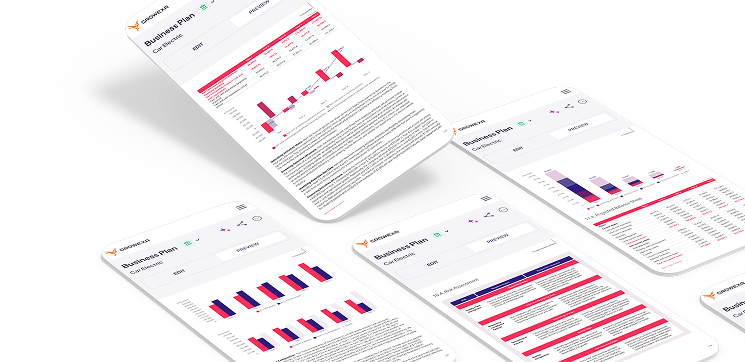

Create a Business Plan in 5 Minutes with AI

Starting a real estate investment business is less about finding a property that appears cheap than building a repeatable process for deciding which properties deserve capital.
That distinction is especially important when financing is expensive. As of September 10, 2026, the average U.S. 30-year fixed mortgage rate tracked by Freddie Mac was 6.76%. Investment-property financing can have different pricing and underwriting, but the broader rate environment illustrates why leverage can no longer be treated as inexpensive by default. A property that produces acceptable cash flow at one financing cost can become marginal when debt service rises.
A professional investment business therefore starts with strategy, acquisition criteria, financing limits, and downside assumptions before it starts with properties. The objective is not simply to buy real estate. It is to acquire assets whose expected income, appreciation potential, risk, and capital requirements fit a defined investment model.
A real estate investment business acquires, controls, improves, operates, or sells property with the objective of generating an investment return. That return can come from rental cash flow, appreciation, value creation, transaction profit, or a combination of these sources.
A long-term rental property business typically earns income from tenants while the investor holds the asset over multiple years. The economics depend on rent, occupancy, operating expenses, financing, capital expenditures, and eventual disposition value.
Short-term rentals replace conventional leases with nightly or weekly stays. Potential revenue can be higher in some markets, but the model adds occupancy volatility, furnishing, cleaning, platform fees, active management, and significant local regulatory exposure.
A fix and flip business generates returns primarily by acquiring property, completing improvements, and reselling it. Holding periods are shorter, but renovation execution and exit pricing become critical. Every month of delay can add financing, tax, insurance, utility, and maintenance costs.
Wholesaling generally involves obtaining contractual rights to a transaction and assigning those rights rather than building a portfolio of owned properties. Rules governing the activity vary by jurisdiction, so investors need to understand applicable state and local requirements.
Commercial real estate adds another layer of complexity. Lease structures, tenant credit, vacancy periods, capital improvements, financing, valuation, and due diligence can differ materially from residential property.
The right model is therefore not the one with the highest advertised ROI. It is the one whose capital requirements and operating risks fit the investor's resources.
For entrepreneurs researching how to start real estate business operations, the first step is to define what the company will actually own, finance, and manage. A rental portfolio, fix-and-flip operation, and transaction-focused business require different capital structures, operating capabilities, and return expectations. Establishing that model ea
The first decision is how the business expects to make money.
An investor with substantial capital but limited operating time may prefer stabilized long-term rentals with professional property management. Someone with construction expertise may be better positioned for renovation-driven investments. An entrepreneur with strong sales and sourcing capabilities but limited acquisition capital may evaluate transaction-oriented strategies.
Time horizon matters as much as expected return. Rental properties can tie up equity for years. Flips require capital to remain exposed until renovation and resale are complete. Commercial investments may involve longer acquisition and leasing cycles.
Operational involvement should also be priced into the decision. A strategy producing $20,000 of annual cash flow but requiring hundreds of hours of management is economically different from one producing the same cash flow with outsourced operations.
Market selection should move from economic fundamentals to individual property economics.
For rental investments, examine achievable rents, vacancy, household and employment trends, property taxes, insurance costs, landlord-tenant rules, new housing supply, and the depth of the resale market. Short-term rental investors also need to examine licensing, zoning, occupancy restrictions, taxes, and building or HOA rules.
Purchase-price growth alone is a weak investment thesis. Appreciation can improve total return, but it does not pay monthly debt service unless the investor sells or refinances.
Property type changes the risk profile as well. A single-family rental may be easier to finance and resell, while a small multifamily property can diversify vacancy across several units. Commercial assets may offer longer leases but can experience prolonged vacancy when a tenant leaves.
The market should fit the strategy—not the other way around.
Written acquisition criteria prevent attractive listings from gradually weakening underwriting standards.
Criteria might include a maximum purchase price, minimum monthly cash flow, minimum cash-on-cash return, acceptable cap rate where appropriate, maximum renovation budget, target loan-to-value ratio, minimum reserve balance, preferred neighborhoods, property condition, and exit requirements.
Cap rate is useful for comparing unlevered property economics: net operating income divided by property value or acquisition price. It does not measure the investor's leveraged return because debt service is excluded.
Cash-on-cash return addresses a different question: how much annual pre-tax cash flow the investment produces relative to the cash actually invested.
Neither metric should be used alone. A high cap rate can reflect substantial risk, while a high cash-on-cash return produced through aggressive leverage can leave little room for vacancies or repairs.
Real estate financing should be designed alongside the acquisition strategy rather than arranged after a deal has already been selected.
Sources can include personal equity, conventional mortgages, portfolio or commercial loans, private financing, seller financing where available, and equity partners. Terms, eligibility, collateral, guarantees, documentation, and pricing vary significantly.
Investors should be particularly careful about assuming that ordinary small-business financing can fund passive property investment. For example, the SBA states that its 504 program cannot be used for speculation or investment in rental real estate. SBA programs can support eligible owner-occupied business real estate, but that is different from financing a conventional rental portfolio.
Reserves also affect financing capacity. Under Fannie Mae's current guidance, Desktop Underwriter generally requires six months of reserves for an investment-property transaction, with additional reserve requirements possible when borrowers own multiple financed properties. Those requirements are specific to applicable conforming transactions, but they demonstrate why available cash after closing matters.
The financing plan should therefore model both the cash required to close and the liquidity remaining afterward.
A repeatable real estate deal analysis should use the same categories for every acquisition.
Start with the purchase price and acquisition costs. Add renovation and immediate capital expenditures. Estimate revenue using supportable rents rather than the highest advertised comparable. Then deduct vacancy, property taxes, insurance, management, maintenance, utilities paid by the owner, HOA costs where applicable, and a reserve for future capital expenditures.
Debt service comes next.
The resulting cash flow can then be compared with the total cash invested. Investors should also test the property at lower rent, higher vacancy, larger repairs, and less favorable refinancing or resale conditions.
This downside case is not pessimism. It identifies how much error the investment can absorb before expected returns disappear.
Owning several properties without standardized operating controls can create a collection of assets rather than a scalable business.
Decide who will handle tenant screening, leases, rent collection, maintenance requests, inspections, bookkeeping, tax documentation, insurance claims, renewals, and vendor management. If property management is outsourced, include the full management cost in underwriting before buying the property.
Bookkeeping should remain property-specific enough to compare actual performance with the original underwriting. Revenue, repairs, maintenance, taxes, insurance, management fees, capital expenditures, and debt payments should be identifiable by asset.
Tax treatment also affects financial reporting. Under current IRS rules, residential rental buildings generally use a 27.5-year recovery period under the General Depreciation System, while land is not depreciable. Individual improvements and other assets can have different treatment, making professional tax advice appropriate when building the model.
Unlike many businesses, real estate startup costs are dominated by the asset itself. Administrative setup may cost relatively little compared with the equity, closing costs, improvements, and reserves required for the first acquisition.
The amount required to start real estate investing business operations depends less on administrative setup than on the first investment strategy. Entity formation and basic professional fees may represent a relatively small portion of the budget; down payments, closing costs, renovations, and liquidity reserves usually determine the real capital requirement for an acquisition-based business.
| Cost Category | What to Budget |
|---|---|
| Entity and administration | State filing, accounting, legal setup, banking and basic systems where applicable |
| Down payment/equity | Investor cash required by the financing structure |
| Due diligence | Inspection, appraisal, surveys and specialized property reviews where needed |
| Closing costs | Lender, title, escrow, recording and other transaction expenses |
| Renovation | Immediate repairs, improvements and unit preparation |
| Initial reserves | Vacancy, repairs, capital expenditures and financing requirements |
| Insurance | Property and liability coverage appropriate to the asset and use |
| Professional services | Attorney, accountant, property manager, contractor or specialist advice |
| Leasing/marketing | Listing, photography, leasing commissions or tenant acquisition |
| Operating setup | Locks, software, bookkeeping, utility deposits and other property-specific costs |
Consider a $300,000 rental acquisition requiring 25% equity. The down payment alone would be $75,000. If closing and due diligence require $10,000, initial improvements $18,000, and post-closing reserves $15,000, the investor has committed approximately $118,000 before considering additional operating setup.
That is why asking how much it costs to start a real estate investing business has no useful universal answer. Capital depends primarily on the strategy, property value, financing terms, renovation exposure, and reserve policy.
Consider a hypothetical long-term rental purchased for $300,000. Assume the investor contributes 25%, finances $225,000 over 30 years at an illustrative 7.25%, and spends another $25,000 on closing, due diligence, improvements, and initial reserves.
These are planning assumptions, not a current loan quote.
| Deal Assumption | Hypothetical Amount |
|---|---|
| Purchase price | $300,000 |
| Down payment | $75,000 |
| Other initial cash | $25,000 |
| Total cash invested | $100,000 |
| Monthly gross rent | $2,900 |
| Annual scheduled rent | $34,800 |
| Vacancy allowance (5%) | -$1,740 |
| Taxes and insurance | -$6,000 |
| Maintenance/capex allowance | -$3,300 |
| Management | -$2,784 |
| Estimated NOI before debt service | $20,976 |
| Estimated annual principal & interest | -$18,420 |
| Estimated pre-tax cash flow | $2,556 |
| Cash-on-cash return | 2.6% |
The example exposes an important point. The property generates positive rental property cash flow, but positive cash flow alone does not make it an attractive investment. Approximately $100,000 of investor cash is producing only about $2,556 in modeled annual pre-tax cash flow before unexpected costs.
The investor may still expect appreciation, loan amortization, tax effects, or future rent growth to improve total real estate ROI. Those benefits should be modeled separately rather than used to disguise weak current cash flow.
At a lower purchase price, higher rent, cheaper financing, or more efficient operating structure, the same property could produce a different result. That sensitivity is exactly why disciplined underwriting matters.
A real estate business plan becomes increasingly useful when investing moves from an occasional personal transaction to a repeatable acquisition strategy.
The plan defines what the company will buy, where it will invest, how acquisitions will be financed, which return thresholds must be met, how properties will be operated, how much liquidity will be maintained, and what conditions would cause management to reject a deal.
It also forces growth assumptions into financial terms.
If the objective is to acquire five rental properties in three years, the plan should show the equity required for each acquisition, expected retained cash flow, financing capacity, reserves, management costs, and whether additional capital must come from owners or partners. A portfolio can grow in asset value while simultaneously becoming more constrained by debt and liquidity.
A property investment financial model turns those growth assumptions into measurable capital requirements. It should connect acquisition prices, financing, rental income, vacancy, operating expenses, capital expenditures, debt service, and reserves at both the property and portfolio levels. This makes it possible to see whether expansion actually increases distributable cash flow or simply adds assets, leverage, and future funding needs.
A structured real estate business plan also creates a common framework for lenders, partners, and investors. Instead of presenting isolated deals, management can explain the acquisition thesis, underwriting standards, capital allocation, risk controls, operating model, and portfolio-level financial projections.
The purpose is not to predict every future property. It is to prevent the investment strategy from changing every time an attractive listing appears.
Starting a real estate investment business does not require predicting which property market will rise fastest. It requires building a process that still makes financial sense when a property is vacant longer than expected, a repair costs more than budgeted, or financing becomes less favorable.
That is the difference between owning property and building an investment operation.
Before committing capital, use a real estate business plan to define acquisition criteria, financing limits, reserves, operating responsibilities, return targets, and growth assumptions. The strongest deal is not necessarily the property with the highest projected return. It is the one whose return remains acceptable after the assumptions are tested.
There is no universal minimum. Capital requirements depend on the investment strategy, property price, financing, required down payment, closing costs, renovation, and reserves. A low-cost transaction-oriented model may require less capital than purchasing rental properties directly, while commercial acquisitions can require substantially more.
Not necessarily. Entity choice depends on ownership, liability, financing, tax, state law, and investment structure. An LLC can be appropriate in some situations, but forming one does not automatically reduce investment risk or produce a particular tax result. Investors should obtain legal and tax advice for their circumstances.
Some financing structures can reduce the investor's initial equity contribution, but lower cash investment usually means higher leverage or another party supplying capital. That can increase financing costs, reduce cash flow, or require sharing returns and control. The relevant metric is risk-adjusted return, not simply the smallest possible down payment.
It can be, but profitability depends on acquisition price, income, vacancy, operating expenses, financing, capital expenditures, taxes, appreciation, and exit value. A property should be analyzed using both expected and downside assumptions rather than relying on historical appreciation or headline rent.
There is no universally superior strategy. Long-term rentals may suit investors seeking recurring income and longer holding periods. Flips require stronger renovation and project-management capability. Short-term rentals involve more active operations and regulatory exposure. The appropriate strategy depends on available capital, skills, time, market conditions, and risk tolerance.


