
Identify both direct and indirect competitors. Direct competitors sell a similar solution to the same customer; indirect competitors satisfy the same need differently.
Compare businesses using consistent criteria. Price, customer segment, product, distribution, service model, positioning, strengths, and weaknesses are more useful than arbitrary feature lists.
Support conclusions with evidence. Competitor websites, published pricing, customer reviews, industry data, public filings, and customer interviews are stronger than assumptions about why another company succeeds.
Define differentiation from the customer's perspective. A competitive advantage matters only when it changes purchase behavior, economics, convenience, risk, or another outcome customers value.
Connect the analysis to the business model. Competitive findings should influence pricing, marketing, product strategy, sales forecasts, operating costs, and risk assumptions elsewhere in the plan.
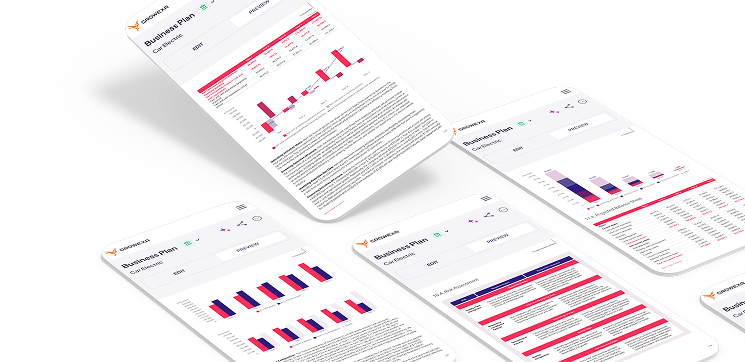

Create a Business Plan in 5 Minutes with AI

A strong competitive analysis business plan section does more than identify companies operating in the same market. It explains why customers choose among alternatives, where competitors are structurally stronger or weaker, and how those differences affect pricing, customer acquisition, margins, and growth.
That is where many business plans fail. Founders often treat competition as a list: competitor names, prices, features, perhaps a SWOT matrix. The result describes the market without explaining what the company should do about it.
The more useful approach is analytical. A business plan competitive analysis should establish who competes for the customer's money, compare those businesses using consistent criteria, identify defensible differences, and translate the findings into operating and financial assumptions.
The counter-intuitive point is that finding strong competitors is usually better than finding none. Established competitors can validate demand. The strategic question is whether the new business has a credible reason to win enough customers despite them.
Competitive analysis evaluates the businesses and alternatives that can prevent a company from acquiring customers, maintaining pricing, or achieving its expected market share.
Within a business plan, its purpose is different from general competitor research. The objective is not to document everything known about competing companies. It is to identify the competitive factors that materially affect the proposed business.
For founders, the analysis helps determine where to compete and where not to. For lenders, it provides evidence that revenue assumptions reflect actual market conditions rather than an uncontested-market scenario. For investors, it helps test whether the company has a plausible route to differentiation and whether that advantage can survive growth.
A useful business plan competition section should therefore answer four questions: Who else can solve the customer's problem? Why would customers choose them? Why would some customers choose the proposed business instead? What do those choices imply for revenue, margins, and customer acquisition?
The definition of competition also needs to extend beyond businesses that look similar. A new coworking space competes directly with other coworking operators, but it can also compete indirectly with home offices, traditional leases, libraries, coffee shops, and employers providing office space. Ignoring those alternatives can overstate the addressable demand available to the new business.
Consider a fictional company, Northline Coffee, planning a 1,500-square-foot neighborhood coffee shop in a mixed residential and office district. Its target customer is not simply “people who drink coffee.” The primary segment consists of local professionals and residents who want specialty coffee, light food, reliable seating, and a place suitable for short meetings or individual work.
Three competitive alternatives matter: a national coffee chain two blocks away, an established independent café in the neighborhood, and convenience-oriented coffee purchased from a nearby bakery or grab-and-go retailer.
That definition immediately makes the analysis more useful. Northline is competing not only on beverage quality but also on convenience, price, seating, food, familiarity, and customer experience.
| Factor | Northline Coffee | National Chain | Local Café | Grab-and-Go Alternative |
|---|---|---|---|---|
| Target customer | Residents, professionals, remote workers | Broad mass market | Specialty-coffee customers | Convenience-driven customers |
| Core offer | Specialty coffee, light food, work-friendly seating | Standardized drinks and food | Premium coffee and local experience | Basic coffee and quick food |
| Price | Mid-premium | Mid-premium | Premium | Low to mid |
| Distribution | One physical location + pickup | Large store/app network | One location | High-traffic retail location |
| Primary strength | Local convenience + workspace | Brand, loyalty program, speed | Product reputation, community following | Speed and price |
| Primary weakness | New brand, limited scale | Less local differentiation | Higher price, limited seating | Limited experience/product depth |
| Positioning | Neighborhood third place | Familiar and efficient | Craft-focused destination | Functional convenience |
| Key differentiator | Work-friendly environment near target residents | Scale and ecosystem | Specialty expertise | Fast transaction |
The table itself is not the conclusion. The conclusion comes from what the comparison implies.
Northline should not attempt to beat the national chain on app functionality, store network, or marketing scale. It also has little reason to compete with the bakery on the lowest possible price. Those positions would require capabilities or economics the startup does not have.
The opportunity is narrower: customers who value better coffee and a local environment but also need more seating and work functionality than the existing independent café provides.
That market positioning affects the operating model. Northline may need more seating per square foot, reliable Wi-Fi, sufficient outlets, faster lunch service, and a menu capable of increasing average transaction value. Those choices then affect buildout costs, table turnover, staffing, food costs, and revenue assumptions.
This is what separates a useful competitive analysis example from a competitor list: the research changes the business plan.
Direct and indirect competitors should be separated because they exert different forms of pressure on the business.
A direct competitor generally targets a similar customer with a similar product or service. For a boutique fitness studio, that might include nearby studios offering comparable instructor-led classes. For accounting software, it could include other platforms designed for the same type and size of business.
Start with the competitors customers are most likely to compare immediately before purchasing. Geography matters for location-dependent businesses; customer segment and use case often matter more for digital products.
Do not automatically classify the largest company in the industry as the most important competitor. A national company serving enterprise customers may exert less pressure on a local small-business provider than a smaller competitor targeting exactly the same buyer.
Indirect competitors solve the underlying problem differently.
A meal-delivery service competes with other delivery companies, but customers can also cook, buy prepared supermarket meals, pick up restaurant food, or decide not to purchase a prepared meal at all. Each alternative competes for the same need or budget.
Substitutes become particularly important when switching is easy. If customers can satisfy the need without purchasing anything in the formal category, market-share assumptions based only on named industry competitors can become misleading.
The analysis should therefore start with the customer's decision rather than the industry's labels: What alternatives does the customer realistically consider before spending this money?
A credible competitor analysis example depends on observable evidence.
Company websites can establish product range, positioning, locations, distribution, and advertised pricing. Online reviews can reveal recurring customer complaints or valued features, although individual reviews should not be treated as representative without examining broader patterns.
Industry reports can provide category-level context. Public companies may disclose revenue mix, margins, geographic exposure, customer concentration, operating risks, and strategic priorities through regulatory filings and investor materials. Local businesses can often be evaluated through menus, booking systems, store visits, public reviews, advertising, and customer interviews.
Competitor pricing should be compared carefully. A $50 monthly subscription and a $500 annual contract are not directly comparable without considering included services, usage limits, contract terms, onboarding, and switching costs.
Customer interviews can provide the missing layer: why buyers actually choose one alternative over another. This is often more useful than asking customers whether they “like” a proposed concept.
The standard should be evidence strong enough to support a business decision—not information collected simply because it is available.
Random feature comparisons create false precision.
Instead, select criteria that influence purchase decisions or business economics. Depending on the industry, these may include target segment, price, product breadth, quality, location, speed, distribution, customer service, contract structure, brand strength, convenience, technology, specialization, or switching costs.
Use the same criteria across every company. Otherwise, the analysis can become unintentionally biased: one competitor is praised for price, another criticized for service, and a third evaluated on product range without establishing which factors actually matter most.
The comparison should also distinguish facts from judgments. “Competitor A charges $99 per month” is observable. “Competitor A provides poor value” requires evidence and a defined basis for comparison.
Consistency makes a competitive analysis table useful because it exposes meaningful tradeoffs rather than producing a collection of disconnected observations.
By mapping out the overall competitive landscape, founders can turn raw market research into actionable, long-term strategic decisions.
Suppose the analysis shows that competitors cluster around low-price standardized service while customer interviews reveal dissatisfaction with response times. A new entrant might compete through higher-touch service at a higher price rather than joining the price competition.
That decision affects more than marketing. Premium service may require additional labor, lower employee-to-customer ratios, stronger training, or more expensive delivery infrastructure. The financial model should reflect those costs.
The same logic applies to customer acquisition. If established competitors dominate paid search, a startup should not assume inexpensive acquisition through the same channel without evidence. It may need partnerships, direct sales, local distribution, referral programs, or a narrower initial segment.
A competitive advantage business plan claim is credible only when the advantage connects to both customer behavior and the economics required to deliver it.
The following competitor analysis template can be adapted to most business plans. The categories should be modified when industry-specific factors matter more.
| Comparison Factor | Your Business | Competitor A | Competitor B | Competitor C |
|---|---|---|---|---|
| Target customer | ||||
| Core product/service | ||||
| Price/price model | ||||
| Sales/distribution channel | ||||
| Geographic reach | ||||
| Primary strength | ||||
| Primary weakness | ||||
| Customer experience | ||||
| Market positioning | ||||
| Key differentiator |
After completing the table, add a short analytical narrative. Explain where the market is crowded, which customer needs appear underserved, what competitors can defend effectively, where the proposed business can differentiate, and which disadvantages it must manage.
The narrative matters because a lender or investor should not have to infer the strategy from checkmarks in a matrix.
Competitive analysis should not exist as an isolated research exercise. Its conclusions should appear throughout the plan.
The market analysis establishes demand and customer segments. Competitive analysis shows who else is pursuing that demand. Positioning explains why the company expects to win a defined portion of it. Marketing and sales strategy then describe how those customers will actually be reached.
Operations should support the promised differentiation. A company positioning itself around speed needs the staffing, technology, inventory, and workflow required to deliver faster service. A company competing on customization may need more labor and lower throughput. A low-price strategy requires a cost structure capable of sustaining lower revenue per transaction.
The financial projections provide the final test.
If competitors charge $50 to $70 for a service, a forecast based on a $120 average price needs evidence that customers will pay the premium. If competitors have mature distribution networks, aggressive first-year market-share assumptions need a credible customer-acquisition mechanism. If differentiation requires higher staffing levels, payroll cannot be modeled as though the company were operating a standardized low-service model.
This is why competitive analysis belongs in a business plan template rather than only in a marketing presentation. It tests whether the strategy, operating model, and forecast tell the same story.
A well-written business plan competitive analysis does not need to prove that the company is better than every competitor. It needs to demonstrate that management understands where the company is stronger, where it is weaker, which customers it can realistically win, and what those choices mean financially.
The strongest competitive analysis does not end with the statement that a company is “better.” That claim has little analytical value.
A useful analysis identifies the specific customers the business can win, the competitors it is likely to lose against, and the economic consequences of both. Sometimes the conclusion will be uncomfortable: a proposed price is unrealistic, customer acquisition will cost more than expected, or a supposed differentiator is already standard in the market. Those findings make the business plan stronger because they allow management to adjust before capital is committed.
Use a business plan template to carry those conclusions into positioning, sales strategy, operations, risk analysis, and financial projections. Competitive research creates value when it changes a decision—not when it merely fills a section of the plan.
There is no fixed number. For many small businesses, three to five important competitors provide enough depth, but the appropriate number depends on market structure. The analysis should cover the businesses and substitutes most likely to influence customer decisions rather than filling a predetermined quota.
Yes, when they provide a realistic alternative to the proposed product or service. Ignoring indirect competitors can overstate demand because customers may satisfy the same need without buying from any direct competitor.
Useful sources include competitor websites, published pricing, product documentation, store visits, customer reviews, industry reports, public financial filings, advertising, distributors, sales channels, and customer interviews. Important conclusions should be based on multiple sources where possible.
No. SWOT evaluates internal competitor strengths and weaknesses alongside external opportunities and threats. Competitive analysis focuses specifically on competitors, substitutes, customer choice, positioning, and the implications for strategy. SWOT can supplement the analysis but should not replace it.
Update it when meaningful market conditions change and review it periodically as part of strategic planning. New competitors, price changes, new products, regulation, distribution shifts, or changing customer behavior can materially affect earlier conclusions.


