
 Ukraine
 USA
USA
 Austria



Pros&Cons
- Clear, cash-flow–driven underwriting
- Strong fit for transaction-heavy businesses
- Systematic SBA lending approach
- Advantages for existing Chase clients
- Low tolerance for volatility
- Strict financial consistency requirements
- Limited adaptability outside standard products
- Longer decision timelines
What Types of Businesses Are Typically Financed?
Chase Bank primarily finances established operating businesses that demonstrate stable revenue, consistent cash flow, and clear financial reporting. The bank’s lending approach is conservative and structured, with a strong focus on repayment capacity and standard commercial risk criteria.
 Business structure
LLCs, C-Corporations, and S-Corporations; sole proprietors considered only in limited cases depending on product and financial strength.v
 Business stage
Operating businesses with an established track record; early-stage and pre-revenue companies are generally excluded.
 Minimum annual revenue
No publicly stated minimum, but revenue must be sufficient to support consistent cash flow and debt service obligations.
 Industries
Core operating industries such as professional services, retail, restaurants, healthcare practices, construction, manufacturing, logistics, and franchise businesses; speculative or non-operating entities excluded.
 Geography
U.S.-based businesses or companies with a clear U.S. operating presence and jurisdiction.
 Use of funds
Working capital, equipment purchases, refinancing existing debt, business expansion, commercial real estate, and SBA-eligible purposes.
 Financial profile
Stable historical cash flow, reconcilable financial statements, and a clear ability to service debt.
 Ownership
Identifiable majority owners with verifiable financial and credit profiles; additional review for complex ownership structures.
 Business credit score
An established business credit file is expected; stronger credit history materially improves approval likelihood.
 Personal credit score
Personal credit of principal owners is reviewed and plays a significant role, particularly for smaller and SBA-backed loans.
 U.S. bank account
A U.S. business bank account is required; an existing Chase banking relationship is strongly preferred.
 EIN / SSN / ITIN
EIN required for business identification; SSN required for primary owners; ITIN accepted only in limited and product-specific cases.
What Business Loan Products Are Available?
-

Business Line of Credit
Best ForManaging ongoing cash flow and recurring working capital needs.
Loan DetailsApply now- Credit lines up to $500,000
- Five-year revolving period
- Five-year repayment term
-

Small Business Loans
Best ForFunding expansion, equipment purchases, or one-time business investments.
Loan DetailsApply now- Loans up to $500,000
- Monthly Installment payments
- Typically terms up to five years
-

Commercial Real Estate Financing
Best ForPurchasing, renovating, or refinancing commercial properties.
Loan DetailsApply now- Term loan secured by a lien on commercial property
- Terms up to 25 years
What Documents Are Required to Apply?
Chase requires a comprehensive documentation package to evaluate a business’s financial stability, repayment capacity, and legal structure. The exact set of documents may vary by loan type, but applicants should be prepared to provide detailed business and owner financial information, along with supporting operational records.
 Business Financials
Business tax returns (typically 2–3 years), profit & loss statement, balance sheet, cash flow statement, and recent business bank statements to verify operating performance and cash flow stability.
 Owner Financials & Identity
Personal tax returns of principal owners, personal financial statement, government-issued photo ID, and personal credit authorization.
 Legal & Tax Documents
Business formation documents (LLC or corporate filings), EIN confirmation letter, business licenses or permits if applicable.
 Loan Purpose & Operations
Written loan purpose statement or business plan explaining how funds will be used, supported by contracts, invoices, or operational documentation when relevant.
 Real Estate & Collateral
Commercial lease agreements, property deeds, appraisals, equipment lists, or collateral documentation required based on loan structure and product type.
Create a Bank-Ready Business Plan in Minutes
 40+ bank-approved structure
Easily generate a financial plan
60+ Page AI PDF in 5 Minutes
Modern design, no extra editing
40+ bank-approved structure
Easily generate a financial plan
60+ Page AI PDF in 5 Minutes
Modern design, no extra editing

How Does the Business Loan Application Process Work?
Pre-screening with a Chase bankerм
Informal qualification call or meeting where the banker evaluates whether the request fits Chase lending criteria before any application is started.
1–2 business days
Treating this as a formality and presenting an unfocused or unrealistic loan request.
Relationship and account alignment
Verification or setup of Chase business accounts; banker reviews transaction patterns and ownership alignment as part of internal risk assessment.
3–7 business days
Opening accounts without matching ownership structure or expected cash flow activity.
Internal eligibility review
Banker performs an internal credit fit check to determine whether the deal should proceed to full underwriting.
2–5 business days
Assuming this step guarantees approval or pushing incomplete financials forward.
Financial and documentation submission
Full financial package is collected only after internal eligibility is confirmed.
5–10 business days (applicant-dependent)
Submitting inconsistent tax returns, outdated statements, or unreconciled numbers.
Formal underwriting
Credit team evaluates cash flow sustainability, debt service coverage, credit history, and collateral if applicable.
2–4 weeks
Slow responses to clarification requests or changing the loan purpose mid-review.
Credit approval and closing
Final terms are approved, guarantees and covenants confirmed, and funds are disbursed through the Chase account.
3–7 business days
Misunderstanding personal guarantees, covenants, or post-funding restrictions.
What Do Customers Say?

Jenny
Dontneedthiseither, KY
I have no complaints about this bank's service (aside from my home town refusing to allow them to do business here) except when it comes to asking questions to customer service re...
Read more
Carrie
Temecula, CA
In a time where automation can trump feeling heard and served as a customer, today I felt the exact opposite. After a very unsuccessful and maddening call with Chase Bank 1800 num...
Read moreCommon Reasons for Loan Denial — and What to Do Next
Most Chase loan denials occur at an early screening stage and are tied to cash flow strength, financial consistency, or overall fit with the bank’s lending model rather than the business idea itself.v
Reason for Denial
What to Do
Insufficient or inconsistent cash flow
01
Strengthen operating cash flow, reduce volatility, and ensure financial statements clearly support the requested loan amount.
Financial statements do not align with tax returns
02
Reconcile internal financials with filed tax returns and prepare clear explanations for any discrepancies before reapplying.
Business does not meet minimum operating history
03
Extend operating history and reapply once the business demonstrates stable performance over a longer period.
High existing debt load
04
Pay down or restructure current obligations to improve debt service coverage before approaching the bank again.
Unclear or unsupported use of funds
05
Redefine the loan purpose and document exactly how funds will be used and repaid through operations.
How Growexa Helps You Get Approved Faster
Bank evaluates business loan applications through structured underwriting, where cash flow, debt load, and loan purpose must align clearly. Growexa helps you prepare a Bank-ready business plan that matches how the bank reviews applications during underwriting.

Pre-qualification before applying
Validate cash flow, debt capacity, and loan size before approaching the bank.

Matching with the right lender
Position your business plan based on lender criteria and loan type.

Reducing rejection risk
Align financials, projections, and loan purpose into one coherent, bank-ready plan.

Working with multiple banks at once
Use the same structured business plan across multiple lenders without reworking it.
-
Pre-qualification before applying Validate cash flow, debt capacity, and loan size before approaching the bank.
Matching with the right lender Position your business plan based on lender criteria and loan type.
-
Reducing rejection risk Align financials, projections, and loan purpose into one coherent, bank-ready plan.
Working with multiple banks at once Use the same structured business plan across multiple lenders without reworking it.
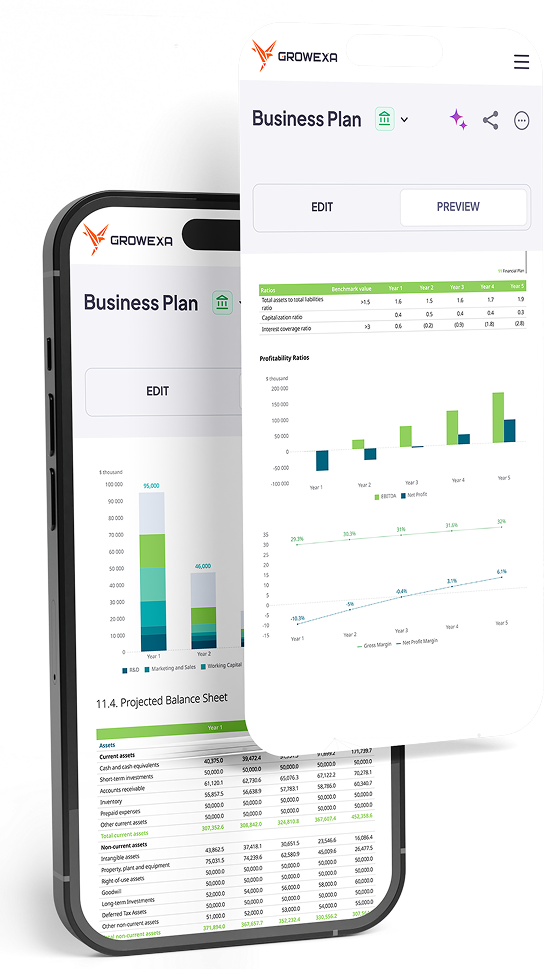
Growexa helps you prepare a bank-ready business plan that speaks the language of lenders—so you can move through underwriting faster and with fewer rejections.
FAQ
01
Do I need an existing Chase business account to apply for a loan?
While it may be possible to start discussions without one, Chase typically requires an active business checking account before moving forward with underwriting and funding.While it may be possible to start discussions without one, Chase typically requires an active business checking account before moving forward with underwriting and funding.
02
Does Chase work with startups or new businesses?
Chase primarily lends to established operating businesses. Startups and pre-revenue companies are generally not a fit for Chase’s lending model.
03
How long does the Chase business loan approval process take?
Depending on the loan type and complexity, the process usually takes several weeks from initial banker contact to funding, with SBA and real estate loans taking longer.
04
Is a business plan required to apply for a Chase loan?
A formal business plan is not always mandatory, but Chase expects a clear and well-documented explanation of loan purpose, cash flow, and repayment logic.
05
Are interest rates and terms disclosed upfront?
No. Chase determines rates and final terms individually during underwriting based on credit profile, cash flow strength, collateral, and overall deal structure.




