
Growexa is strongly oriented toward funding-ready output. Its current plans combine AI-generated narrative with P&L, cash-flow and balance-sheet forecasts, financial ratios, dedicated bank and investor formats, and PDF output.
LivePlan has the deepest ongoing financial-planning ecosystem in this comparison. It combines three-statement forecasting with scenarios, accounting integrations, performance dashboards and plan review.
Upmetrics combines broad AI functionality with flexible plan creation. Its Premium plan includes AI writing and industry research, up to seven-year forecasts, a pitch-deck builder, collaboration and multiple export formats.
For bank or investor plans, the end document matters as much as the AI. Growexa has the clearest explicit specialization around separate Bank and Investor formats, while LivePlan and Upmetrics provide broader planning environments.
The right tool depends on what happens after the first draft. A serious comparison should look at financial modeling, editable assumptions, document structure and export—not simply how quickly AI can produce several pages of text.
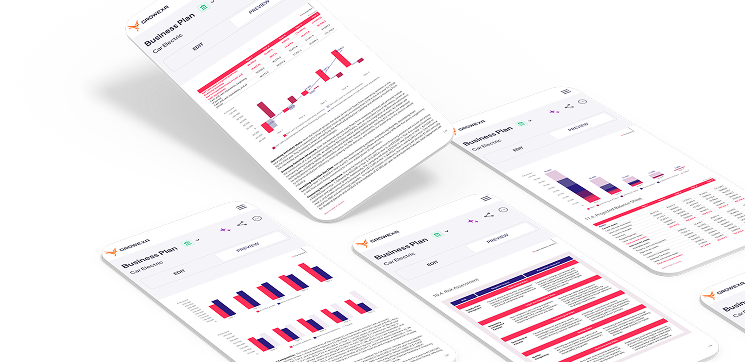

Create a Business Plan in 5 Minutes with AI

The market for business-planning software has changed substantially since generative AI became mainstream. Writing assistance is now close to a baseline feature. The meaningful differences between products are increasingly found elsewhere: how they structure the planning process, how financial projections are built, how assumptions connect to financial statements, and whether the finished document is suitable for the audience that will actually read it.
That changes what “best” means in an AI business plan generator comparison.
A founder who needs to explore an early-stage idea has different requirements from an established company preparing a bank loan application. A consultant managing multiple client plans needs collaboration and project capacity. A startup preparing for investors may care more about pitch materials and scenario modeling. And a user who primarily wants help writing narrative sections may not need sophisticated forecasting at all.
For this comparison, we reviewed three dedicated platforms—Growexa, LivePlan and Upmetrics—using publicly available product and pricing information current as of August 2026. The comparison focuses on functionality rather than customer ratings, promotional rankings or vendor claims about being the “best.”
The central finding is straightforward: AI writing is no longer the feature that separates serious business-planning tools from one another. Financial architecture and planning workflow are.
A credible business plan generator comparison needs consistent criteria. It is easy to produce a feature list in which every platform appears equivalent: most now advertise AI, financial forecasting, templates and downloadable plans.
The differences become clearer when those broad categories are broken down.
We assessed each product across nine areas: business-plan structure, AI drafting, financial projections, editing flexibility, collaboration, document export, business plan templates or examples, current published pricing and suitability for funding-oriented plans.
Financial functionality received particular attention. A tool that can generate a paragraph explaining expected revenue growth is not necessarily capable of building a financial forecast. Likewise, generating a revenue table is different from producing interconnected profit-and-loss, cash-flow and balance-sheet statements.
We also distinguish between features confirmed on vendors' current websites and broader claims that could not be independently verified. Prices below are published prices observed in August 2026 and can change.
The comparison is therefore not a review score. It is closer to a procurement exercise: what does each product actually appear to do, and for which planning problem is that functionality most useful?
| Platform | AI Drafting | Financial Planning | Collaboration | Export | Current Entry Pricing* | Strongest Fit |
|---|---|---|---|---|---|---|
| Growexa | Full-plan, subsection and field-level generation; rewriting | P&L, cash flow, balance sheet, financial ratios and forecasts | Team collaboration; up to 5 assistant invites listed | PDF + online sharing | $19/mo; $13/mo billed yearly | Bank and investor-ready structured plans |
| LivePlan | Section writing, rewriting and AI forecast suggestions | Three-statement forecast, scenarios, accounting sync and plan-vs.-actual analysis | 5 contributors + unlimited guests | PDF, Word; forecast data export; pitch to PowerPoint | $20/mo; $15/mo billed yearly | Detailed forecasting and ongoing business planning |
| Upmetrics | AI plan writing, research and assistance | Up to 7-year forecast on Premium, automated forecasting and what-if scenarios | Up to 5 team members + unlimited guest access | PDF/DOC/PPT + Excel | $19/mo; $14/mo billed yearly | Flexible planning, forecasting and collaboration |
*Published vendor pricing observed in August 2026. Annual prices are shown as monthly equivalents where vendors publish them that way. Features and prices can change.
The table makes the positioning differences clearer. These are no longer three versions of essentially the same AI writing product.
LivePlan extends furthest into ongoing financial management and performance monitoring. Upmetrics combines business-plan creation with flexible forecasting, scenario modeling, collaboration and pitch creation. Growexa is more narrowly oriented around turning business and financial inputs into a structured document for a funding audience.
That distinction becomes more important than the amount of text each platform can generate.
Growexa approaches AI business planning from the output backward: the platform is designed around producing structured plans for banks, investors and other funding contexts.
Its current Starter plan includes three plan formats—Bank, Investor and One-page—along with AI-generated narrative, P&L, cash-flow and balance-sheet projections, financial ratios and forecasts, team collaboration, online sharing and business plan PDF export. Growexa says its structure is based on requirements collected from more than 40 banks and SBA lenders.
The AI component operates at several levels. Growexa currently lists generation of the entire business plan, individual subchapters and individual fields, plus AI text improvement. The broader workflow asks users to enter key information, generate the narrative, build the financial model, select a design and export or share the resulting plan.
That makes Growexa's business plan with AI generator particularly relevant when the end product needs to function as a conventional funding document rather than simply a collection of AI-generated sections.
The trade-off is specialization. Growexa currently supports English, German and Ukrainian generation, whereas Upmetrics lists a broader language set. Its published ongoing performance-management functionality is also less extensive than LivePlan's accounting connections, performance dashboards and real-time forecasting.
LivePlan is the most mature planning environment among the products compared here, and its current feature set extends well beyond AI-assisted business-plan writing.
The Standard plan currently costs $20 per month or $15 per month when paid annually. It includes guided planning, AI writing assistance, a complete financial forecast, lender-ready statements, more than 550 sample plans, a pitch presentation creator and plan review functionality.
Financial modeling is where LivePlan becomes particularly differentiated. The platform supports projected profit and loss, balance sheet and cash flow. Its AI can suggest revenue streams, direct costs, personnel and expenses, while scenario tools allow users to test alternative assumptions. LivePlan also connects with QuickBooks Online and Xero and provides performance dashboards and actual-versus-forecast analysis.
This makes LivePlan more than software for producing a document. An operating business can continue using it after the plan has been submitted to compare actual performance with forecasts, update cash projections and analyze variances. LivePlan itself distinguishes its Standard product for planning from Premium functionality oriented toward monitoring operational performance.
That breadth is an advantage for businesses that want an ongoing planning system. It can be unnecessary complexity for someone whose immediate objective is simply to produce a funding-ready plan quickly.
Upmetrics has developed into a broad AI-enabled planning platform that sits between guided business-plan software and a collaborative strategy workspace.
Its Premium tier currently lists AI plan writing and assistance, AI industry research, up to seven-year financial forecasting, an AI pitch-deck builder and strategic-planning tools. It supports up to five team members, multi-versioning, PDF/DOC/PPT and Excel exports, and QuickBooks Online and Xero connections. The published price is $19 monthly or $14 per month when billed annually.
The platform also includes more than 400 sample plans, step-by-step instructions, an automated forecast builder, what-if scenario planning and lender-ready reports. The Professional tier extends the forecast horizon to ten years and adds additional workspace capacity and custom templates.
That combination makes Upmetrics a strong generalist. It does not require users to approach planning exclusively through a lender-oriented workflow, while still providing substantially more structure than a general-purpose AI writer.
The corresponding trade-off is that flexibility still requires planning judgment. A flexible editor and AI assistant can help build a strong plan, but they do not remove the need to determine which assumptions are material for the bank, investor or other reader evaluating it.
The three platforms above are not the entire business-planning software market. Several products compete for adjacent use cases, although their positioning is not identical.
Bizplan, for example, uses a guided modular business-plan builder and provides financial tools rather than positioning itself primarily around generative AI. Products aimed specifically at financial modeling, pitch creation or startup validation can also overlap with individual parts of the workflow.
That matters because an entrepreneur does not necessarily need an all-in-one AI business plan tool. Someone who already has a sophisticated Excel model may care primarily about narrative and document production. Another founder may already have the narrative but need a more rigorous forecasting environment.
The Upmetrics alternatives depend partly on which part of the planning process remains unsolved.
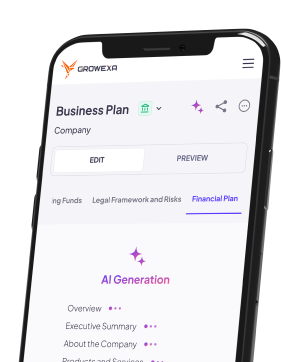
Financial forecasting is the point at which superficial similarities between AI business plan tools begin to break down.
For users who need a sophisticated ongoing financial-planning environment, LivePlan has the broadest verified feature set in this comparison. It combines three-statement forecasting with scenario analysis, accounting-system integrations, actual-versus-forecast tracking, performance dashboards and real-time profit and cash forecasting.
Growexa takes a more funding-document-oriented approach. Its plans include P&L, cash flow, balance sheet, financial ratios and forecasts, with those numbers incorporated directly into Bank and Investor business-plan formats. This makes the financial model part of the finished financing document rather than a separate analytical exercise.
Upmetrics is LivePlan alternatives in forecasting breadth. Premium includes an automated forecast builder, up to seven-year projections, what-if scenario planning and lender-ready reports; it also connects to QuickBooks Online and Xero and supports Excel export.
The practical distinction is not whether a product has a button labeled “financial projections.” It is what happens after an assumption changes.
If adding employees changes payroll, cash requirements and projected profitability across the model, the software is doing financial planning. If AI simply rewrites a paragraph to say that payroll will increase, it is doing writing assistance.
This comparison changes once the final audience becomes a bank or investor.
A funding document has requirements that go beyond AI drafting. The narrative needs to connect with the financial model, the funding request needs to correspond to the use of funds, and the finished document has to present the information in a structure that a financing audience can evaluate.
For a bank-oriented business plan, Growexa has the clearest explicit specialization of the three platforms. Its current product offers separate Bank, Investor and One-page formats alongside P&L, cash flow and balance-sheet forecasts, financial ratios and automated financial calculations. Growexa also states that its plan structure is based on requirements collected from more than 40 banks and SBA lenders.
LivePlan is a serious alternative. Its Standard product generates lender-ready statements and includes Plan Review functionality designed to assess whether a plan is ready for a lender or investor. Its financial model and what-if scenarios are particularly useful when repayment capacity and downside cases require closer analysis.
For an investor-oriented plan, the gap is narrower. Growexa provides a dedicated Investor format. LivePlan combines its plan with a pitch presentation creator and investor-readiness review. Upmetrics integrates business planning, financial forecasts and an AI pitch-deck builder within the same platform.
No software makes a plan investor-ready merely by selecting a template. Investors may focus on market scale, traction, unit economics, management and capital efficiency; lenders are more likely to scrutinize cash generation, repayment capacity, leverage and use of funds. The underlying model still needs to support the document.
General-purpose AI and dedicated business-planning software overlap in one obvious area: both can generate and improve business-plan text. The similarity becomes much weaker once the task moves from writing to maintaining a complete financial and funding document.
ChatGPT is highly flexible. It can challenge a business model, rewrite an executive summary, explain financial concepts, develop alternative positioning, analyze assumptions or help draft industry-specific sections. For a founder who understands the required plan structure and financial model, that flexibility can be valuable.
Dedicated AI business plan software, by contrast, places AI inside a predefined planning workflow.
| Capability | Dedicated AI Business Plan Software | ChatGPT |
|---|---|---|
| Business-plan structure | Pre-built workflow with defined sections and inputs | Structure can be created or adapted conversationally |
| AI drafting | Generates content within specific plan sections | Highly flexible generation, analysis and rewriting |
| Financial projections | Dedicated platforms can build structured P&L, cash-flow and balance-sheet forecasts | Can calculate, analyze and help build forecasts, but is not inherently a persistent business-planning financial model |
| Linked assumptions | Forecasting software can propagate changes through connected statements | Relationships must be established and maintained within the chosen workflow |
| Scenario modeling | Built into platforms such as LivePlan and Upmetrics | Can analyze scenarios when supplied with the relevant assumptions and data |
| Bank/investor structure | Some platforms provide dedicated funding-oriented formats | Can tailor content to banks or investors, but does not impose a fixed funding workflow |
| Document consistency | Narrative, financials and structure can use the same project data | Consistency depends more heavily on how the user organizes prompts, calculations and source data |
| Final document | Designed to assemble narrative, tables and financials into an exportable plan | Can create document content and artifacts, but the workflow is more general-purpose |
| Flexibility outside business planning | Primarily constrained to planning-related tasks | Broad research, reasoning, analysis, editing and problem-solving capabilities |
The distinction should not be exaggerated. ChatGPT can perform financial calculations, work with spreadsheets and create structured documents when given the appropriate data and instructions. What dedicated planning software adds is persistence and predefined financial architecture: the model already knows where revenue assumptions, payroll, operating expenses and statements belong.
LivePlan, for example, connects its AI forecast suggestions to a full three-statement forecasting environment. Upmetrics links AI assistance to its automated forecast builder and financial reports. Growexa combines automated financial calculations with dedicated Bank and Investor document formats.
A founder might therefore use ChatGPT to pressure-test whether a customer-acquisition assumption is realistic, compare alternative pricing models or improve the logic of an executive summary. Dedicated planning software can then maintain the underlying assumptions and assemble the resulting financials into the final plan.
The dividing line is not AI versus no AI. Both approaches use AI. It is general-purpose reasoning and flexibility versus a purpose-built business-planning workflow.
A polished demo can make almost any business plan software look sufficient. Before subscribing, test the functions that determine whether the finished plan will actually be usable.
The last point is easy to overlook. Business-plan software is inexpensive compared with professional consulting, but pricing structures differ substantially. A founder preparing one plan has different economics from a consultant maintaining 20 client projects.
The first generation of AI business-plan products competed largely on speed: how quickly could financial forecast software turn a short description into several pages of professional-looking text?
That benchmark is becoming less useful.
Generating ten pages is easy. Building a plan in which market assumptions support the sales forecast, sales drive staffing and operating requirements, those requirements flow through the financial statements, and the resulting funding requirement can withstand scrutiny is much harder.
That is where buyers should focus in 2026.
Choose Growexa when the primary objective is a structured funding document with integrated financials. LivePlan makes more sense when detailed forecasting and ongoing performance management are central to the decision. Upmetrics is a strong alternative when flexibility, collaboration, forecasting and pitch creation need to coexist.
And regardless of platform, treat AI-generated text as a draft and AI-generated assumptions as assumptions. The purpose of a business plan is not to demonstrate that software can produce 50 pages. It is to demonstrate that the economics of the business make sense.
For founders preparing a plan specifically for financing, Growexa's business planning platform connects AI-assisted drafting with financial projections and a structured bank or investor document rather than leaving the narrative and financial model as separate exercises.
There is no defensible universal winner because the products solve somewhat different planning problems. Growexa has the clearest specialization around bank and investor business plans. LivePlan offers the broadest verified functionality for detailed forecasting and ongoing performance management. Upmetrics combines flexible AI planning, forecasting, collaboration and pitch tools. The best choice depends on the intended use of the plan.
Yes. Current tools can generate substantial portions—and in some cases essentially the complete first draft—of a business plan. Growexa, for example, currently lists AI generation for the entire plan as well as individual sections and fields. The output still requires validation: market facts, pricing, operating assumptions, funding requirements and projections should be checked against the actual business.
Yes, but functionality varies considerably. Growexa, LivePlan and Upmetrics all provide financial forecasting rather than text generation alone. Growexa includes P&L, cash flow, balance sheet, ratios and forecasts; LivePlan provides a complete three-statement forecast and scenarios; Upmetrics offers automated multi-year forecasting and what-if planning.
LivePlan includes AI writing assistance, rewriting, idea validation and AI forecast suggestions inside a broader business-planning platform. It is therefore more accurately described as business-planning and forecasting software with integrated AI rather than a simple text-based plan generator.
They can be, but AI generation alone does not make a document lender-ready. Banks evaluate the underlying business and its ability to support the proposed financing. Financial assumptions need to be credible, statements should be internally consistent, and the funding request should connect to the use of funds and expected cash flow. Products such as Growexa and LivePlan explicitly provide bank- or lender-oriented structures and financial outputs.


